wayground logo

Free Printable Worksheets

Font size

S
M
L
XL
Worksheets

Review: ATP, C.R. and Photosynthesis

Total questions: 48

Worksheet time: 1hrs 3mins

Name
Class
Date
1.
What are the parts of the ATP molecule?
a)
adenine, thylakoids, stroma
b)
stroma, grana, chlorophyll
c)
adenine, ribose, phosphate groups
d)
NADH, NAHPH, FADH
2.
Which structures shown in the Figure make up the ADP molecule?
a)
A and B
b)
A, B and C
c)
A, B, C, and D
d)
C and D
3.
Which of the following can be compared to a battery in need of recharging?
a)
ADP
b)
ATP
c)
Ribose
d)
Adenosine
4.
What do all cells use for energy?
a)
Carbs
b)
Protein
c)
Fat
d)
ATP
5.
About how many molecules of ATP can be generated from one molecule of glucose?
a)
2
b)
6
c)
36
d)
4
6.

What are the reactants (things that go into) photosynthesis? (check all that apply)

a)

oxygen

b)

carbon dioxide

c)

water

d)

glucose

7.

What are the products (things that are made) of photosynthesis? (check all that apply)

a)

oxygen

b)

carbon dioxide

c)

water

d)

glucose

8.

Of the products, which is the main goal of photosynthesis?

a)

oxygen

b)

carbon dioxide

c)

water

d)

glucose

9.

Where does photosynthesis take place?

a)

Mitochondria

b)

Chloroplast

c)

Sunlight

d)

Soil

10.

In photosynthesis, light energy is converted into what?

a)

chlorophyll

b)

chemical energy

c)

cellular energy

d)

heat

11.

What are the reactants (used in) of cellular respiration? (check all that apply)

a)

Carbon dioxide

b)

Oxygen

c)

Glucose

d)

ATP

e)

Water

12.

What are the products (created by) of cellular respiration? (check all that apply)

a)

Carbon dioxide

b)

Oxygen

c)

Glucose

d)

ATP

e)

Water

13.

Of the products of cellular respiration, which is the most important that is made?

a)

Carbon dioxide

b)

Oxygen

c)

Glucose

d)

ATP

e)

Water

14.

When you add a phosphate to ADP, do you release energy or store energy?

a)

Store energy

b)

Release energy

15.
What is the function of ATP in living things?
a)
provides energy for cells
b)
stores genetic information
c)
provides structure in the nucleus
16.
Which bond of the ATP molecule is broken in order to release energy?
a)
A
b)
B
c)
C
d)
D
17.
Using the figure, between which parts of the molecule must the bonds be broken to form an ADP molecule?all of the above
a)
A and B
b)
B and C
c)
C and D
18.
Energy is released from ATP when _______________________.

a)
a phosphate group is added
b)
adenine bonds to ribose
c)
a phosphate group is removed
d)
ATP is exposed to sunlight
19.
What does the "TP" in ATP stand for?
a)
di (2) phosphates
b)
tri (3) phosphates
c)
tri (3) adenosine
20.
Plants need carbon dioxide from their environment to produce glucose during which stage of photosynthesis? 
a)
The light-dependent stage
b)
The light-independent stage
c)
The electron transport chain
d)
ATP formation
21.

What is the primary source of energy ?

a)

sun

b)

food

c)

cynobacteria

d)

animals

22.
Which of the following is the correct equation for PHOTOSYNTHESIS?
a)
CO+ light + H2O --> O+ Sugar
b)
CO+ sugar + H2O --> O+ light
c)
O2 + light + H2O --> CO+ Sugar
d)
CO+ O2 + H2O --> Light+ Sugar
23.

What is the function of NADPH and ATP during photosynthesis?

a)

They absorb light

b)

They power the light-dependent reactions

c)

They are light-reflecting pigments

d)

They are short term energy carriers

24.

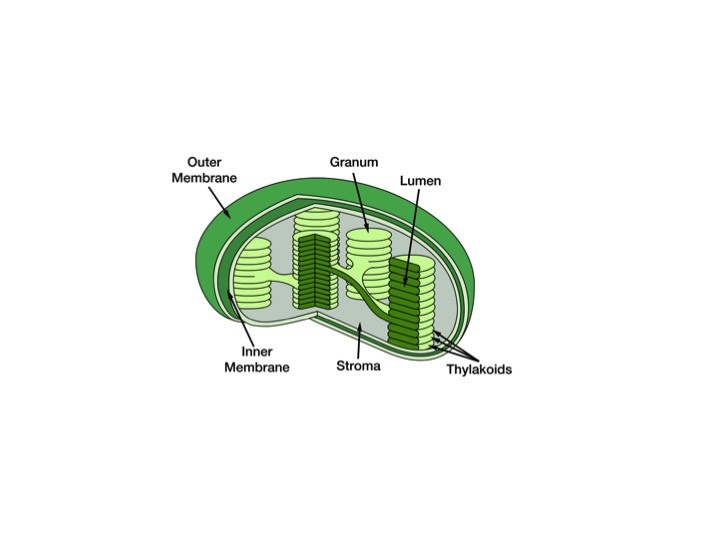
Where do the dark reactions (Calvin cycle) take place?

a)

thylakoid membrane

b)

lumen

c)

stroma

25.
What are the two products of the light reactions that are needed for the calvin cycle?
a)
NAD and NADPH
b)
NADP + and Glucose
c)
NADPH and ATP
d)
Oxygen and NADPH
26.
Most plants appear green because chlorophyll
a)
absorbs green light.
b)
absorbs violet light.
c)
does not absorb green light.
d)
does not absorb violet light.
27.
What is the pigment in chloroplasts that performs photosynthesis?
a)
Chlorosynthesis
b)
Chlorophyll
c)
ADP
d)
Electron Transport
28.
The stacks of disks in the chloroplast are called:
a)
Lamellae
b)
Grana
c)
Stroma
d)
Thylakoid
29.
Where do the light reactions happen?
a)
mitochondria membrane
b)
thylakoid membrane
c)
stroma
d)
central vacuole
30.
Which of the following molecules is not needed for the Calvin Cycle?
a)
CO2
b)
ATP
c)
NADPH
d)
H2O
31.
Which gas is removed from the atmosphere during photosynthesis?
a)
hydrogen
b)
oxygen
c)
nitrogen
d)
carbon dioxide
32.
Plants need ________ for photosynthesis
a)
oxygen
b)
soil
c)
carbon dioxide
d)
sugar
33.
What is photosynthesis?
a)
The process in which humans eat their food
b)
When a photographer takes a photo.
c)
To get your pictures from the photo lab.
d)
The process in which plants make their food.
34.
Chloroplasts are...
a)
Structures of animal cells to produce ATP
b)
Organelles where lipids are elaborated
c)
Specialized structures of plants where food is made
d)
Waste organelle of plants
35.
What is produced as a result of photosynthesis?
a)
Glucose and Chlorophyll
b)
Glucose and Oxygen
c)
Water and Light energy
d)
Carbon dioxide and Water
36.
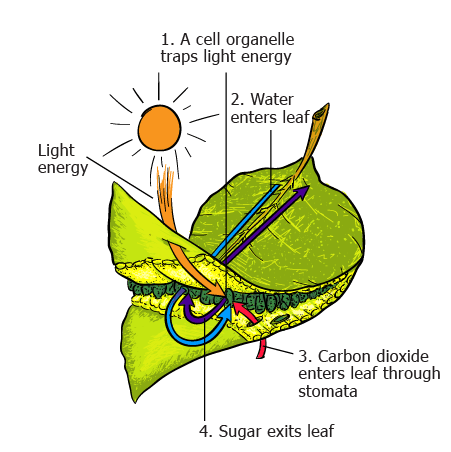
Look at the image
What substances and organelle work together to absorb sunlight to perform photosynthesis in this example?
a)
cell wall and chloroplast
b)
mitochondria and water
c)
vacuole and carbon dioxide
d)
chloroplast and chlorophyll
37.
Where does the Citric Acid Cycle (Krebs Cycle) happen in the cell?
a)
Cytosol
b)
Inner Mitochondrial Membrane
c)
Cell Membrane
d)
Mitochondrial Matrix
38.
The purpose of cellular respiration is to produce ?
a)
energy
b)
oxygen
c)
sugar
d)
protein
39.
What is the energy molecule?
a)
DNA
b)
ATP
c)
RNA
d)
AAA
40.
What is the energy organelle?
a)
nucleus
b)
mitochondria
c)
ribosomes
d)
lysosomes
41.
The splitting of the glucose molecule is called?
a)
synthesis
b)
denaturalization
c)
glycolysis
d)
dissolving
42.
The two type of fermentation are alcohol and _____________ acid fermentation. 
a)
lactic
b)
sulfuric
c)
hydrochloric
d)
acetic 
43.
The waste gas given off by cellular respiration is?
a)
oxygen
b)
carbon dioxide
c)
nitrogen
d)
methane
44.

In which way are photosynthesis and cellular respiration similar?

a)

Both processes destroy energy.

b)

Both create energy.

c)

Photosynthesis breaks down sugar while cellular respiration produces sugar.

d)

Both processes transfer energy from one form to another.

45.

What is the correct equation for cellular respiration?

a)

oxygen + sugar -> carbon dioxide + water + Energy

b)

carbon dioxide + sugar + Energy -> carbon dioxide + water

c)

carbon dioxide + water -> oxygen + sugar + Energy

d)

carbon dioxide + water + Energy -> oxygen + sugar

46.

One molecule needed for cellular respiration is

a)

carbon dioxide

b)

glucose

c)

water

d)

chlorophyll

47.

One molecule produced by animals during cellular respiration is

a)

carbon dioxide

b)

glucose

c)

oxygen

d)

chlorophyll

48.
How are plant cells different from animal cells?
a)
Only plant cells can grow
b)
Only animal cells can reproduce
c)
Only animal cells can store energy
d)
Only plant cells can perform photosynthesis