wayground logo

Free Printable Worksheets

Font size

S
M
L
XL
Worksheets

Lesson 2 Quiz

Total questions: 25

Worksheet time: 14mins

Name
Class
Date
1.

How long does it take the sun's energy to reach the Earth?

a)

2 minutes

b)

5 minutes

c)

1 hour

d)

8 minutes

2.

What is the ultimate source of energy?

a)

Water

b)

Coal

c)

Sun

d)

Food

3.

The ability to do work is _________

a)

energy

b)

forces

c)

power

d)

Earth

4.

a)

A

b)

B

c)

C

d)

D

5.
What causes winds to form on Earth?
a)
solar energy
b)
ocean currents
c)
elevation differences
d)
uneven heating of the Earth by the sun
6.
A student states the weather is the same as the climate. Which response BEST tells the student the difference between weather and climate?
a)
Weather is about the wind and the rain, but climate is about the clouds.
b)
Weather is the conditions in one day, but climate is the conditions over a long time.
c)
Weather is measured with tools like thermometers, but climate is measured with tools like forecasts.
d)
Weather is recorded on charts, but climate is recorded on world maps.
7.
Which observation describes a change in climate rather than a change in weather?
a)
The thunderstorm dropped about three centimeters of rain today.
b)
The average summer temperatures have increased over the last ten years.
c)
 The snowfall in this area was more this week than it was last week.
d)
The average wind speed in April was less than it was in March.
8.
Weather refers to the conditions of Earth’s atmosphere at a particular ____________. 
a)
 Location
b)
Time
c)
Place
d)
 Time and Place
9.
 Where do tropical storms start? 
a)
northpole
b)
on the coast
c)
in the ocean, near the equator
d)
in the ocean, near land
10.
"A tropical cyclone is a very strong tropical storm that starts in the ocean waters near the equator. The storm moves its way toward where the air is cooler, which is usually away from the equator. The wind gets stronger, and the rain gets heavier." What can be concluded about a tropical storm as it moves away from the equator? 
a)
It disappears.
b)
Its strength does not change. 
c)
It gets stronger.
d)
It gets weaker.
11.
What might be a reason why scientists track tornadoes? 
a)
to encourage more people to use radar technology
b)
to warn people against living in “Tornado Alley”
c)
to lower the number of tornadoes that happen every year
d)
to gather information that is used to warn people that a tornado is approaching 
12.

How are thunderstorms different from rainstorms?

a)

The temperature of thunderstorms is higher than rainstorms.

b)

Thunderstorms have thunder, lightning, and high wind.

c)

Thunderstorms are very rare.

d)

Nothing, they are the same.

13.

What are some of the dangers that result from thunderstorms? Select all that apply.

a)

Flash flooding

b)

Lightning strikes

c)

Hail

d)

Strong Winds

14.

True or False: A tornado can happen anytime, anywhere, any season.

a)

True

b)

False

15.

When do most tornadoes typically occur?

a)

Spring and Summer

b)

Fall and Winter

c)

Winter and Spring

d)

Summer and Fall

16.

True or False: A tornado is not called a tornado until it reaches the ground.

a)

True

b)

False

17.

Choose the Hurricane

a)
b)
c)
d)
18.

What are tornadoes?

a)

a storm with thunder and lighting and typically also heavy rain or hail

b)

a mobile, destructive vortex of violently rotating winds having the appearance of a funnel shaped cloud and beneath a large storm system.

c)

a storm that can be the same as thunderstorms, but can be even more dangerous

d)

a huge storm with strong winds and storm surges

19.

A severe storm that involves high winds and forms over water is

a)

tornado

b)

hurricane

c)

thunderstorm

d)

blizzard

20.

This person studies the Earth's atmosphere and monitors and forecasts the weather

a)

Seismologist

b)

Volcanologist

c)

Geologist

d)

Meteorologist

21.

Where is Tornado Alley located?

a)

Near the equator of the Earth

b)

South Central Los Angeles

c)

Near the North Pole

d)

Middle states of United States

22.

What are the effects of a thunderstorm?

a)

destruction of property, storm surge, tidal flooding, high winds, possible tornadoes, heavy rain, flooding and loss of life.

b)

produces lightning, Strong winds, hail, and possible tornadoes.

c)

Major destruction of property, loss of life, lightning and hail. 

d)

saturated soil, mud-slides, property damage and loss of life.
23.
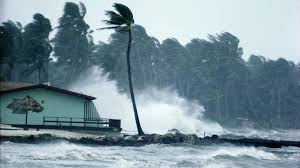
What fuels a hurricane's strength?
a)
Wind
b)
Sunlight
c)
Warm Water
d)
Cold Water
24.
What is the calm area in the center of a hurricane called?
a)
Wall
b)
Eye
c)
Arm
d)
Hole
25.
What is the source for warming up ocean water?
a)
the sun
b)
water movement
c)
wind
d)
fish peeing in the ocean water