
 Worksheets
ASC0305 - Chemical Kinetics
Total questions: 20
Worksheet time: 21mins
Units of rate is _______-
M/s
mol/s
m.s
s/M
Consider this reaction:
2SO2(g) + O2(g) → 2SO3(g)
The rate of disappearance of SO2 is 1.6 gL-1 min-1. What is the rate of formation of SO3 in molL-1min-1? [Molar mass SO2: 64.0 gmol-1]
0.035
0.025
0.120
0.050
What is the order of reaction with respect to A?
What is the overall order of reaction?
A reaction is found to be second order with respect to carbon monoxide. If the concentration of carbon monoxide is doubled, the rate of reaction __________.
doubles
remains unchanged
increases by a factor of 4
is reduced by a factor of 2

The iodide ion reacts with hypochlorite ion in the following way:
OCl- + I- ⟶ OI- + Cl-.
This rapid reaction gives the rate data shown. What is the rate law?
rate = [OCl-]2[I-]
rate = [OCl-][I-]2
rate = [OCl-][I-]
rate = [OCl-]
rate = k[A]
The rate constant in the rate law above is 0.5 L/mol·s. If the initial concentration of A is 0.1 M, how long will it take for [A] to drop to 0.025 M?
0.7 s
1.4 s
2.8 s
There is not enough information given.
What is the unit for rate constant,K if rate law:
Rate = k [A]
s-1
M s-1
M-1 s-1
M-2 s-1
The first order rate constant for the decomposition of 0.5 M compound A at 100oC is 0.03 min-1. Calculate the half-life of A.
1.5 min
8.3 min
23.1 min
66.7 min

Which species is the catalyst in this reaction mechanism?
R
W
X
There is no catalyst.
The catalyst alters the rate of a chemical reaction by,
providing an alternative pathway with a lower Ea
changing the products formed in the direction of the reaction
providing a surface on which the molecules react
increasing the frequencies of collisions between molecules
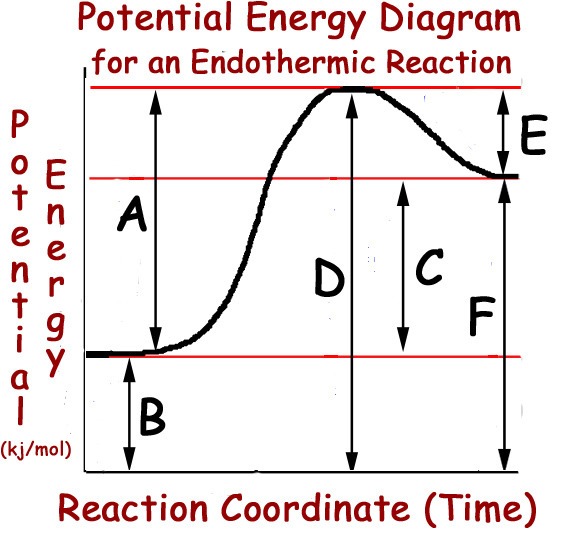
What letter represents the activation energy?
A
B
C
D
Collision
Big Bang
Evolution
Which factors increase the rate of a reaction?
increasing temperature
increasing time
decreasing surface area
all of the above
Which of the following best describes why increasing temperature increase reaction rate?
Activation energy is reduced.
Collisions become more frequent.
Collisions become more energetic.
Collisions become more frequent and more energetic.
Suppose the activation energy of a certain reaction is 250 kJ/mol.
If the rate constant at T1 = 300 K is k1 and the rate constant at T2 = 320 K is k2,
then the reaction is __ times faster at 320 K than at 300 K. (Hint: Solve for k2/k1.)
525
3 x 10-29
15.0
0.067

