
 Worksheets
Music Theory Terms
Total questions: 74
Worksheet time: 46mins




count this rhythm.

count this rhythm.


What is this?
whole note
half note
rest
eighth note

What does this dynamic mean?
Loud
Very Loud
Very Soft
Soft

What does this dynamic mean?
Loud
Soft
Soft to Loud
Loud to Soft


These intervals are all what quality?
Major
Minor
Perfect
Diminished
Augmented
How loud and quiet the music is
Dynamics
Meter
Tempo
Instrumentation
The speed of the music
Dynamics
Meter
Tempo
Instrumentation
play at a fast and lively speed
andante
largo
allegro
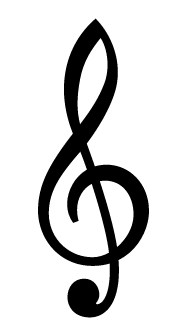
treble clef

What do you do when you see this?
Skip it
Just play it as usual
Repeat it
Play it louder
Cry
Which musical term means "VERY quiet?"


Music created and performed spontaneously or “in-the-moment" is...
improvisation
crazy
dangerous
unnatural
Tone color or tone quality that distinguishes one sound source, instrument, or voice from another is called...
classification
separation
timbre
declassification
What is the sign which indicates the raising of the pitch by one half step?
flat
sharp
natural
Choral music without instrumental accompaniment is referred to as
(a)
What is the term that means singable (or in a sweet style)?
Arietta
Cantible
Antiphonal
Whisperatta
What does the key signature tell you?
What to play sharp or flat in a song.
How to unlock the song.
Who wrote the song.
How to count the song.
What does the symbol > mean?
Greater than: the note is better than the next note.
Repeat: play the note again.
Staccato: play the note short.
Accent: sudden attack
The symbol . above or below a note means:
Staccato: play short, with space.
Make the note longer.
Legato: play with smooth, connected bows.
Make the note pretty.
What does rit. (ritardando) mean?
To gradually get louder.
To gradually slow down.
To gradually speed up.
To gradually get softer.
What does accel. (accelerando) mean?
To gradually slow down.
To suddenly play faster.
To get softer.
To gradually speed up.
What should you do when you see a fermata?
Yell "ahoy!"
Gradually get louder.
Hold the note until the conductor cuts off.
Gradually get faster.
The symbol // (cesura mark) means:
To cut off.
To play short.
To play smoothly.
To hold the note.
A Tempo means:
Play faster.
Make up your own tempo.
Play the right tempo.
Return to the original tempo.
Legato
Short and detached
Gradually get louder
Smooth and connected, without breaks between notes.
Gradually get softer
Decrescendo/diminuendo
Short and detached
Gradually get louder
Smooth and connected, without breaks between notes.
Gradually get softer
Very fast tempo
Largo
Moderato
Allegro
Presto
Accelerando (accel.)
Gradually getting slower
Gradually getting softer
Gradually getting faster
Gradually getting louder
Ralentando (rall.)
Gradually getting slower
Gradually getting softer
Gradually getting faster
Gradually getting louder
Which of the following relates to the articulation of sound?
Crescendo
Coda
Adagio
Tenuto
Each of the following deals with dynamics in music except:
Fortissimo
Mezzo Piano
Animato
Diminuendo
Each of the following is true of slurs in music except:
Slurs create legato phrases
Slurs are for notes of different pitches
Slurs combine the rhythmic value of two notes
Slurs are indicated with a connecting curvy line
What music term indicates for everyone to sing together (not necessarily the same notes):
(a)
Define "Syncopation".
Continue in the same style
Back to the original tempo
Gradually slower
Emphasis on the weak beat
Dynamics from quiet-to-loud. Which example is correct?
p-pp-mp-f-mf-ff
pp-p-mp-mf-f-ff
mp-p-pp-mf-f-ff
p-mp-f-mf

1st ending
Take 2nd ending after performing repeated section
Repeat from the sign
Perform 1st ending then repeat back to the beginning or repeat sign
Symbol used to direct you to the coda

Dal Segno (D.S.)
Take 2nd ending after performing repeated section
Repeat from the sign
Perform 1st ending then repeat back to the beginning or repeat sign
Symbol used to direct you to the coda

2nd ending
Take 2nd ending after performing repeated section
Repeat from the sign
Perform 1st ending then repeat back to the beginning or repeat sign
Symbol used to direct you to the coda

Coda
Take 2nd ending after performing repeated section
Repeat from the sign
Perform 1st ending then repeat back to the beginning or repeat sign
Symbol used to direct you to the coda
fine
indicates a section should be repeated
Sudden strong accent
Take 2nd ending after performing repeated section
end

Double bar line
indicates a section should be repeated
Sudden strong accent
Take 2nd ending after performing repeated section
indicates the end of a piece

sforzando
indicates a section should be repeated
Sudden strong accent
Take 2nd ending after performing repeated section
indicates the end of a piece
Del Segno (D. S.) al Coda
Go to the coda, then the sign.
Go to the beginning, then the sign.
Go to the sign, then the coda.
Go to the beginning, then the coda.
Notes that sound the same but are named and played differently.
chord
enharmonic
passing tones
dominant

What is this?
chord
time signature
key signature
melody line
How long does an accidental last?
The whole measure
For one beat
Until told other wise
None of the above


