
 Worksheets
Unit 5 Practice Test
Total questions: 89
Worksheet time: 52mins
An offspring that is the result of asexual reproduction
has two parents.
developed from a zygote.
inherited genes from two parents.
is genetically identical to its parent.

The leaf’s cuticle
stores water.
reduces evaporation.
transports water in the leaf
absorbs water for the leaf.

What produces egg and sperm cells during the life cycle of a plant?
gamete
sporophyte
gametophyte
zygote
The joining of an egg cell and a sperm cell is called
gestation.
adaptation.
asexual reproduction.
Fertilization
Budding is a form of
sexual reproduction.
gestation
asexual reproduction
complete metamorphosis.
Germination will not happen unless a seed
is dispersed far from the plant that produced it.
absorbs water.
uses its stored food.
grows stamens and a pistil.

What part of a woody stem forms rings that indicate the tree’s age?
xylem
cambium
phloem
inner bark
The stages of a plant’s life cycle are
sporophyte and spore.
spore and gametophyte.
sporophyte and gametophyte.
egg and gametophyte.
The female parts on a plant are called
stamen.
pistils.
petals.
metamorphosis

A banana has two soft layers surrounding the seeds. Because of this, it is considered to be which type of Fruit?
Drupe
Multiple Fruit
Berry
Pepo


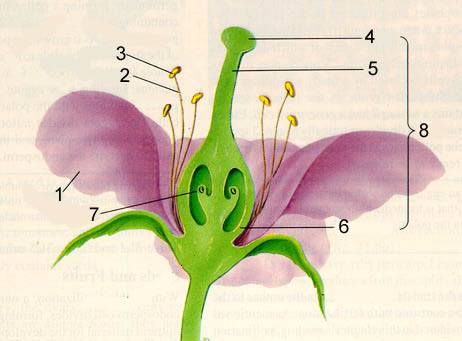

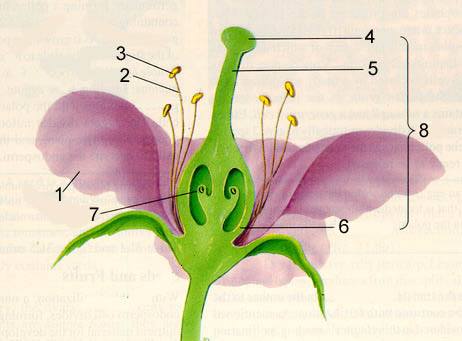


What is letter "A" in the image?
Pistil
Stamen
Sepal
Petal
What is letter "C" in the image?
Pistil
Stamen
Sepal
Petal

J
sepal
stem
petal
pistil
Job of the sepal
protect developing bud
make food
attract insects
There is no purpose.
The anther sit on top of the
stamen
filament
style
ovary

B
fruit
ovary
pistil
stigma
Filament and anther are _____ parts of the plant.
female
male
female and male
Stigma and style are ______ parts of the flower.
female
male
The main job of petals is to
make seeds
make food for the plant
attract insects
look pretty
Most flowering plants reproduce
asexually
sexually

Which structure guides the pollen to the ovule?
Petal
Stamen
Anther
Style
Which structure is represented by A?
Pistil
Stamen
Ovule
Anther
Which structure is represented by B?
Ovary
Stamen
Filament
Anther
Which structure is represented by C?
Ovary
Stamen
Style
Anther
Which structure is represented by D?
Ovary
Stamen
Style
Stigma
Which structure is represented by E?
Ovary
Stamen
Pistil
Petal
Which structure is represented by F?
Anther
Ovary
Pistil
Petal
Which structure is represented by G?
Anther
Ovary
Stamen
Petal
Which structure is represented by H?
Anther
Filament
Ovule
Petal
Which structure is represented by I?
Anther
Filament
Ovule
Sepal
Which structure is represented by J?
Petal
Filament
Ovule
Sepal
Which structure attracts pollinators?
Petal
Filament
Ovule
Sepal
Which structure protects the young bud?
Petal
Filament
Ovule
Sepal
Which structure supports the anther?
Petal
Filament
Ovule
Sepal
Which structure holds the pollen?
Petal
Filament
Ovule
Anther
Which structure is the female reproductive part?
Petal
Filament
Pistil
Anther
Which structure is the male reproductive part?
Petal
Stamen
Pistil
Ovary
Which structure holds the ovule?
Petal
Stamen
Anther
Ovary
Which structure guides the pollen to the ovule?
Petal
Stamen
Anther
Style
Which structure collects the pollen?
Petal
Stamen
Anther
Stigma
Which structure is fertilized by the pollen?
Petal
Stamen
Anther
Ovule
True or False: During internal fertilization, an embryo forms inside the female's body.
True
False
True or False: Flowering plants that complete a life cycle within one growing season are called perennials.
True
False
True or False: In plants, sexual reproduction occurs when a sperm cell and an egg cell unite to form a zygote.
True
False
Animals like bees and hummingbirds are helpful to plants in the process of
Germination
Pollination
Transpiration
Fertilization
Select the three parts of the seed
Seed coat
Cotyledon
Embryo
Stigma
Anther
A tree has 15 dark rings and 15 light rings. How many years old is the tree?
(a)
(a) on the surface of a leaf control the movement of gases into and out of the leaf.
Flowering plants are an example of which type of plant?
Angiosperm
Gymnosperm
Nonvascular plants
Pteriodophytes
Match the type of Angiosperm to the length of its life cycle
Annual
1 Growing Season/Year
Biannual
2 Growing Seasons/Years
Perennials
Multiple (2+) Growing Seasons/Years
Moss is an example of which type of plant?
Angiosperm
Gymnosperm
Nonvascular plants
Pteriodophytes
Grafting is an example of which type of reproduction?
Sexual
Asexual
Mitosis
Ferns are an example of which type of plant?
Angiosperm
Gymnosperm
Nonvascular plants
Pteriodophytes
The product of the union of a sperm and egg is called a(n)
Embryo
Gametophyte
Fruit
Zygote
An offspring that is the result of asexual reproduction
has two parents.
developed from a zygote.
inherited genes from two parents.
is genetically identical to its parent.
True or False: Most Gymnosperms produce both male and female fruit.
True
False
True or False: The female cone of gymnosperm has scales
True
False
True or False: All fruits have multipe seeds
True
False
Germination will not happen unless a seed
is dispersed far from the plant that produced it.
absorbs water.
uses its stored food.
grows stamens and a pistil.
The stages of a plant’s life cycle are
sporophyte and spore.
sporophyte and gametophyte
spore and gametophyte.
egg and gametophyte.
The female parts on a plant are called
pistils.
stamen.
metamorphosis.
petals.
Most vertebrates and invertebrates reproduce (a)
Which type of reproduction requires a mate?
Sexual
Asexual
Both Sexual and Asexual
True or False: Offspring from asexual reproduction have different DNA than the parents
True
False
Budding is a form of
sexual reproduction.
asexual reproduction.
gestation.
complete metamorphosis.

California blackworms, also known as mudworms, are able to break apart. Each body section that broke apart is able to become an identical new worm. What type of reproduction does this example represent?
Sexual reproduction
Asexual reproduction


finger
arm
brain
leg
low objective lens (4x)
medium objective lens (10x)
high objective lens (40x)
super extra high power lens (1000x)

revolving Nosepiece

Letter G is which part on the microscope?
Rotating Nosepiece
Eyepiece
Objective Lenses
Arm
If the magnification of the eyepiece is 10x and you are using scanning power, what would be the total magnification?
40x
100x
200x
400x
Label the parts of the microscope.
Fine Adjustment Knob
Arm
Objective Lenses
Ocular Lens
Coarse Adjustment Knob
Diaphragm
Light Source
Stage
During what stage of its life is a plant producing it's sex cells?
Chlorocyte
Sporophyte
Gametophyte
Heliocyte

