
 Worksheets
Optional EC Practice - Unit 9 Practice Part B
Total questions: 64
Worksheet time: 3hrs 32mins
Congruent figures are figures that are the SAME size and the SAME shape.
A dilation produces a congruent figure.
True
False

In this figure, triangle TRS is the (a) , triangle T'R'S' is the (b) and a(n) (c) occurred.

Which of the following statements is true about the scale factor (k) for this dilation?
k>1
k=1
0<k<1

In this figure, triangle ABC is the (a) and triangle A'B'C' is the (b) . The scale factor for this dilation is (c) . A(n) (d) occurred.

Quadrilateral NDPM was dilated to quadrilateral N'D'P'M'. What was the scale factor for this dilation?
2
3
1/3
1/2

If triangle ABC was dilated by a scale factor of 3, with the origin as the center of dilation, what would the coordinates of B' be?
(12,0)
(12,12)
(4,3)
(0,12)

What is the correct scale factor for this dilation?
2.5
1.5
3.5
4

State the coordinates of point C after a dilation with a scale factor of 1/2 and center of dilation at point P.
(-6, 1)
(-3, -2)
(1, -6)
(-2, -3)
A triangle has vertices with coordinates A(2,0), B(3, -1) and C(-2,-5). If the triangle is dilated by a scale factor of 3, with the origin as the center of dilation, what are the coordinates of the vertices of the new image?
A'(5,3), B'(6,2), C'(1,-2)
A'(6,0), B'(9,-3), C'(-6,-15)
A'(2/3,0), B'(1,-1/3), C'(-2/3,-5/3)
A'(-1,-3), B'(0,-4), C'(-5,-8)

State the coordinates of point B after a dilation, with the center of dilation at the origin, and a scale factor of 1/2.
(1.5,-4)
(-1.5,1)
(-1,-1.5)
(-2,-2)
State the coordinates of point A after a dilation, with the center of dilation at (0,0), and a scale factor of 1/2.
(2,2)
(8,8)
(0,12)
(4,12)
If the scale factor is between zero and one, the new figure will be
an enlargement
a reduction
a scale factor
bigger

The red triangle has been dilated by a scale factor of 1/4, with the center of dilation at (0,0), which triangle is it's new image?
green triangle
red triangle
black triangle
none of these

Where is the center of dilation?
(0, 0)
(3, 1)
(1, 1)
(4, 3)

What are the coordinates for the center of dilation?
(0, 0)
(4.5, 5.5)
(3, 2)
(6.5, 4)

What are the coordinates for the center of dilation?
(3, 0)
(0, 0)
(3, 1)
(3, -2)

What are the coordinates for the center of dilation?
(0, 0)
(-3, -1)
(-12, 6)
(-3, -3)
Which of the following algebraic rules represents an enlargement? Select all that apply.
(x, y) --> (3x, 3y)
(x, y) --> (0.5x, 0.5y)
(x, y) --> (0.75x, 0.75y)
(x, y) --> (0.999x, 0.999y)
(x, y) --> (5x, 5y)
Point A is ( 7, 3) and Point A' is ( 21, 9). What is the algebraic rule for this dilation if the center of dilation is at the origin?
f(x,y) →(31x, 31y)
f(x,y)→(3x, 3y)
f(x,y) →(x+14, y+6)
f(x,y) → (0x, 0y)

Under what composition of transformations does triangle ABC map onto triangle A''B''C''
Reflection over x-axis, then Rotation of 90 Degrees
Rotation of -90 Degrees, then Reflection over y-axis
Reflection over y-axis, then Rotation of -90 Degrees
Rotation of 90 Degrees, then Reflection over x-axis

If the red triangle is rotated 180 degrees, then reflected over y=2 what is the final image?
Green Triangle
Blue Triangle
Orange Triangle
Red Triangle

Which of these segments could be an image of segment AB after a sequence of transformations? Check all that apply.
CD
GH
JK
LM
NP


Which transformation rules create an image where distance is preserved? (the size/shape doesn't change) Select all that apply.
(x, y)→(−x, y)
(x, y)→(2x, 2y)
(x, y)→(x+3, y)
(x, y)→(−y, x)
(x, y)→(0.4x, 0.4y)
What is the ordered pair for the final location of P( 2, 3) after this series of transformations? (x,y)→(x+2, y−4) then reflected over the y−axis?
P′(−4, 1)
P′(−4, −1)
P′(1, −4)
P′(−1, −4)
What is the ordered pair for the final location of P( -7, 3) after this series of transformations? (x,y)→(x, y+3) then rotated 90° clockwise about the origin.
P′(−7, 6)
P′(−7, −6)
P′(6, −7)
P′(6, 7)

Find the image of A( -3, 5) after translating (x,y) --> (x , y-4) then reflecting across the y-axis
(3,1)
(3, -1)
(-1, 5)
(-1, 3)


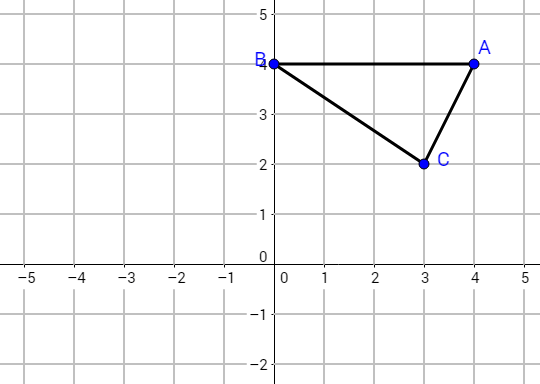
What is the ordered pair for the final location of P( 2, 3) after this series of transformations? (x,y)→(x+2, y−4) then reflected over the y−axis?
P′′(−4, 1)
P′′(−4, −1)
P′′(1, −4)
P′′(−1, −4)
What is the ordered pair for the final location of P( -7, 3) after this series of transformations? (x,y)→(x, y+3) then rotated 90° clockwise about the origin.
P′′(−7, 6)
P′′(−7, −6)
P′′(6, −7)
P′′(6, 7)

Find the image of A( -3, 5) after translating (x,y) --> (x , y-4) then reflecting across the y-axis
(3,1)
(3, -1)
(-1, 5)
(-1, 3)
What is the translation rule that follows: T<5,-9>
Up 5, Left 9
Right 5, Up 9
Left 5, Down 9
Right 5, Down 9
When we do the following composition of translations we do (a) first:
( Rm°Ry−axis ) ( ΔABC )


If AA"=18, what is the distance between lines l and m?
36
9
4.5
72

If AA"=8, what is the distance between lines l and m?
16
4
32
2
If the distance between l and m is 12, then what is AA"?
6
24
48
3
If AA"=10, what is the distance between lines l and m?
2.5
5
10
20
Which type of isometry is the equivalent of two reflections in two horizontal lines?
rotation
reflection
dilation
translation
Which type of isometry is the equivalent of two reflections in two parallel lines?
translation
reflection
double rotation
rotation
Which type of isometry is the equivalent of two reflections in intersecting lines?
translation
reflection
double rotation
rotation
Which type of isometry is the equivalent of two reflections along the x then the y axis?
translation
reflection
double rotation
rotation
Select all that apply. The equation y= 0 is :
the x-axis
a horizontal line
a vertical line
the y-axis
Select all that apply. What are the two transformations in a glide reflection?
glide
translation
rotation
reflection
dilation


