
 Worksheets
Unit 5: Periodic Table MCP
Total questions: 30
Worksheet time: 1hrs 29mins
Name
Class
Date
1.
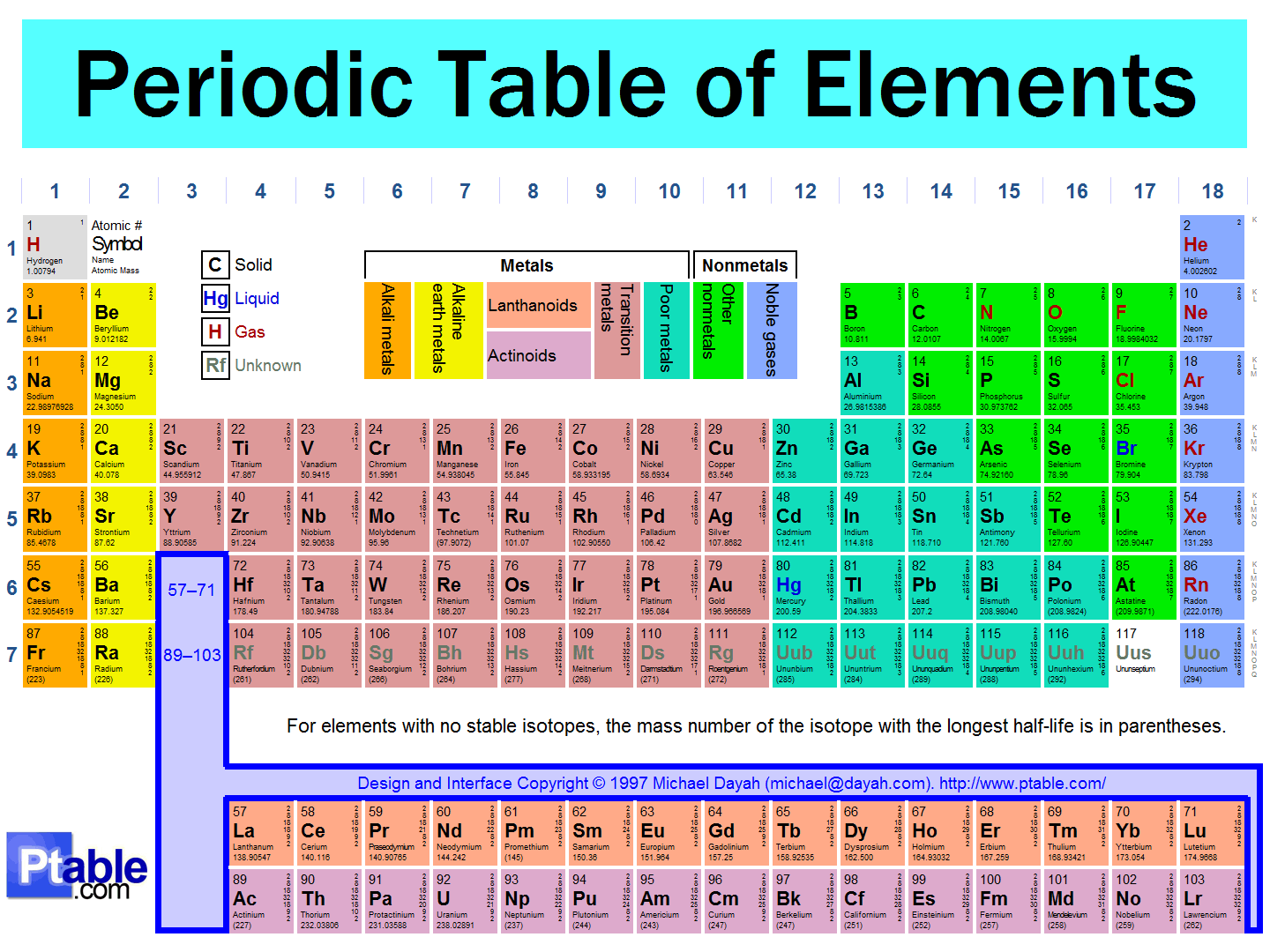
The vertical (up and down) columns in the Periodic Table are called
a)
groups
b)
towers
c)
periods
d)
atomic numbers
2.
The Modern Periodic Table of Elements is arranged by
a)
atomic mass
b)
atomic number
c)
valence electrons
d)
number of isotopes
3.
Which group of the periodic table is composed of inert (not reactive) gases?
a)
alkali metals
b)
alkaline earth metals
c)
halogens
d)
noble gases
4.

The atoms along the staircase are called
a)
metals
b)
nonmetals
c)
metalloids
d)
noble gases
5.
Which is an alkali metal?
a)
Magnesium
b)
Iron
c)
Sodium
d)
Europium
6.
Which is a halogen?
a)
Helium
b)
Chlorine
c)
Oxygen
d)
Neptune
7.
Elements in a ..................have similar chemical properties.
a)
period
b)
group
c)
row
8.
As you move down a group, atomic radius increases because -
a)
you add more and more neutrons
b)
you add more and more protons
c)
you add more and more shells (energy levels)
d)
you add more atomic mass
9.
Which of the following will have a lower ionization energy than Scandium (Sc)?
a)
Helium (He)
b)
Titanium (Ti)
c)
Calcium (Ca)
d)
Magnesium (Mg)
10.
Electronegativity is...
a)
the ability of an atom to attract/ accept electrons
b)
the ability of an atom to lose electrons
c)
the energy required to remove an electron from a specific atom
d)
how easy it is to make friends.
11.
Which has the greater Electronegativity:
N or C?
N or C?
a)
C
b)
N
12.
As you move across the periodic table atoms tend to get smaller because, ______________.
a)
the atoms have more mass.
b)
the atoms have less mass
c)
the atoms have more protons.
d)
the atoms have less electrons.
13.
Elements in the same column of the periodic table always have the same # of _______ as one another.
a)
Protons
b)
Neutrons
c)
Electrons
d)
Valence Electrons
14.
How many valence electrons are in an atom of K?
a)
3
b)
8
c)
4
d)
1
15.
How many valence electrons are in an atom of Ar?
a)
2
b)
8
c)
4
d)
1
16.

The symbols W, X, Y, and Z represent four elements shown on the outline of a periodic table.
Which element has the highest electronegativity?
Which element has the highest electronegativity?
a)
W
b)
X
c)
Y
d)
Z
17.
Which of these elements has the greatest atomic radius?
a)
H
b)
N
c)
Cl
d)
Cs
18.
Fluorine, chlorine, bromine, and iodine all have the same number of valence electrons and have a tendency to gain electrons. Which element has the greatest ionization energy and electronegativity?
a)
fluorine
b)
chlorine
c)
bromine
d)
iodine
19.
All elements found on the left side of the Periodic Table of the Elements have what properties in common?
a)
They conduct heat and electricity
b)
They are all gases
c)
They are brittle and dull
d)
They are radioactive
20.
Based on their locations in the periodic table, which element has chemical properties most similar to those of calcium, Ca?
a)
beryllium, Be
b)
potassium, K
c)
titanium, Ti
d)
yttrium, Y
21.
The number of valence electrons in an element affects the reactivity of that element. Which element listed has the fewest valence electrons?
a)
beryllium (Be)
b)
sodium (Na)
c)
oxygen (O)
d)
neon (Ne)
22.

What is the family name of this group of elements?
a)
Alkali metals
b)
Halogens
c)
Noble Gases
d)
Alkali Earth Metals
23.
Which element has 2 valence electrons?
a)
cesium (Cs)
b)
magnesium (Mg)
c)
boron (B)
d)
argon (Ar)
24.
How many Valance electrons does Iodine Have?
a)
6
b)
16
c)
7
d)
17
25.
Which atom has the largest atomic radius?
a)
potassium
b)
rubidium
c)
francium
d)
cesium
26.

Which element has 3 valence electrons?
a)
A
b)
B
c)
E
d)
C
27.

Which elements are in the same period?
a)
A & F
b)
F, B & D
c)
E & D
d)
F & B
28.

Is silicon a metal, nonmetal or metalloid?
a)
Metal
b)
NonMetal
c)
Metalloid
29.
Which two elements on the periodic table are in the same period?
a)
Sn and Rb
b)
K and Ba
c)
F and Cl
d)
Se and Te
30.
The horizontal rows on the periodic table, which indicate the number of energy levels/orbitals that an atom has, are called ___________.
a)
Periods
b)
Element
c)
Atomic Number
d)
Group
100 %

