
 Worksheets
DNA Replication and Structure
Total questions: 25
Worksheet time: 13mins
Name
Class
Date
1.
The monomers (building blocks) of DNA are called
a)
nitrogen bases
b)
nucleotides
c)
sugar
d)
phosphates
2.
What is the name of the enzyme that adds nucleotides according to the base pair rules during replication?
a)
helicase
b)
polymerase
c)
protease
d)
lipase
3.
The sugar found in DNA is called?
a)
Ribose
b)
Glucose
c)
Deoxyribose
d)
Sucrose
4.
Three parts of a nucleotide are
a)
Adenine and Guanine
b)
Sugar, nitrogen base and protein
c)
Glucose
d)
Sugar, phosphate and Nitrogen Base
5.
In DNA Replication, A always bonds with
a)
Cytosine
b)
Guanine
c)
Thymine
d)
Enzymes
6.
Cytosine always bonds with
a)
G
b)
A
c)
T
d)
U
7.
The nitrogen bases are held together by
a)
weak hydrogen bonds
b)
sugar
c)
phosphate
d)
nitrogen bases
8.
DNA is shaped like a
a)
Double Helix
b)
Ladder
c)
Helix
d)
Circular chain
9.
If adenine makes up 15% of the DNA molecule, what percent makes up cytosine?
a)
15%
b)
30%
c)
70%
d)
35%
10.
Who receives credit for the discovery of the DNA structure?
a)
Chargaff
b)
Watson and Crick
c)
Crick and Franklin
d)
Franklin
11.
The sides of the DNA ladder are made up of alternating
a)
Nitrogen Bases
b)
Sugars and Phosphate Groups
c)
Phosphate Groups and Nitrogen Bases
d)
Hydrogen Bonds
12.
The process of making more DNA is called
a)
DNA Duplication
b)
DNA Replication
c)
DNA Ditto
d)
DNA Copying
13.
What is the DNA compliment of A T A C C G
a)
T T A G G C
b)
T A T G G C
c)
A T T G G A
d)
T A T A C A
14.
Which of the following bases are purines?
a)
A/T
b)
C/G
c)
C/T
d)
A/G
15.
DNA replication results in each new DNA molecule
a)
each with two new strands.
b)
one w/ two new strands, the other w/ two original strands
c)
each with one complimentary strand and one original template strand
d)
each with two original strands
16.
Which of the following enclose their DNA in a nucleus?
a)
prokaryotes
b)
bacteria
c)
eukaryotes
d)
amoeba
17.
During DNA replication, what two processes occur before the two strands can separate?
a)
unwind and break hydrogen bonds
b)
unwind and shrink
c)
unwind and expand
d)
unwind and add bases
18.

Structure X is
a)
phosphate
b)
Deoxyribose
c)
DNA
d)
a nucleotide
19.
What is the name of the enzyme that causes the DNA to "unzip"?
a)
Ligase
b)
Helicase
c)
Dioxylase
d)
Amylase
20.
What are the strong bonds that hold all nucleotides together in a DNA molecule?
a)
hydrogen
b)
covalent
c)
ionic
d)
polar
21.
Which 2 bases are pyrimidines?
a)
A/G
b)
A/T
c)
C/T
d)
C/G
22.
In a DNA sample, there is 10% of adenine. How much guanine is there?
a)
10%
b)
90%
c)
80%
d)
40%
23.
Pyrimidines have _____ ring(s) while purines have _____ ring(s).
a)
One; Two
b)
Two; One
24.
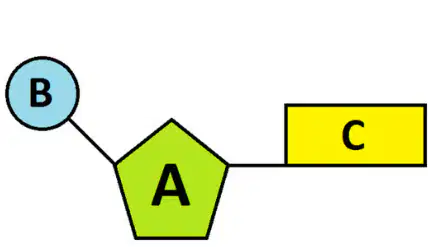
What is letter A?
a)
phosphate
b)
deoxyribose
c)
nitrogen base
25.
Who is responsible for creating the base-pair rules?
a)
Franklin
b)
Chargaff
c)
Avery
d)
Crick
100 %

