Wayground logo

Free Printable Worksheets

Font size

S
M
L
XL
Worksheets

Chapter 6 Review

Total questions: 18

Worksheet time: 19mins

Name
Class
Date
1.
Ionic bonds are between...
a)
nonmetals and nonmetals
b)
carbon and oxygen
c)
metals and nonmentals
d)
hydrogen and chlorine
2.
Covalent bonds are between...
a)
two or more nonmetals
b)
sodium and chlorine
c)
metals and metals
d)
metals and nonmetals
3.
What are valence electrons?
a)
sum of the protons and neutrons
b)
protons minus electrons
c)
electrons in the inner shells
d)
electrons in the outer shell
4.
If an atom loses two electrons what charge will it have?
a)
-2
b)
-1
c)
+1
d)
+2
5.

The octet rules states that most elements want to have _____ valence electrons.

a)

2

b)

4

c)

6

d)

8

6.
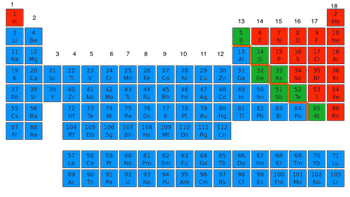
Where are metals located on the periodic table?
a)
Blue
b)
Green
c)
Red
7.

Where are the nonmetals located on the periodic table?

a)

Blue

b)

Red

c)

Green

8.
VSEPR theory is to
a)
determine the number of bonding and lone pairs electrons
b)
determine the number of ECC
c)
determine the shape and geometry of molecule
d)
determine the lewis structure of molecule
9.
What molecular shape is the structure shown here? (BCl3)
a)
linear
b)
trigonal planar
c)
tetrahedral
d)
trigonal pyramidal
10.
What molecular shape is the structure shown here? (H2O)
a)
tetrahedral
b)
trigonal planar
c)
bent
d)
trigonal pyramidal
11.
What molecular shape is the structure shown here? (NH4+)
a)
linear
b)
trigonal planar
c)
tetrahedral
d)
trigonal pyramidal
12.

Using the chart, determine the molecular shape of a molecule with 3 bonded atoms and 2 lone pairs?

a)

T-Shape

b)

Trigonal Bipyramid

c)

See-Saw

d)

Square Planar

13.
How many electrons are shared between two atoms that are triple bonded?
a)
6
b)
2
c)
4
d)
8
14.

Which type of IMF is responsible for the attraction pictured above?

a)

Dipole-Dipole Interaction

b)

Hydrogen Bonds

c)

London Dispersion

15.

Which type of IMF is responsible for the attraction pictured above?

a)

Dipole-Dipole Interaction

b)

Hydrogen Bonds

c)

London Dispersion

16.

Intermolecular forces are attractions between ______.

a)

Cations and anions

b)

Atoms within a molecule

c)

Neighboring molecules

d)

Protons and electrons

17.

Which of the following might cause a hydrogen bond to form?

a)

Carbon

b)

Phosphorus

c)

Sulfur

d)

Oxygen

18.

Intermolecular forces are responsible for which of the following properties?

a)

Phase Change

b)

Color

c)

Odor

d)

Conductivity