Wayground logo

Free Printable Worksheets

Font size

S
M
L
XL
Worksheets

Digestive system & Enzymes

Total questions: 30

Worksheet time: 20mins

Name
Class
Date
1.
Tube that carries swallowed food to the stomach
a)
esophagus
b)
liver
c)
pancreas
d)
rectum
2.

Where does digestion begin:

a)

nose

b)

mouth

c)

esophagus

d)

stomach

3.

What is the squeezing motion called that moves food down the esophagus?

a)

peristalsis

b)

absorption

c)

respiration

d)

diffusion

4.
Breaking food down with the use of enzymes is known as:
a)
Chemical Digestion
b)
Physical Digestion
5.
Chewing food is an example of _____________.
a)
chemical digestion
b)
mechanical digestion
6.

What is the name of the flap that prevents food from entering your lungs?

a)

epiglottis

b)

alveoli

c)

salivary amylase

d)

chyme

7.
The mouth has 2 different types of digestion.  They are
a)
Physical and Elemental
b)
Mechanical and heat
c)
Mechanical and chemical
d)
Acidic and motion
8.
Salvia breaks down food using
a)
Mechanical digestion
b)
Acidic digestion
c)
Chemical digestion
d)
None of the above
9.
Which organ does most of the chemical digestion of food and allows nutrients to be absorbed into the body?
a)
stomach
b)
esophagus
c)
small intestine
d)
liver
10.
Which part of the digestive system is number 3?
a)
esophagus
b)
stomach
c)
small intestine
d)
liver
11.
Which part of the digestive system is number 4?
a)
esophagus
b)
large intestine
c)
small intestine
d)
liver
12.

Which of the following digestive enzyme is found in the saliva?

a)

Sucrase

b)

HCl

c)

Salivary amylase

d)

Pepsin

13.

The villi are found in the ______.

a)

small intestine

b)

mouth

c)

esophagus

d)

stomach

14.

No mechanical or chemical digestion occurs in the ______.

a)

mouth

b)

esophagus

c)

stomach

d)

small intestine

15.

Where is food made into chyme?

a)

mouth

b)

small intestine

c)

esophagus

d)

stomach

16.

HCl is present is the _________ & helps with digestion.

a)

mouth

b)

stomach

c)

small intestine

d)

esophagus

17.

Which part of the digestive system is number 2?

a)

esophagus

b)

stomach

c)

small intestine

d)

liver

18.

Why do we need food to break apart the food we eat?

a)

So it can fit into our stomachs

b)

So our bodies can use the nutrients from the food

c)

So liquids can be separated from solids

d)

So that our bodies' enzymes have something to do.

19.

What is the main function of villi?

a)

They move food from the stomach to the small intestine

b)

They absorb nutrients into the bloodstream

c)

They absorb water from chyme

d)

They move food from the small intestine to the large intestine

20.

What are these structures call that are found on the lining of the small intestine?

a)

Gallbladder

b)

Villi

c)

Sphincter

d)

Duodenum

21.

Nutrients from your ______ pass into your blood stream.

a)

stomach

b)

small intestine

c)

large intestine

d)

liver

22.

Passive transport _________ require energy

a)

does

b)

does not

23.
What is a substance called if it speeds up a chemical reaction?
a)
reusable
b)
catalyst
c)
specific
d)
fragile
24.
With what 3 letters do enzymes typically end?
a)
-ose
b)
-ase
c)
-ese
d)
-tic
25.

Enzymes are an example of

a)

Lipids

b)

Carbohydrate

c)

Protein

d)

Nucleic Acid

26.
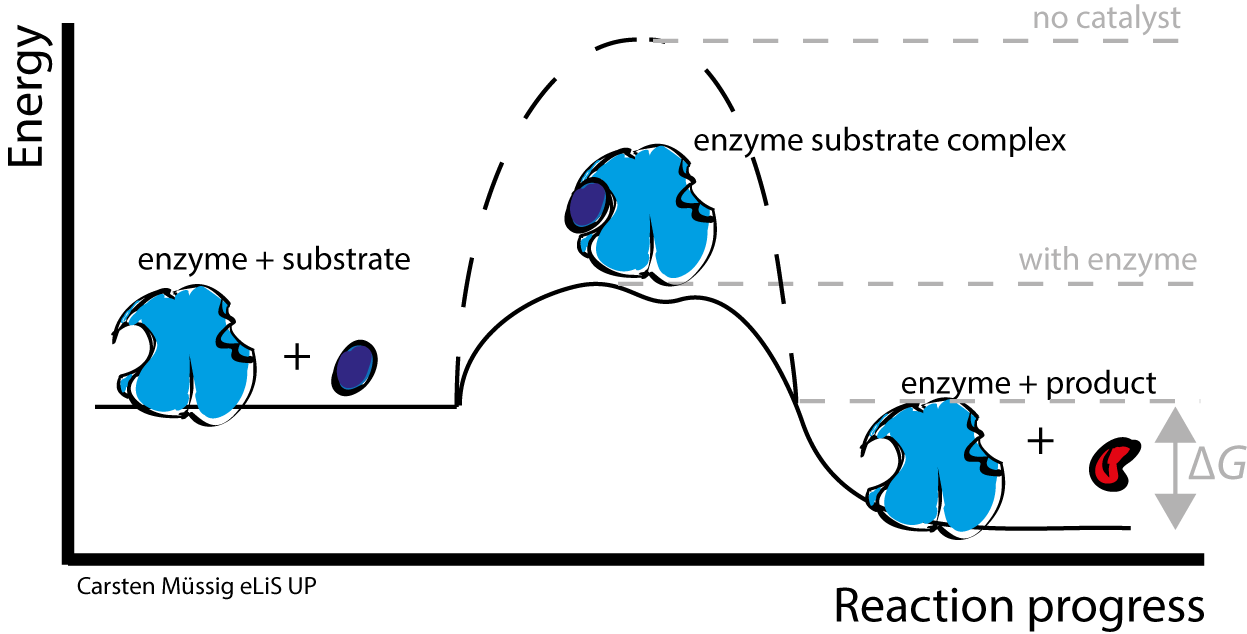
An enzyme speeds up a reaction by
a)
lowering the activation energy.
b)
raising the activation energy.
c)
releasing energy.
d)
absorbing energy.
27.

What happens when enzymes are heated to a high temperature?

a)

The enzymes die.

b)

The shape of the enzyme are changed and it denatures

c)

The enzymes' amino acid sequence changes.

d)

The enzymes remain the same

28.
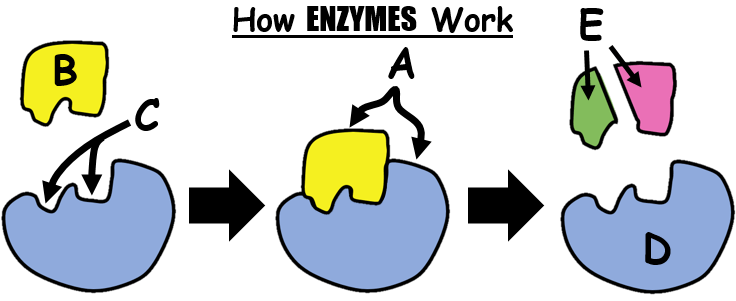
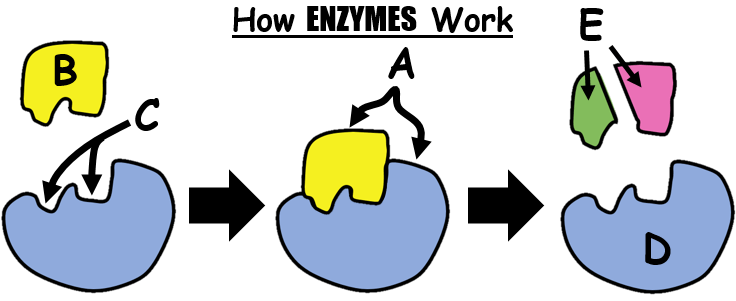
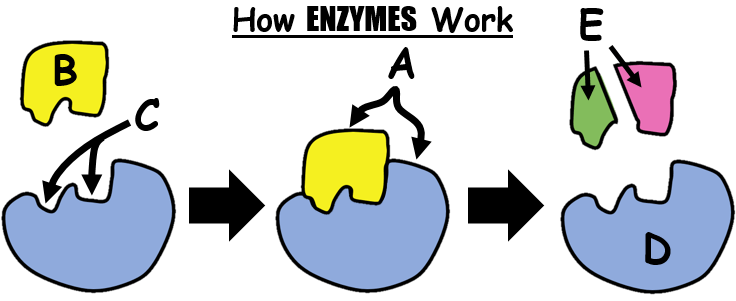
Letter C...
a)
active site
b)
enzymes
c)
substrate
d)
products
29.
Letter E...
a)
active site
b)
enzyme
c)
substrate
d)
products
30.
Letter B...
a)
active site
b)
enzyme
c)
substrate
d)
products