
Font size
 Worksheets
Unit 1 Test Review
Total questions: 27
Worksheet time: 23mins

As the depth of ocean water increases, the temperature
increases.
decreases.
fluctuates depending on the pressure.
stays the same.

When temperature decreases, the density of liquid water _________________.
increases
decreases
stays the same

Earth's Oceans carry more than just water. They carry matter (good and bad) and energy all over the globe.
True
False
A. Global Wind Patterns
B. Earth's Rotation
C. Continental Deflection
D. All of the above
Which type of water would sink to the bottom of the ocean.
Warm, fresh
Cold, fresh
Warm, salty
Cold, salty
A. The North Pole
B. The South Pole
C. The Equator
D. Both A and B
colder temperature & more salt
warmer temperature & less salt
Which water is densest?
warm fresh water
cold fresh water
warm salt water
cold salt water
The definition of a gyre is...
circular patterns of surface currents in the world's oceans
circular patterns of wind over the world's oceans
weather pattenrs that cause hurricanes
deep ocean currents that start at the Earth's poles
Which is the true statement?
Warm water will sink and push cold water up.
Cold water will sink and push warm water up.
Cool/cold water flows away from...
the poles
the equator
Warm water flows away from...
the poles
the equator
How do oceans influence weather and climate?
Oceans cause winds to move by the motion of strong currents.
Oceans reflect the sun's energy back through the atmosphere into space.
Oceans absorb the energy of the sun, store it, and release it.
Oceans' waves continually generate heat through wave action.
(a) is what causes the water to continue to move in a cycle.
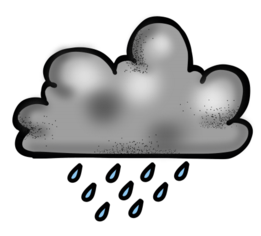
This process is called (a) where rain, sleet, or snow fall to the Earth due to (b) .
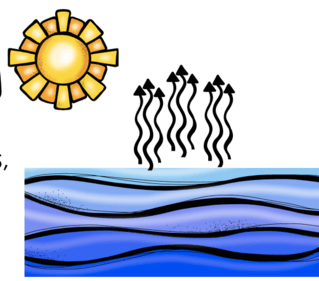

Radiation from the sun impacts water movement by
density
salinity
convection
conduction
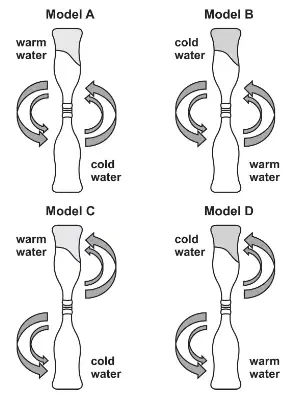
Model B represents a convection current because it shows (a) water sinking and (b) water rising.

What type of energy is shown here?
Conduction
Convection
Radiation

What type of energy is being shown here?
Conduction
Convection
Radiation

What type of energy is being shown here?
Conduction
Convection
Radiation
On the beach, does the land or sea heat up faster?
Land
Sea
They heat at the same rate
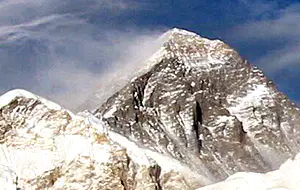
When a solid turns into a gas without ever being a liquid
Evaporation
Precipitation
Sublimation
Condensation

Water that is not absorbed into the soil or evaporated into the atmosphere and flows along the surface of the Earth.
Infiltration
Runoff
Water Storage
Watershed
Matter, such as dust, can move thousands of miles through the atmosphere from a (a) .

