
Font size
 Worksheets
Year 8 Biology revision
Total questions: 20
Worksheet time: 10mins

Which of these are the adaptations of polar bear ?
They are always in group
They have a very strong sense of smell
They can only swim for a short period of time
The paws are wide and large.
what is an adaptation?
a change in behavior or physical aspect of an organism in order to be better suited to survive in a particular environment.
a change that an organism quickly develps to survive
a unique characteristic that makes an organsism more dominant
a shift in an organisms behavior
Adaptations that desert plants have include
waxy cutticles
hairy stems
thin leaves
short roots
What would be the most useful adaptation for a rabbit in the snow...
camoflauge
having long ears
having strong legs
strong teeth
A producer is something that:
Eats plants
Makes its own food
Eats animals
Eats plants and animals
Producers are always at the __________ of a food chain
Beginning
Middle
End
Producers are not part of the food chain
What do the arrows show in this food chain:
plant → grasshopper → bird → snake → owl.
The arrow points from the organism being eaten to the organism that eats it.
The arrow points from the organism that eats it to the organism that is being eaten.
The arrow points from biggest animal to smallest animal.
The arrow points from the consumers to the producers.

How much energy does trophic level 2 store from trophic level 1? (and so on..)
1%
10%
50%
100%
An autotroph is another word for a ________, meaning it needs to ________
Consumer, eat other animals
Consumer, eat other plants
Producer, make its own food
Producer, survive without water
An heterotroph is another word for a ________, meaning it needs to ________
Consumer, eat other organisms
Consumer, go through photosynthesis
Producer, make its own food
Producer, survive without water
What is the scientific word that refers to the differences within a species?
variation
characteristics
features
inheritance
What causes variation?
inherited factors only
environmental factors only
inherited and environmental factors
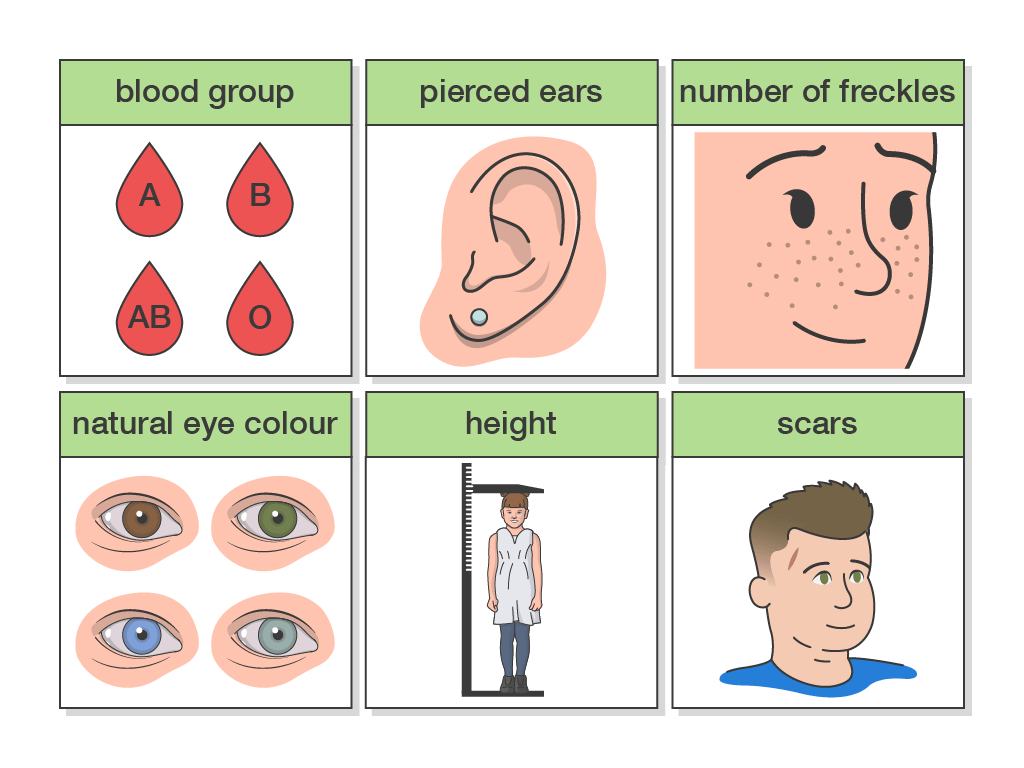
Which two characteristics show variation as a result of inherited factors only?
blood group
pierced ears
number of freckles
natural eye colour
height
Which two characteristics show variation as a result of a combination of both inherited and environmental factors?
blood group
pierced ears
number of freckles
natural eye colour
height
List three external conditions required for seed germination
soil, water, air
suitable temperature, water, sunlight
oxygen, water, suitable temperature
Which list is in the correct order from biggest to smallest?
organism-cell-nucleus-chromosome-DNA-gene
gene-DNA-chromosome-nucleus-cell-organism
organism-DNA-cell-gene-chromosome-nucleus
organism--cell-nucleus-gene-chromosome-DNA
Our eye color is an example of an _______________________.
inherited trait
environmental trait
The structure that carries the food from the mouth to the stomach
mouth
esophagus
pancreas
large intestine

The process that is taking place there is
peristalsis
digestion
absorption
excretion

