wayground logo

Free Printable Worksheets

Font size

S
M
L
XL
Worksheets

Evolution Assessment

Total questions: 48

Worksheet time: 34mins

Name
Class
Date
1.
How does adaptation help an organism?
a)
It helps the organism change colors.
b)
It improves its ability to survive and reproduce.
c)
It improves its ability to change species.
d)
It helps the organism become a fossil.
2.
If one animal or plant has the same characteristics as another, they may both be a part of the same
a)
Evolution.
b)
Planet.
c)
Species.
d)
Fossil Record.
3.
Where do scientists look for evidence of evolution?
a)
In the layers of the Earth
b)
In caves
c)
In water
d)
In old books
4.
What is a fossil?
a)
A layer of sediment
b)
A living organism
c)
A very old organism
d)
Remains of a once-living organism
5.
The fossil record provides evidence about
a)
The age of rocks.
b)
The order in which species have existed.
c)
The number of layers the Earth has.
d)
The composition of minerals.
6.
All living things inherit similar traits from their
a)
Ancestors.
b)
Evolution.
c)
Fossils.
d)
Descendants.
7.
If you compared two kinds of living organisms, what might you learn about their history?
a)
How long ago they evolved
b)
Whether they share a common ancestor
c)
Whether they live in the same place
d)
Whether they could mate and reproduce
8.
What do organisms inherit from ancestors?
a)
Mammal characteristics
b)
Traits and DNA
c)
Hind limbs
d)
New traits
9.
What does the similarity between humans, dolphins, cats and bats indicate?
a)
That they all evolved recently
b)
That their ancestors lived in the same place
c)
That they share a common ancestor
d)
That they are becoming more alike over time
10.
Fossils provide evidence that Antarctica was once located
a)
At the North Pole.
b)
Near the equator.
c)
At the South Pole.
d)
Where it is now.
11.
What does natural selection explain about a population?
a)
How long it has been since it evolved
b)
How it changes in response to its environment
c)
How it resists change
d)
How likely its members are to leave fossils
12.
Which individuals in a population are most likely to survive and reproduce?
a)
The largest ones
b)
The ones with the most DNA
c)
The best adapted ones
d)
The oldest ones
13.
How does adaptation help an organism?
a)
It helps the organism change colors.
b)
It improves its ability to survive and reproduce.
c)
It improves its ability to change species.
d)
It helps the organism become a fossil.
14.
The fossil record provides evidence about
a)
The age of rocks.
b)
The order in which species have existed.
c)
The number of layers the Earth has.
d)
The composition of minerals.
15.
If you compared two kinds of living organisms, what might you learn about their history?
a)
How long ago they evolved
b)
Whether they share a common ancestor
c)
Whether they live in the same place
d)
Whether they could mate and reproduce
16.

The transfer of various characters from parent to child is called ________.

a)

Variations

b)

Heredity

c)

Evolution

d)

Trait

17.
A cow is driven off from its herd. It joined another herd and contributed to the gene pool of the new herd. What would likely happen?
a)
Mutations
b)
Fitness of the strong
c)
Genetic variation
d)
Naturally same
18.
Vestigial structure is 
a)
Plant cells that support the plants
b)
Animal bones found from fossil
c)
A branch of interbreeding species
d)
Seems no use such as our wisdom teeth
19.
Divergent is
a)
A definition in geography
b)
A word in history
c)
Come together
d)
Be apart
20.
Convergent is
a)
Come together
b)
Become different
c)
A word in history
d)
A word in geography
21.

The scientist who came up with the current classification system

a)

Darwin

b)

Newton

c)

Mendel

d)

Linnaeus

22.

How did Darwin contribute to the theory of evolution?

a)

stated that evolution occurred through natural selection

b)

stated that evolution caused mutation

c)

stated that evolution caused natural selection

d)

he was the first to describe evolution

23.

What islands did Darwin make his discoveries regarding evolution?

a)

Hawaiian

b)

Polynesian

c)

Galapagos

d)

Bahamas

24.

Which best describes the term evolution?

a)

Naturally occurring mutations

b)

inherited, genetic changes in organisms over time

c)

the ability of an organism to survive and reproduce

d)

random changes in a DNA sequence

25.

Which best describes the term biodiversity?

a)

the outward appearance of an organism

b)

natural, random mutations in a population

c)

a change in an organism that allows it better survive in its environment

d)

the large variety of different species found on earth

26.

What did Darwin notice about the Finches in the Galapagos?

a)

the size and shape of beak was different depending on the food source of each island

b)

the size of finch was different depending on the habitat of each island

c)

the shape and size of beak was the same

d)

the size of finch was the same but the color was different

27.

What is the likely cause of analogous traits?

a)

Two species share a common ancestor

b)

Two species face similar environmental pressures

c)

A remnant of a trait that no longer serves a function

28.

If TWO species have a similar trait because they DID have a recent common ancestor, what do we call that trait?

(a)  

29.

What is the difference between a VESTIGIAL trait and a HOMOLOGOUS trait?

4 lines
30.

What

type

of structure?

a)

Homologous

b)

Analogous

c)

Embryological

d)

Vestigial

31.

What

type

of structure?

a)

Homologous

b)

Analogous

c)

Embryological

d)

Vestigial

32.

What

type

of structure?

a)

Homologous

b)

Analogous

c)

Embryological

d)

Vestigial

33.

What

type

of structure?

a)

Homologous

b)

Analogous

c)

Embryological

d)

Vestigial

34.

What

type

of structure?

a)

Homologous

b)

Analogous

c)

Embryological

d)

Vestigial

35.
Structures that are inherited from a common ancestor are homologous.
a)
True
b)
False
36.
Humans, birds, whales, and lizards all have similar arm bones. What is the reason for this?
a)
The function of these bones is the same in all animals
b)
They live in similar environments
c)
They have a common ancestor
d)
All organisms resemble humans
37.
Bird wings and butterfly wings are an example of
a)
Homologous structure
b)
Analogous structure
c)
Mimicry
d)
Camoflague
38.
Bird wings and butterfly wings are an example of
a)
Homologous structure
b)
Analogous structure
c)
Mimicry
d)
Camoflague
39.
Shark fins and dolphin fins are examples of analogous structures.
a)
True
b)
False
40.
Analogous structures show common ancestry.
a)
True
b)
False
41.

Penguin flipper and fish fin

a)

Homologous

b)

Vestigial

c)

Analogous

d)

None of the above

42.

An anatomical feature that no longer seams to have a purpose in the current form of an organism

a)

Homologous structure

b)

Analogous structure

c)

Vestigial structure

d)

None of the above

43.

Which of the following are vestigial structures humans have? Select all that apply.

a)

Appendix

b)

Tailbone

c)

Forearm bones

d)

Goosebumps

44.

What evidence is most important when using relative dating?

a)

the half-life of a radioactive element

b)

the position of sediment in petrified rock

c)

the types of minerals in a petrified fossil

d)

the position of fossils in sedimentary rock layers

45.

How does the fossil record help to support the theory of evolution?

a)

the fossil record shows that organisms slowly change over time

b)

The fossil record shows that species evolve very quickly

c)

The fossil record does not support the theory of evolution

46.

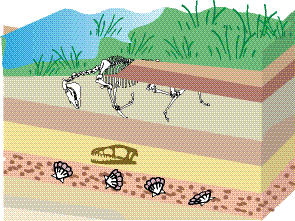
Which rock layer most likely contains fossils of the oldest organisms?

a)

1

b)

2

c)

3

d)

4

47.

According to the law of superposition, the oldest fossils are found

a)

At the top of the rock layers

b)

Near the bottom of the rock layers

c)

Somewhat near the surface

48.

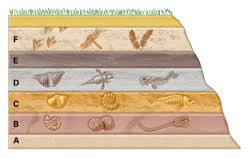
Which rock layer contains the newest fossils?

a)

B

b)

C

c)

D

d)

E

e)

F