
 Worksheets
Stoichiometry, Limiting Reactant, & Percent Yield Quiz
Total questions: 167
Worksheet time: 10hrs 58mins
24 grams of CH4 was added to the above reaction. Calculate the theoretical yield of CO2.
2Fe2O3 + 3C → 4Fe + 3CO2
You add 28 grams of carbon. You find the actual yield to be 81.2 grams of CO2. What is the percent yield of CO2? (Hint: calculate theoretical yield of CO2 first)
58.83%
308%
6435%
79.14%
Actual yield = 62g
Calculate the percent yield.
The reaction of 75.0g P4 with excess chlorine gas produces 110g PCl3 in lab. Find the theoretical yield and calculate percent yield for the reaction.
2Pb(NO3)2 (s)→2PbO(s)+4NO2(g)+O2(g)
What is the formula for percent yield?
theoretical yieldactual yield×100
actual yieldtheoretical yield×100
moles Bmoles A
grams Bgrams A
If you are converting from grams of substance A to grams of substance B, drag the correct order of the conversion process:
(a) ---> (b) ---> (c) ---> (d)
Based on the following equation and question, choose the actual yield:
Zn + 2HCl → ZnCl2 + H2
20 g of ZnCl2(136.286 g/mol) is formed in a lab. What is percent yield if 10 g of HCl (36.453 g/mol) is consumed?
44.5%
35.4%
10.6 %
26.8 %
Calculate percent yield based on the following information:
Actual Yield: 50
Theoretical Yield: 60
0.8333 %
83.33 %
120 %
1.2 %
Which of the following reactions has the lowest percent yield?
Theoretical yield 25.7 g; actual yield 23.2 g
Theoretical yield 42.1 g; actual yield 39.9 g
Theoretical yield 18.2 g; actual yield 15.6 g
Theoretical yield 93.4 g; actual yield 87.9 g
List one reason why the actual yield is lower than the theoretical yield.
(a)
How many grams of aluminum sulfate would be formed if 250g H2SO4 completely reacted with aluminum?
Mg + 2HCl --> MgCl2 + H2
How many grams are in 7.8 moles of NaCl?
476 grams
460 grams
452 grams
462 grams
CaC₂(s) + H₂O(l) --> C₂H₂(g) + Ca(OH)₂(aq)
Fe2O3(s) + 3H2(g) → 2Fe(s) + 3H2O(l)
How many moles of iron can be made from 6 moles H2?
1 Mg + 2 HCl --> 1 MgCl2 + 1 H2

Percent yield=(________)÷(________)×100%
LiOH + KCl → LiCl + KOH
b) I actually produced 6 grams of lithium chloride and I began this reaction with 20 grams of lithium hydroxide. What is my percent yield?
In the experiment above, 7.62 g of Fe are allowed to react with 8.67 g of S.
How much FeS is formed?
Use the equation 2 Al + 3 Cl2 ---> 2 AlCl3. If 2 moles of aluminum and 2 moles of chlorine are reacted, identify the limiting reactant.
AlCl3
Cl2
Al
It refers to the substance(s) that are considered to be "ingredients" of a chemical reaction.
reactants
products
catalysts
enhancers
4NH3+6NO --> 5N2 + 6H2O
1 Cheese + 2 Bread --> 1 grilled cheese
How many grilled cheeses can you make with 26 slices of bread and 14 pieces of cheese?
14
13
26

The Formula to make S'mores is:
2C + 1M + G2 → C2MG2. If you have 5 Marshmallows (M), 9 Chocolate Pieces (C), and 9 Graham Cracker Halves (G), how many S'mores can you make?
5
4
8
42
Why is it important to identify the limiting reagent?
The limiting reagent speeds up the reaction.
The limiting reagent controls the amount of product formed.
If there is no limiting reagent, the reaction will not occur.
No stoichiometry calculations can be done without a limiting reagent.

Using the diagram, determine the limiting reactant, the product formed is water.
oxygen
hydrogen
none of the reactant are limiting
both hydrogen and oxygen
A chemical reaction stops before the limiting reagent is used up.
How many cars can you make with 92 tires and 34 bodies?
How many cars can you make with 92 tires and 34 bodies?
In this senario the tires would be the _____________ reactant.
The Formula to make S'mores is:
2C + 1M + G2 → C2MG2. If you have 5 Marshmallows (M), 9 Chocolate Pieces (C), and 9 Graham Cracker Halves (G), what is the limiting reactant?
Chocolate pieces (C)
Marshmallows (M)
Graham Cracker Halves (G)
There is not a limiting reactant present
Synthesis
Multiple reactants form a single compound.
Decomposition
A single compound breaks down into simpler substances
Single Displacement
One element replaces another element in a compound
Double Displacement
Ions in two compounds exchange places to form two new compounds
Combustion
Elemental oxygen is a reactant.
What must be done FIRST to solve a stoichiometry problem?
Write and balance a chemical equation.
Mathematically determine the limiting reactant.
Mathematically determine the excess reactant.
Ensure all quantities are in grams.
The mole ratio number of a substance is represented by its
chemical formula
subscripts
superscripts
coefficient
What type of chemical reaction is this one?
Al(OH)3 --> Al2O3 + H2O
Decomposition
Combustion
Synthesis
Single Displacement
What type of chemical reaction is this one?
Ca + MgCl2 --> CaCl2 + Mg
Decomposition
Combustion
Synthesis
Single Displacement
What type of chemical reaction is this one?
CuO + CO2 --> CuCO3
Decomposition
Combustion
Synthesis
Single Displacement
3KOH + H3PO4 --> K3PO4 + 3H2O
Synthesis
Decomposition
Single displacement
Double displacement
4Fe + 3O2 → 2Fe2O3
Synthesis
Decomposition
Single Displacement
Double Displacement
2H2O2 →2 H2O + O2
Synthesis
Decomposition
Single Displacement
Combustion
Classify the following chemical reaction
BaCl2(aq) + K2CrO4(aq) --> BaCrO4(s) + 2KCl(aq)
Synthesis
Decomposition
Single Displacement
Double Displacement
Combustion
Classify the follow chemical reaction.
2C6H6(l) + 15O2 --> 6H2O(l) + 12CO2(g)
Synthesis
Decomposition
Single Displacement
Double Displacement
Combustion

Identify the type of chemical reaction pictured above
Synthesis
Decomposition
Single Displacement
Double Displacement
Combustion

Identify the type of chemical reaction picture above
Synthesis
Decomposition
Single Displacement
Double Displacement
Combustion
Synthesis
Decomposition
Single displacement
Double displacement
Synthesis
Decomposition
Single displacement
Double displacement
What reaction has the following general formula:
A + CD --> C + AD
Synthesis
Decomposition
Single Displacement
Double Displacement
Combustion
What is the left part of a chemical equation called?
2H2 + O2 ---> 2H2O
Reactants
Yields
Products
Chemical equation
What is the right part of a chemical equation called?
2H2 + O2 ---> 2H2O
Reactants
Yields
Products
Chemical Equation
What is the little number after an element in a chemical equation called?
Example: H2
Coefficient
Atom
Subscript
Equation
Is the following equation balanced?
Al + O2 ---> 2Al2O3
YES
NO
What is the number before a chemical formula called?
Example: 2H2 + O2 ---> 2H2O
Coefficient
Atom
Subscript
Equation
What is the Law of Conservation of Mass?
It states that matter cannot be created or destroyed.
It states that energy cannot be created or destroyed.
It states that matter can be created or destroyed.
It states that sound can be created or destroyed.
What are the numbers that you CANNOT change in a chemical equation?
Subscripts
What is the right ratio of chemicals for the balanced chemical equation?
__Ca + __H2O --> __Ca(OH)2 + __H2
What is the right ratio of chemicals for the balanced chemical equation?
__CO + __Fe2O3--> __Fe + __CO2
How many moles of oxygen are consumed if 8 moles H2 are used?
How many moles of oxygen are produced when 6.7 moles of KClO3 decompose completely?
How many grams of potassium chloride can be produced from 356 g of chlorine and 356 g of potassium bromide?
Mg + 2HCl --> MgCl2 + H2
What is the balanced chemical equation for the reaction between hydrochloric acid and calcium carbonate when the products of the reaction are calcium chloride, carbon dioxide, and water?
HCl + CaCl2 → CaCO3 + CO2 + H2O
HCl + CaCO3 → CaCl2 + CO2 + H2O
2HCl + CaCO3 → CaCl2 + CO2 + H2O
2HCl + CaCl2 → CaCO3 + CO2 + 2H2O
The reaction of 5.0 grams of fluorine with excess chlorine produced 5.6 grams of ClF3. What percent yield of ClF3 was obtained?
Cl2 + 3F2 → 2ClF3
58%
69%
76%
86%

What is the limiting reactant in the reaction shown?
ammonia
nitrogen
hydrogen
There is no limiting reactant.
Which of the following is NOT part of a conversion factor we studied that equals 1 mole?
grams from the periodic table
22.4 Liters
22.4 meters
6.02 x 10^23 particles (atoms, molecules)
Two or more chemical species combine to form a more complex product.
Decomposition Reaction
Synthesis Reaction
Single Replacement Reaction
Double Replacement Reaction
Compares the hands-on results to the calculated predictions.
Theoretical yield
Actual yield
Percent yield
Probable yield
The amount that according to the DA (calculated) you should get if everything is just perfect.
Theoretical yield
Actual yield
Percent yield
Probable yield
A reactant that is totally consumed when the chemical reaction is completed.
Theoretical Reactant
Excess Reactant
Limiting Reactant
Actual Reactant
What type of reaction is 2NaCl --> 2Na + Cl2?
Decomposition Reaction
Synthesis Reaction
Single Replacement Reaction
Double Replacement Reaction
How do you know an equation is balanced?
The coefficients on the left equal the coefficients on the right.
The subscripts on the left equal the subscripts on the right.
There are an equal number of each type of atom on both sides of the arrow
The elements on the left are the same as the elements on the right.
The amount (usually mass) that you measured when you did the experiment.
Theoretical yield
Actual yield
Percent yield
Probable yield
What is the first step in solving a stoichiometry problem?
Note the unit of the given substance.
Put the number and unit of the given at the beginning.
Convert the unit of the given to moles if it does not start with moles.
Writing the balanced chemical equation for the reaction.
Atoms or compounds that are generated as a result of a chemical reaction (RIGHT SIDE)
Products
Reactants
Excess Reactant
Limiting Reactant
In stoichiometry, what step always come after your unit is in moles?
molar mass
mole to mole ratio
percent yield
coefficients

Which of the following shows the steps to go from the grams of the given to the grams of the unknown?
molar mass (given) to molar ratio to molar volume (unknown)
molar mass (given) to molar ratio to molar mass (unknown)
molar ratio to molar mass (unknown)
molar mass (given) to molar ratio to
Avogadro's to molar mass (unknown)
The study of quantitative relationships between the amounts of reactants used and amounts of products formed by a chemical reaction.
Percent yield
Stoichiometry
Types of Reactions
Balancing
The ____ in a balanced chemical reactions gives the MOLE RATIO used in stoichiometry problems.
coefficients
reactants
subscripts
products
One reactant is exchanged for one ion of a second reactant.
Decomposition Reaction
Synthesis Reaction
Single Replacement Reaction
Double Replacement Reaction
When you need to convert from moles of the given to the moles of the unknown, where do you find the information for the conversion factor?
The map
The balanced equation
The question itself
The periodic table

How do you convert the given from liters to grams of an unknown substance?
molar mass (given) to molar ratio to molar volume (unknown)
molar volume (given) to molar ratio to molar mass (unknown)
molar mass (given) to molar ratio to Avogadro's to molar mass (unknown)
molar ratio to molar mass (unknown)
What shows how many atoms or ions are within a compound?
Coefficients
Reactants
Subscripts
Products
If the given for a mole problem is 2.45 g, how many significant figures can the final answer have?
1
2
3
As many as the calculator will show.

What is the percent yield if the actual yield is 20g and the theoretical yield is 25g?
125%
5%
80%
50%
24 grams of CH4 was added to the above reaction. Calculate the theoretical yield of CO2.
2Fe2O3 + 3C → 4Fe + 3CO2
You add 28 grams of carbon. You find the actual yield to be 81.2 grams of CO2. What is the percent yield of CO2? (Hint: calculate theoretical yield of CO2 first)
58.83%
308%
6435%
79.14%
Actual yield = 62g
Calculate the percent yield.
The reaction of 75.0g P4 with excess chlorine gas produces 110g PCl3 in lab. Find the theoretical yield and calculate percent yield for the reaction.
2Pb(NO3)2 (s)→2PbO(s)+4NO2(g)+O2(g)
What is the formula for percent yield?
theoretical yieldactual yield×100
actual yieldtheoretical yield×100
moles Bmoles A
grams Bgrams A
If you are converting from grams of substance A to grams of substance B, drag the correct order of the conversion process:
(a) ---> (b) ---> (c) ---> (d)
Based on the following equation and question, choose the actual yield:
Zn + 2HCl → ZnCl2 + H2
20 g of ZnCl2(136.286 g/mol) is formed in a lab. What is percent yield if 10 g of HCl (36.453 g/mol) is consumed?
44.5%
35.4%
10.6 %
26.8 %
Calculate percent yield based on the following information:
Actual Yield: 50
Theoretical Yield: 60
0.8333 %
83.33 %
120 %
1.2 %
Which of the following reactions has the lowest percent yield?
Theoretical yield 25.7 g; actual yield 23.2 g
Theoretical yield 42.1 g; actual yield 39.9 g
Theoretical yield 18.2 g; actual yield 15.6 g
Theoretical yield 93.4 g; actual yield 87.9 g
List one reason why the actual yield is lower than the theoretical yield.
(a)
List one reason why the theoretical yield is less than the actual yield
(a)
1 Cl2 + 2 KBr → 1 Br2 + 2 KCl
How many grams of potassium chloride (KCl) can be produced from 356 g of potassium bromide (KBr)?
(a) + 35 = 74g x 2 = 148g 39 + 80 = (b) g x 2 = 238g
(c) / (d) x 148 = (e) g
1 B2H5 + 3 O2 → 2 HBO2 + 2 H2O
What mass of O2 will be needed to burn 36.1 g of B2H5?
16 x 2 = (a) x 3 = 96 g (11 x 2) + (1 x 5) = 27 g
(b) / (c) x (d) = (e) g
2 Al + 3 H2SO4 → 1 Al2(SO4)3 + 3 H2
How many grams of aluminum sulfate (Al2(SO4)3) would be formed if 250.0 g sulfuric acid (H2SO4) completely reacted with aluminum?
(27x2) + ( (a) x3) + (16x12) = 342 g (1x6) + (32x3) + (16x12) = 294 g
(b) ÷ (c) x (d) = (e) g
How many molecules are in 9.4 moles of ibuprofen?
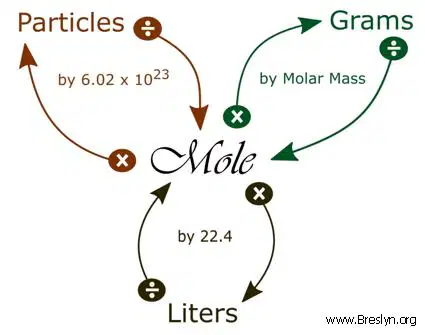
Match the following...
You convert moles to grams by...
multiplying by the molar mass
You convert liters to moles by...
dividing by 22.4L
You convert moles to particles by...
multiplying my avagadro's constant
You convert grams to moles by...
dividing by the molar mass
You convert moles to liters by...
multiplying by 22.4L
True/False: Before you begin, you must be sure your equation is balanced
True
False

Converting from gram A to gram B, the first step is to
Convert from mole A to mole B
Convert from mole B to gram B
Convert from gram A to mole A

When you multiply for each step you are using a fraction, called a
conversion factor
percentage
multiplier
prefix
What percentage of the total atomic mass of carbon monoxide (CO) is composed of carbon?
29%
43%
57%
73%
What percentage of the total atomic mass of carbon monoxide (CO) is composed of oxygen?
29%
43%
57%
73%
What percentage of the total atomic mass of magnesium bromide (MgBr2) is composed of magnesium?
13%
43%
63%
87%
What percentage of the total atomic mass of magnesium bromide (MgBr2) is composed of bromine? Hint - consider the mass of both atoms of bromine in your calculation.
13%
43%
63%
87%
What percentage of the total atomic mass of lithium phosphide (Li3P) is composed of lithium? Hint - consider all three atoms of lithium in your calculation.
13%
29%
40%
60%
What percentage of the total atomic mass of lithium phosphide (Li3P) is composed of phosphorus?
13%
29%
40%
60%
What percentage of the total atomic mass of calcium nitrate (Ca(NO3)2) is composed of nitrogen? Hint - another way to think of calcium nitrate is Ca(NO3)(NO3).
17%
24%
29%
59%
2.40 g of an explosive, J, contains 0.473 g of nitrogen. J also contains 33.8% carbon and 1.41% hydrogen by mass. The remainder of J is oxygen.
What is the empirical formula of J?
C4HNO2
CH2N2O
C2HNO2
CHNO
Calculate the percent water in strontium chloride hexahydrate
6.76%
59.45%
68.21%
40.55%
S2O4
C2H4
SO2
SO3
SO4
A sample contains 36.95 g of mercury (Hg) and 13.05 g of chlorine (Cl). What is the empirical formula for this compound?
HgCl2
Hg3Cl
Hg17Cl36
HgCl
What is the empirical formula if you have 36.84% nitrogen and 63.16% oxygen?
NO
N2O4
N2O3
N2O5
What is the empirical formula for P2O6?
P2O6
PO
PO3
P3O
What is the molecular formula for a compound with the empirical formula: K2SO4 and a molecular mass of 696g.
K2SO4
K8SO16
K8S4O8
K8S4O16
What is the molecular formula if the empirical formula is CH2O and the molecular molar mass is 180.18?
CH2O
C2H4O2
C4H8O4
C6H12O6
Determine the empirical formula of a compound containing 63.50 % silver, 8.25 % nitrogen, and the remainder oxygen.
AgNO3
Ag2NO3
AgNO2
Ag2N2O5
What is the empirical formula for Si2F6?
SiF
Si2F6
SiF3
Si6F2
Which of the following could be a molecular formula with the empirical formula of CH2O?
CH2O2
CHO
C3H5O3
C2H4O2
What is the empirical formula of Na2SO4?
Na2SO4
NaSO2
Na2SO2
NaSO8
The actual number of atoms in a compound.
MOLECULAR FORMULA definition
The simplest reduced ratio of elements in a compound.
EMPIRICAL FORMULA defintion
N2O4
MOLECULAR FORMULA example
NO2
EMPIRICAL FORMULA example
MATCH THE EMPIRICAL AND MOLECULAR FORMULAS.
N2O8
NO4
A compound is found to be 69.6% iron (Fe) and 30.4% oxygen (O) by mass. What is the empirical formula of the compound?
FeO
Fe2O3
Fe3O4
FeO2

