
Font size
 Worksheets
Fast and Curious: India
Total questions: 12
Worksheet time: 12mins
Mohenjo-daro and (a) were the two largest cities in the Indus River Valley civilization.
The Indus River Valley probably began around (a) years ago. Artifacts such as weights and scales were probably used to measure (b) and represented a standard money system in the Indus River Valley. The Great Bath was probably used in (c) rituals. More than 400 (d) have been found on stone seals, but archaeologists are unsure of what they mean. Mohenjo-daro had an advanced (e) system made of brick pipes to get rid of waste.
Monsoons were seasonal ____ that had a large influence on India's climate.
winds
rain
fires
hurricanes
Most of the Indus River Valley civilization is in modern day
Pakistan
India
Afghanistan
Iran
Sometime around 1900 b.c., the people of the Indus Valley began to (a) their cities and villages. Why did the people leave? Archaeologists have found several possible causes. There was a severe (b) that lasted for hundreds of years. It destroyed crops and caused people to starve. (c) and floods killed many more people and changed the course of the Indus River. Meanwhile, groups of people called the (d) migrated to India. Soon a new (e) emerged.
The (a) were not a race or ethnic group. Many historians believe that the Aryan people's language was part of a large language family known as Indo-European. A language family is a group of similar (b) . Many modern Indian languages, like (c) , are part of the (d) family. So are many European languages, including (e) . The Aryans were speakers of Indo-European languages.
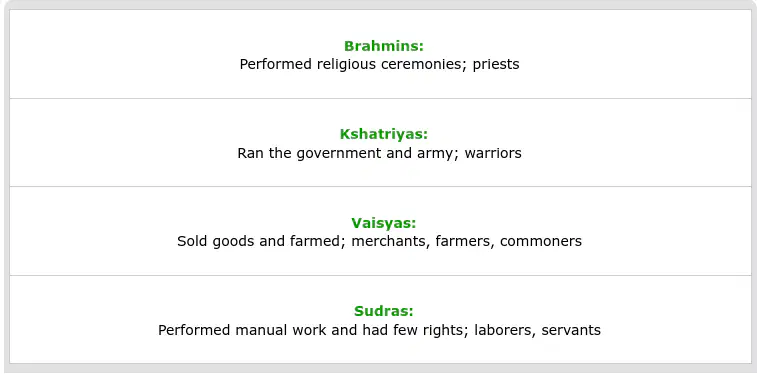
This image shows the social classes of ancient Indian society, also known as the (a)
Hinduism (HIHN • doo • ih • zuhm) is one of the world's (a) religions. It is also the (b) largest religion, after (c) and Islam. Hinduism has no one (d) and no one holy book. Hindus usually pay respect to the (e) . They also take part in religious rituals, either at home or in a local temple.
During the 500s BC, Siddhartha Gautama founded this religion that included the practice of meditation
Hinduism
Buddhism
Jainism
Islam
Around 321 BC, after Alexander the Great left India, Chandra Gupta became the first ruler of the ____ Empire.
Mauryan
Gupta
Indus River Valley
Aryan
Reorder the following in chronological order
India's first civilization began in the valley around the Indus River. The Indus Valley civilization is called the cradle of ancient India
The Aryans, part of the Indo-europeans, migrated into India, where the lived in tribes, many around the Ganges River.
the founding of Buddhism
Chandra Gupta became the first ruler of the Mauryan Empire.
Chandra Gupta's son, Ashoka, promoted Buddhism throughout the empire.

India is an example of a ____ , a large landmass that is smaller than a continent.
subcontinent
island
river valley
isthmus

