
 Worksheets
Smile Mastery's Virtual Trivia Night
Total questions: 27
Worksheet time: 2hrs 15mins
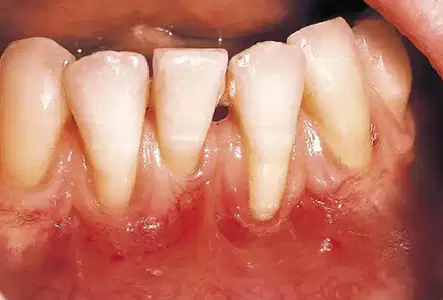
A 30 year old woman came in with the complaint of gum recession and sensitivity on lower front teeth.
She remembers noticing slight recession 3 years ago. She feels it has worsened over the last 12 months. There has recently been some sensitivity to hot and cold and gingival soreness, most noticeably on tooth brushing and eating ice cream.
How is gingival recession measured?
From CEJ to free marginal gingiva
From gingival margin to junctional epithelium
From gingival margin to depth of sulcus
From CEJ to mucogingival junction
How would you measure the total width of attached gingiva?
A: From CEJ to mucogingival junction
B: From free gingival margin to mucogingival junction minus pocket depth
A + B
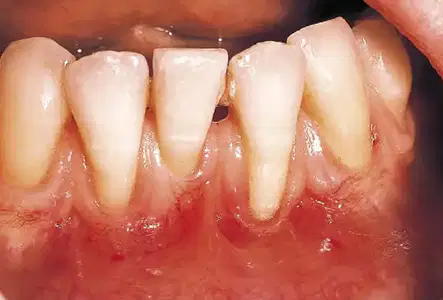
Which of the following treatment gives the most aesthetic and predictable outcome for gingival recession?
Connective tissue graft
Free gingival graft
Lateral pedicle flap
Double papilla flap
A patient, when in full intercuspation, shows a right side posterior crossbite and a lower midline that is deviated to the right. At initial contact, there are bilateral posterior crossbites and coincident midlines.
The most likely cause of this finding is
Temporomandibular dysfunction
Two ideal occlusions
True unilateral crossbite
Occlusal interference and functional shift

The greater palatine foramen is usually located at
(a)
A fracture in the porcelain of a porcelain fused to metal crown may be caused by
Sharp line angles in the tooth preparation
Lack of parallelism of axial walls
Excessive metal thickness
Sharp line angles in the metal under the porcelain
A partial denture which fits the master cast may fail to sit correctly in the mouth due to
Contraction of the metal framework during casting
Failure to block out undercuts
Distortion of impression
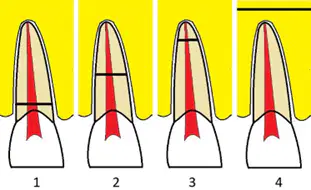
The above diagram shows 4 dentoalveolar fracture scenarios in permanent teeth.
Which one of the splinting protocols is correct?
A
All the 4 scenarios need 4 weeks splinting
B
Scenario 2, 3 may need one month splinting
C
Scenario 1 may need 4 months splinting.
D
The tooth should be extracted in scenario 1.
E
B & C are correct
Intermittent painful swelling in the submandibular region that increases at meal time is indicative of
Blockage of Wharton's duct
Blockage of Stensen's duct
Ranula

Following implant surgery in the lower left second premolar position, the patient reported unpleasant and painful spontaneous sensations in the area circled.
The patient`s symptom is best described as
Anaesthesia
Hyperalgesia
Neurapraxia
Dysaesthesia
What is the minimum height (h) and width (w) of bone required to accommodate implant of 4 mm in diameter?
10 mm h, 6 mm w
15mm h, 7 mm w
10mm h, 5 mm w

Which is the most commonly used veneer preparation?
(a)
Areas of isolated gingival recession are most frequently seen in which of these common scenarios?
Non vital tooth
Labially prominent in arch
Ankylosed
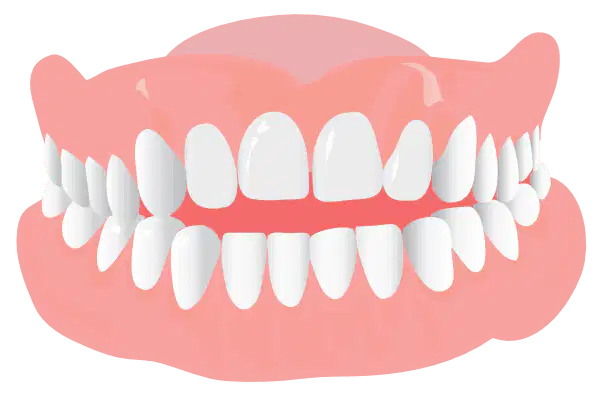
While issuing a complete denture, the above scenario is encountered due to
The use of anterior teeth of too short of a length
The posterior of the lower occlusal rim lifting away from the mucosa during the recording of jaw relationship
The posterior of the lower occlusal rim lifting away from the mucosa during the recording of jaw relationship
Which of the following indicates with greatest reliability that the pulp is non vital?
No response when EPT is applied to the tooth
No response when ice crystals applied to the tooth
Area of radiolucency surrounding apex of the tooth
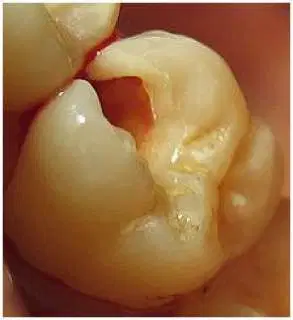
Unsupported enamel should be
Protected by the restoration
Reduced in height
Finished at 90 degree to the tooth surface
Removed
Patient experiences pain and gingival swelling in the anterior segment of the mandible.
The mandibular lateral incisor has a shallow restoration, is tender to percussion and gives a positive response to the electric pulp tester. There is Grade I mobility.
The most likely diagnosis is
Acute apical abscess
Lateral periodontal abscess
Chronic ulcerative pulpitis
Acute suppurative pulpitis

A 13-year-old patient was referred to you at the end of her orthodontic treatment for upper lip frenectomy. The frenum itself is fleshy and has attachment at the gingival papilla.
Which of these statements is correct?
It would have been more ideal to perform the frenectomy 2 years earlier prior to orthodontic treatment.
Z-plasty is the technique of choice for a thick frenum.
A fleshy frenum should be excised using diamond excision technique.
If possible, laser excision is the preferred technique for frenectomy.
What is a zip perforation?
A perforation caused by the tip of a file that was used too heavily
A perforation of the pulp chamber floor, often caused by making the access cavity too deep
A perforation caused by the side of a file going round a curve
Which statement about post preparation is incorrect?
Post is needed if there is inadequate coronal tooth structure
Posts reinforce the tooth and prevent vertical fracture
Post retains core in the tooth with extensive loss of coronal structure

Following a sport injury, the permanent incisor has intruded in its socket.
Which of the following treatment options is incorrect?
Surgically reposition the tooth with forceps.
Flexible passive splint for 4 weeks once repositioned surgically.
Orthodontic extrusion.
Root canal treatment should be started 2 weeks
after injury or as soon as the tooth position allows.
None of the above.
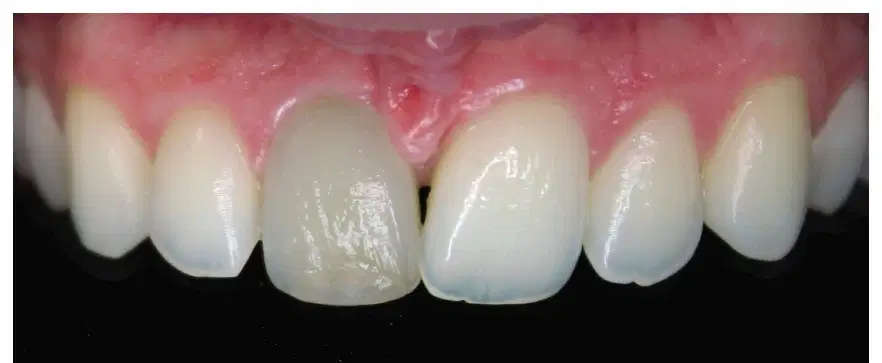
A patient complains of the discolouration of an unrestored maxillary central incisor.
Radiographically, the pulp chamber and the root canal space are obliterated, there is no evidence of caries and the periodontal ligament space appears normal.
An external bleaching procedure has not been successful.
The most appropriate management would be to
Fabricate a porcelain veneer
Perform root canal treatment and fabricate a porcelain veneer
Perform root canal treatment and fabricate a post retained porcelain fused to metal crown
Which space infection can produce the most pronounced swelling of the soft palate?
Pterygomandibular
Peritonsillar
Buccal
Submassetric
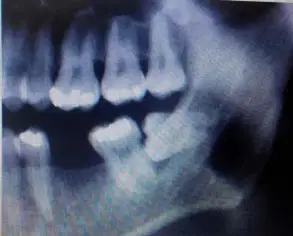
A 24 year old male is referred for a second opinion on the need to remove his lower third molar teeth.
Patient had two episodes of pericoronitis previously.
The first episode was relatively mild whereas the second episode, about 3 months ago, was associated with inability to open the mouth and facial swelling.
Patient required a course of oral antibiotics.
Which of the classification describes the case seen above?
Class 1, position C, horizontal impaction
Class 1, position B, mesioangular impaction
Class 2, position B, mesioangular impaction
In Winter’s WAR lines, which coloured line indicates the amount of bone & tooth that will have to be removed before elevation of the tooth?
(a)
A 28 year old female patient comes to the dental clinic requesting to close the gap on upper right back tooth region.
On examination, her upper right second premolar is missing, extracted due to failed root canal treatment 2 years ago.
Patient wants to get the space filled as it is visible during speech.
All four first premolars are missing as well as they were extracted for orthodontic treatment in her teens and the spaces were closed successfully.
There are composite restoration on mesio occlusal surface of 16, 13 and 26 respectively.
The first molars and the incisor teeth are in Class I occlusion, with canine guidance in left lateral excursion.
Which is an ideal conservative replacement for this patient?
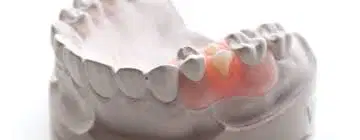
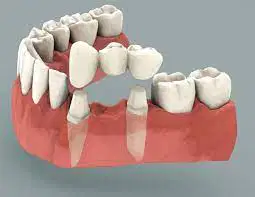

For this patient, a simple cantilever design was chosen using 16 as an abutment which has a mesio occlusal restoration.
Which if the following is false with regards to maximizing the bonding of the indirect restoration?
Maintain the existing restoration
Remove the existing restoration

