
 Worksheets
Waves
Total questions: 26
Worksheet time: 18mins


Which diagram - A, B, C, or D - represents the appropriate hand movements and patterns for a longitudinal wave?
A
B
C
D
A wave is present in a slinky. A coil of the slinky makes 12 complete up and down cycles of vibration in 4 seconds. The period of this wave is _____ and the frequency is _____.
4 seconds; 3 Hz
3 seconds;
0.333 Hz
4 seconds; 0.25 Hz
0.333 seconds;
3 Hz
Definition: Crest
The highest point of a transverse wave
The lowest point of a transverse wave
The center of a transverse wave
The distance between two points on a wave
What is the frequency of a wave?
# of oscillations produced in a certain amount of time
The distance the wave oscillates from it's resting position
The lowest point of a transverse wave
Resting point of a wave - no wave movement
What is the amplitude of a wave?
Where there is no wave movement
The distance the wave oscillates from it's resting position
A disturbance that transfers energy from one place to another
The distance between two corresponding parts of a wave
What is a medium?
The lowest point of a transverse wave
The size of a wave
The middle of a wave
Matter through which a wave travels
What type of matter can waves travel through?
Solid
Liquid
Gas
All of the Above
ex. police car siren sounding lower pitch after the car passes
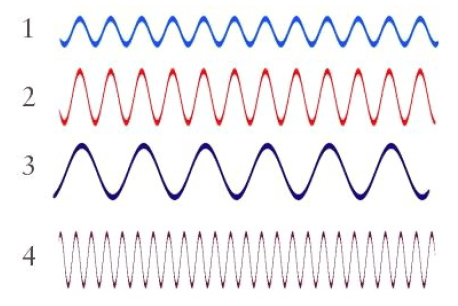

What type of interference is represented in this diagram?
Constructive
Destructive
Wavelength and Frequency have a(n) ________________ relationship.
Direct
Inverse
Exponential
No relationship.
What equation (tool) can you use to find the frequency of a wave?
γ = v/f
f = 1/p
p = 1/f
γ = γ*f
The period of a wave is...
the amount of time it takes to complete one full cycle of a wave.
the amount of cycles a wave will complete in a given time.
the length of a wave from crest to crest or trough to trough
the amount of displacement a wave undergoes
What is being transferred with a wave?
medium
energy
matter
Chicken
Increasing the amplitude means you are increasing the _______________ of a wave.
frequency
amplitude
energy
wavelength
Longitudinal waves move:
at a right angle compared to the direction the wave is traveling
in a circle compared to the direction the wave is traveling
matter
in the same direction as the wave is traveling
A wave with a large wavelength will have a ______ frequency and _____ energy
high, low
high, high
low, high
low, low
What is the resting position?
A disturbance that transfers energy from one place to another
The distance between two corresponding parts of a wave
The distance the wave oscillates from it's resting position
Where there is no wave movement

