
 Worksheets
Blood and bone forensics
Total questions: 41
Worksheet time: 32mins
Which of the following do blood experts analyze to determine the crime? Mark all that apply.
direction of blood
angle of blood spatter
blood source height
blood patterns - gush, swipe, smear, shadow void
blood type
An allergic reaction where red blood cells clump together,
ABO
Plasma
Agglutinate
Secretors

Which blood type is the "universal donor"? (can give to any type)
A
B
AB
O
A basic blood factor, independent of ABO types. Gives Blood types their + or -.
Plasma
Rh Factor
Chemiluminescence
Erythrocytes

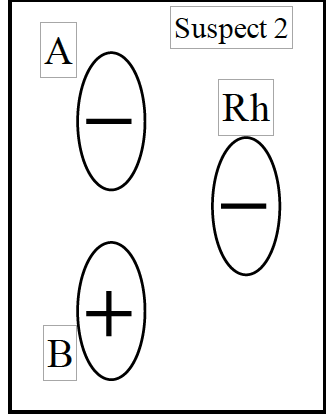
What is the blood type?
O-
AB-
AB+
O+
Which of these would you classify as High Velocity Spatter?


Which blood cell has DNA in it?
red blood cell
white blood cell
platelet

As the angle of impact gets smaller, what happens to the tail?
Gets longer
Gets shorter
Stays the same

This blood typing test shows that the person has which blood type?
A+
A-
B+
B-
AB+
Blood type is considered what type of evidence?
Class
Individual
Direct

The following drops can tell you:
direction of travel
weapon used
age of drop
source of blood
What type of antigens can be found on the surface of RBC's when someone has blood type O?
A
B
AB
none
Who were blood types discovered by in 1901?
Ben Landsteiner
Karl Landsteiner
Kastle Meyer

These proteins are found on the surface of red blood cells and they provide self identity
antibodies
DNA
phospholipids
antigens
RBCs with no A or B antigens are what blood type?
A
B
AB
O

What is the blood type?
O+
B+
AB-
AB+
You can tell the age of a skeleton by looking at...
the length of the femur
the number of fused bones
the shape of the pelvis
the color of bone
In general, a female skeleton will have a pelvis that is (wider/narrower) than a males.
wider
narrower
Which bone is most commonly used to determine the height of the deceased?
sternum
femur
clavicle
humerus
You can tell if a person is right or left handed from the bones?
True
False
Wearing at joints at certain points on the skeleton can give you cues about the person's...
height
gender
ancestry
weight
If a forensic anthropologist uses their thumb to check the width of a notch on the pelvis, they are trying to identify the...
age
gender
ancestry
weight
The sagittal suture in the skull can be investigated to determine...
age
gender
ancestry
weight
Compared to a male, the jaw of a female is...
round
square
flat
jutting
The skull of somone with African ancestry would likely have a ____________ eye orbital than European ancestry..
wider
narrower
Tissue depth markers are used to determine what on a skull?
the length of the nose
the size of the ears
the amount of flesh on the bone
the color of the skin
To reconstruct a face, which of the following characteristics can NOT be determined from the skull?
shape of the ears
shape of the jaw
position of the cheekbones
width of the eyes
If a person has missing teeth, the appearance of the cheeks and jaws will appear:
distorted
wider
sunken
darker
The field of science that would be involved in identifying skeletal remains is called...
facial reconstruction
anatomy
forensic antrhopology
anthropology physiology

Name the red bone.
(a)

Name the red bone.
(a)

The highlighted bones are the:
Humerus
Radius
Ulna
Scapula

What are these bones (blue) called?
Tarsals
Carpals
Metatarsals
Metacarpals

The bones (green) are technically called:
The skull
The head
Parietals
The cranium

The highlighted bones are known as:
Humerus
Radius
Ulna
Fibula

The bone (in green) is known as the:
C1 Vertebra
Mandible
Hyoid
Trachea
If you wanted to find the ulna, you would look in the
leg
skull
arm
foot
Besides the pelvis, what is another skeletal feature that assists in determining gender?
Male skeletons don't have breast bones.
Female skeletons have three less ribs than male skeletons.
A female's chin is more rounded and v-shaped than a male's.
A male's eye sockets are bigger than a female's.

