
 Worksheets
Friction
Total questions: 9
Worksheet time: 8mins
In case of friction, the true statement is,
The total friction that can be developed is independent of the magnitude of the area of contact.
The total frictional force that can be developed is proportional to the normal force transmitted to the contact surface.
For low velocities, the total friction that can be developed is practically independent of velocity.
All of the these.
A car starts from rest on a curved road of 250 m radius & accelerates at constant tangential acceleration of 0.6 m/s2. The time & the distance for which the car will travel when the total acceleration is 0.75 m/s2, is,
17 sec & 90 m
17.68 sec & 93.63 m
18 sec & 95 m
18.68 sec & 93.63 m
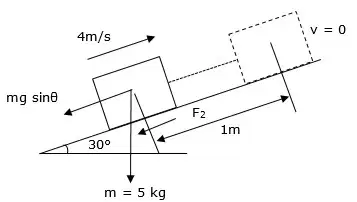
A block of mass 5 kg is thrust up a 30° inclined plane with an initial velocity 4 m/s. It travels a distance of 1m. The force of a friction acting on it would be, (a)
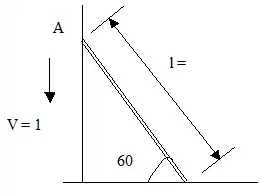
A rod of length 'l' is sliding in a corner as shown in figure at an instant the velocity of the point A is 1 m/s and rod makes an angle of 60° with the horizontal. The angular velocity of rod at this instant is,
2 rad/s
1.5 rad/s
0.5 rad/s
0.75 rad/s
The maximum speed of a car without skidding, on a banked road in terms of radius 'r' of the curve, the banking angle θ & the angle of friction (f) between the tyres & road is,


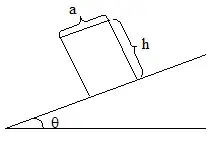
A uniform rectangular block with height h and width a rests on an inclined surface whose coefficient of static friction is μ. If we slowly increase the angle of inclination, θ, what should be the relationship between a, h and μ for the block to tip over before sliding down the surface? (Civil services)
μ = ah
μ < a/h
μ < h
μ > a/h
A body of weight 120 N rests on a rough horizontal surface (μ = 0.3) and is acted upon by a force applied at an angle of 30 degree to the horizontal. The force required to just cause the body to slide over the surface is about (a)
A block of weight W resting on a table (static friction coefficient f) does not more when a horizontal force T is applied to it. Which of the following conditions must hold: (Gate-87)
T = efw
T = W
T = fW
none of the these
Two spheres of equal weight are dropped simultaneously from the same height but in separate paths. The sphere dropped in the bath of water reaches the bottom before the sphere dropped in the bath of oil because (Civil Services)
the terminal velocity of the sphere in the bath of oil is less than that of the sphere in the bath of water
the specific gravity of oil is greater than 1
water has a greater viscosity
the terminal velocity of the sphere in the bath of oil is less than that of the sphere in the bath of water and the specific gravity of oil is greater than 1

