
Font size
 Worksheets
e-Worksheet: The Zeroth Law and First Law of Thermodynamics
Total questions: 13
Worksheet time: 10mins

The sum of the (Kinetic EnergyParticles + Potential EnergyParticles) in a system, is the _____ _____ of the system.
(a)

Measuring the average kinetic energy of all the particles in the beaker of water is measuring the (a) of the water.

_____ _____ is the total kinetic energy of the random motion of the atoms or molecules composing the water.
(a)

One way to change a body's internal energy(U) is to have heat transfer between bodies. In the Figure shown with the lavender blocks in thermal contact, heat transfer would _____.
flow from left to right
flow from right to left
go back and forth between the 2 objects
not flow between the 2 objects.

The internal energy(U) of a body depends upon which of the following properties? _____.
Physical State of Matter
Material Composition
Temperature
Internal energy depends upon all of these properties.
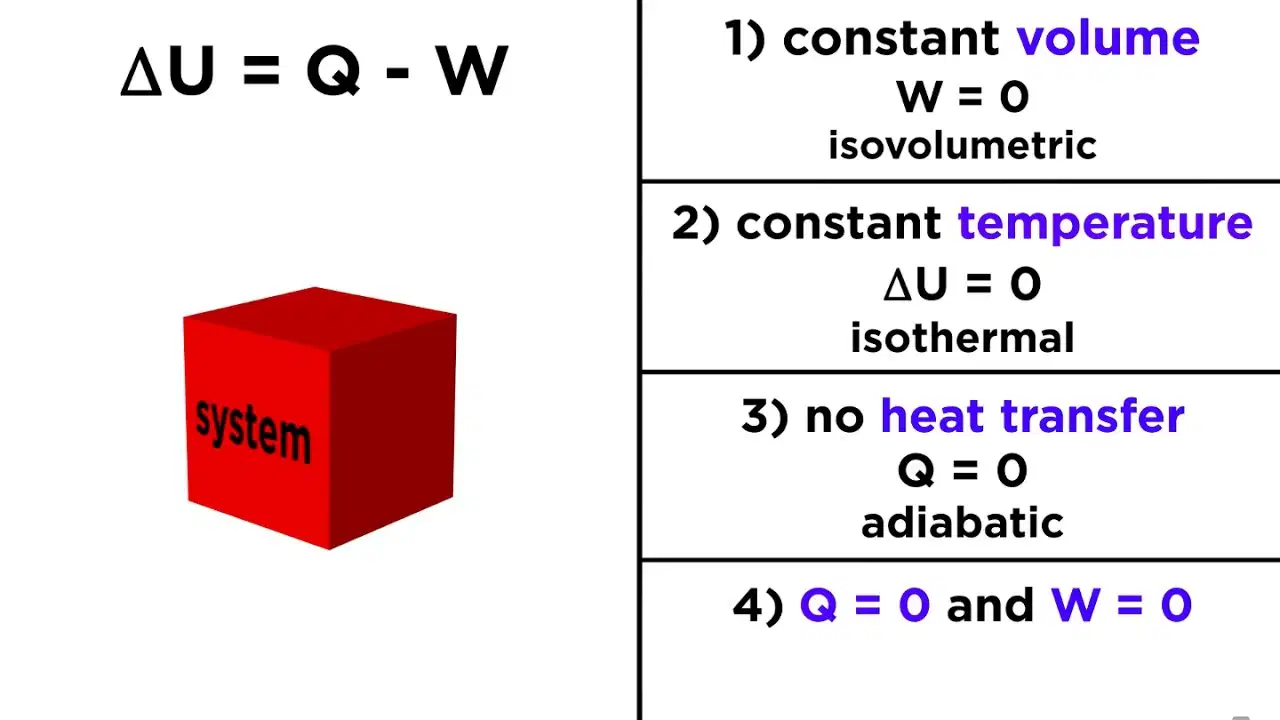
Essentially, the (a) is the Law of Conservation of Energy applied to a thermal system.

A(n) (a) is a well-defined set of atoms, molecules, particles or objects.
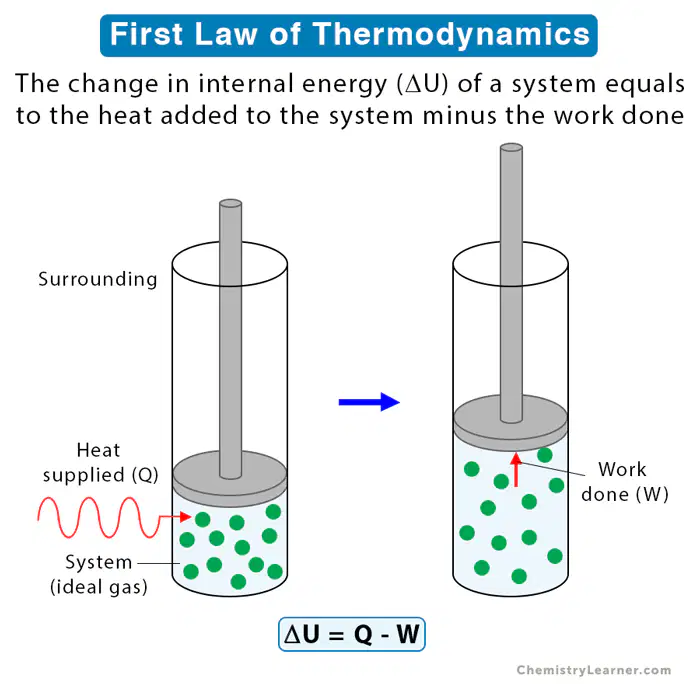
The mathematical equation, using symbols, representing the First Law of Thermodynamics is _____.
U1 + U2 = W + Q
Δ U = Q - W
W2 - W1 = Q - ΔU
Δ U = Q + W

Work(W), a form of energy, is considered as (a) (word) when work is done on the system.

Which piston in the Figure (b), represents the motion of air particles inside the piston, if it is in thermal contact with a heat source, at the bottom? The _____ piston, represents the motion of heated air particles.
right
left
both
neither

In the Figure(b) shown, if heat(Q) is in thermal contact with the piston, Q is _____.
added to the system; therefore, Q is negative
removed from the system; therefore, Q is positive
added to the system; therefore, Q is positive
removed from the system; therefore, Q is negative

A sample of gas does 200 J of work against its surroundings. If the system loses 110 J of internal energy in the process, does the sample of gas gain or lose heat energy? The sample of gas (a) heat energy.
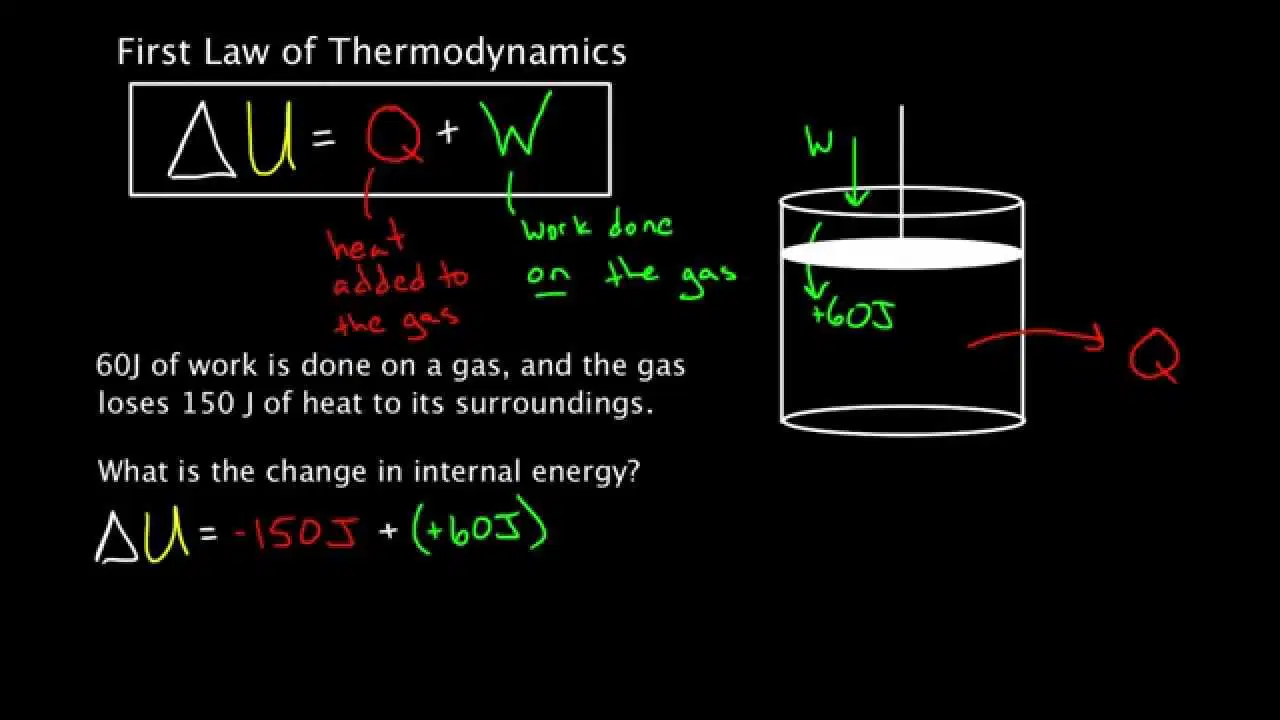
A sample of gas does 200 J of work against its surroundings. If the system loses 110 J of internal energy during the process, how much heat was involved in this process? _____ was involved in this process.
90 J
310 J
-90 J
-310 J

