
 Worksheets
MOY Sci CBA review: Forces*Circuits*Patterns*Changes*Resources
Total questions: 38
Worksheet time: 38mins

What is it called when weathered rock is carried away?
weathering
erosion
deposition
breaking

What is an enormous mass of ice moving over land, causing weathering of rock and soil?
A glacier
An iceberg
A mudslide
A sand dune

Which is the best way to make these rocks smooth in a lab?
Put them in a freezer and shut the door
Bury them in a garden and sprinkle water over them
Put them in a bucket of water and shake it
Put them in a bucket of water and let it sit
Rain washing away soil from a hillside downwards
weathering
erosion
deposition

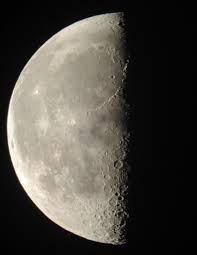
Waning Crescent
Third Quarter (or last quarter)
New Moon
First quarter


Which part of Jacob and Angelina’s model represents cloud formation in the water cycle?
Tiny drops of water forming at the top of the bottle
Drops of water running down the side of the bottle
The lamp shining on the bottle and the water
Water sitting in the bottom of the bottle
Which part of Jacob and Angelina’s model would cause the water to evaporate?
Tiny drops of water forming at the top of the bottle
Drops of water running down the side of the bottle
The lamp shining on the bottle and the water
Water sitting in the bottom of the bottle

Which of the following correctly identifies the part of the water cycle specified in the diagram?
precipitation
condensation
transpiration
evaporation
___ is when the Sun heats the water in rivers, lakes, or oceans and turns it into steam
evaporation
condensation
transpiration
groundwater

2. By changing the surface over which the car rolls from sandpaper to wax paper, you might be able to test the effect of what force?
A. Magnetism
B. Wind
C. Wind
D. Friction
Damon was testing the amount of time leaves take to fall to the ground after being tossed up into the air. What force made the leaves fall to the ground?
Seasons
Friction
Magnetism
Gravity
An icy sidewalk will have ______ friction.
More
Less
A softball is tossed outside a window. Which two forces will act on the ball's motion as the ball flies and then hits the ground?
gravity and friction
friction and heat
magnetism and gravity

In the picture above, the magnet is pick up iron filings. This is an example of _________.
a noncontact force
a contact force
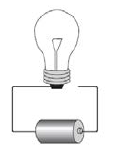


A group of students built the circuit shown above. The lightbulb does not glow. Which statement explains this observation?
The battery is not charged
The lightbulb is not part of a complete circuit
The circuit does not have a switch
The bell uses most of the energy from the battery
What changes when the seasons change? Choose THREE correct answers.
Temperature
Sun getting hotter
Number of daylight hours
Weather
Moon getting farther away from Earth
Which is a characteristic of summer?
Longer daylight hours
Shorter daylight hours
Full moon
Which data describes only the weather, not the climate?
a line graph of average temperatures during the year
a bar graph of average precipitation during the year
a map that shows the temperature today across Texas
a circle graph that shows the average number of sunny, cloudy, and rainy days during the year
The teacher asks Harmony to research the climate of Lubbock, Texas. Which subjects should Harmony include in her research? Select TWO correct answers.
safety rules when severe weather occurs
the months when tornadoes are most likely to strike
the weather forecast for next week
the appearance of clouds that produce rain
the average temperature and precipitation throughout the year
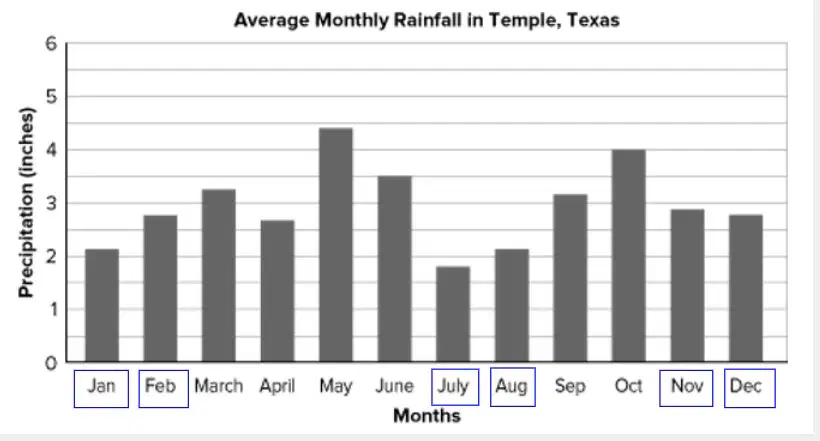
Observe the graph of average monthly rainfall in Temple, Texas. Which months have the LEAST rainfall? Select THREE correct answers.
December
January
November
July
August
Which process is primarily responsible for the formation of sand dunes?
Erosion by water
Deposition by wind
Freezing and thawing of ice
Sedimentation by rivers

What is a delta, and how is it formed?
A large hole created by glaciers
A flat area formed at a river's mouth by sediment deposits
A mountain formed by volcanic activity
A canyon formed by river erosion

How does wind contribute to the changing landscape?
By melting glaciers
By eroding and depositing sediments
By creating earthquakes
By forming volcanoes
What role does ice play in shaping Earth's surface?
It breaks rocks into smaller pieces through freezing and thawing
It causes earthquakes
It creates sand dunes
It forms deltas
What is the primary force that moves sediment in rivers?
Wind
Ice
Water flow
Earthquakes
What is the process of breaking down rocks into smaller pieces called?
Deposition
Erosion
Weathering
Sedimentation
Which of these locations is most likely to have a canyon?
A flat desert
A mountainous region
A coastal area
A river valley
One advantage to solar power is that solar power does not create ______________.
Pollution
Garbage
Sewage
Biomass
Which statement BEST describes the main advantage of using fossil fuels for energy?
Fossil fuels can be created on farms and ranches.
Fossil fuels are renewable resources that are easy to obtain.
Fossil fuels are energy-rich and convenient to use.
Fossil fuels release little or no pollution.
Where would solar power NOT be a good choice for generating electricity? Choose TWO correct answers.
plains that are hot in summer and cold in winter
a shady section of a forest
a sunny desert
a northern town that has two months of darkness
a Texas suburb
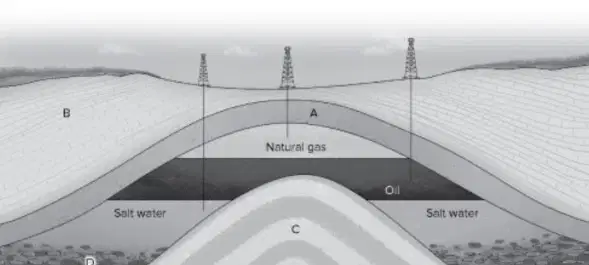
Observe the underground cross section shown here. Which layer of impermeable rock keeps the oil underground and must be penetrated to tap the oil?
Layer A
Layer B
Layer C
Layer D

