
Font size
 Worksheets
ISME Exam 1
Total questions: 84
Worksheet time: 42mins
Both steel and iron are carbon-alloys
True
False
The carbon contain in T10 tool steel is about ____.
10%
1%
.1%
Both brass and bronze contain copper.
True
False
Atoms in most metals have a ____ structure.
molecular
crystalline
amorphous
Generally speaking, which structure has a better ductility (ability to deform with fracture)?
FCC
BCC
SC
Equal
Generally speaking, metals have _____________ thermal conductivity than plastics.
higher
lower
On Boeing 787 airplanes, which type of material is used the most?
Metals
Composites
Plastics
Cermanics
What materials are used to mint the 25-cent coins now?
Ag
Cu + Ag
Cu + Ni
Ag + Ni
Density is one of material's ___________
Physical Properties
Mechanicals properties
If we let the young’s modulus of AISI 4140 steel be 1, which value will most likely be the young’s modulus of plastics?
.1
1
10
Can the young’s modulus of a material be greatly changed by manufacturing processes?
Yes
No
Can the yield strength of a material be greatly changed by manufacturing processes?
Yes
No
Can the ductility of a material be greatly changed by manufacturing processes?
Yes
No
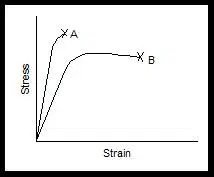
Which material has a lower elastic modulus?
A
B
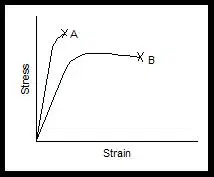
Which material has a lower yield strength?
A
B
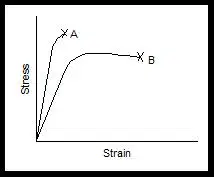
Which material has a lower tensile strength?
A
B
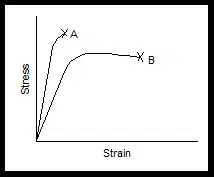
Which material is less ductile?
A
B
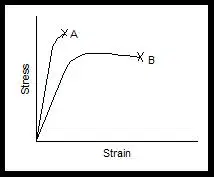
Which material has a lower toughness?
A
B
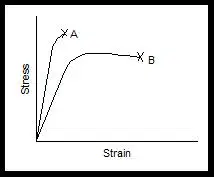
Which material is more likely to be bronze while the other one being cast iron?
A
B
Why did you feel hard to bend the copper tubing (or other specimen) back to shape?
Young’s modulus increased by strain hardening
Yield strength increased by strain hardening
Generally speaking, as tensile strength increases, material’s ductility _________________
increases
decreases
Generally speaking, as tensile strength increases, material’s hardness ____
increasees
decreases
Which one of the following is NOT among the purposes of heat treatment?
To increase the strength and hardness.
To decreases the strength and hardness.
To harden only the surface of a part without changing the interior properties.
To alter the shape of a part.
In the Iron-Carbon Equilibrium Diagram, which one of the following phases exists at a high temperature (> 912°C) environment?
Ferrite
Austeinite
Cementite
Which one of the following represents the most common heat treatment processes?
Hardening
Softening
Which of the following order represents the hardness order (from hardest to softest) of the structures?
Martensite > Pearlite > Bainite.
Pearlite > Bainite > Martensite.
Martensite > Bainite > Pearlite.
Bainite > Pearlite > Martensite.
Which one of the following quenching media quenches fastest?
Water
Oil
Air
Surface hardening is helpful to create components that must have a very ____ surface to resist wear and a ____ interior to resist the impact that occurs during operation.
hard, tough
soft, tough
hard, soft
soft, soft
Which heat treatment process will give the maximum ductility to a machined metal part?
Tempering
Normalizing
Full annealing
Generally speaking, when heat treatment of steel parts, the faster the cooling rate, the ____________ the parts will be after the heat treatment.
harder
softer
Which one of the following heat treatment methods CANNOT improve the treated metal’s machinability?
Annealing
Quenching
Normalizing
In tempering, the workpiece needs to be heated to _______________.
above the upper transformation temperature (A3-Acm)
below the lower transformation temperature (A1)
In between the two critical transformation temperatures
In full annealing, the workpiece needs to be heated to _______________.
above the lower transformation temperature (A1)
below the lower transformation temperature (A1)
Typically, the brittleness of the steel _____________ when tempering temperature decreases.
increases
decreases
Normalizing gives ___________________ steel than full annealing.
weaker and more brittle
stronger and more ductile
weaker and more ductile
stronger and more brittle
To study the effects of cooling rate on steel crystallization structure, it is needed to heat the steel into _____________ first.
bainite
austenite
martensite
pearlite
steel bar (carbon content known) is heated to a certain temperature and kept at that temperature for a long time (say, five hours). Which diagram would you use to find out the crystallization structure of this steel at that temperature?
Equilibrium phase diagram.
Time-Temperature-Transformation (TTT) diagram.
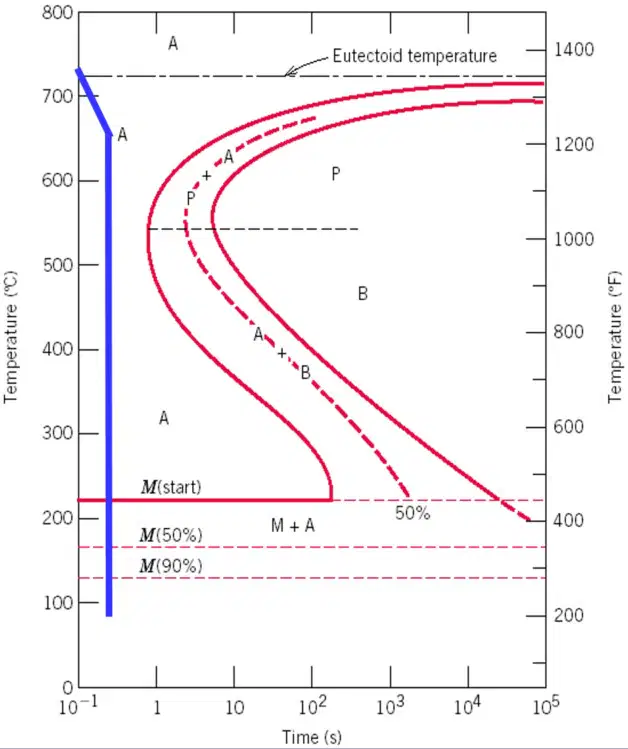
Please write down the steel microstructure by following the cooling curve:
Fully Martensite
Fully Bainite
Fully Austenite
50% Bainite +50% Martensite

Please write down the steel microstructure by following the cooling curve:
Fully Martensite
Fully Bainite
50% Bainite +50% Martensite
Fully Austenite
Please write down the steel microstructure by following the cooling curve:
Fully Martensite
Fully Bainite
50% Bainite +50% Martensite
Fully Austenite
Measuring and gauging is used__________________
in all phases of manufacturing.
only on final products.
____________ is the degree of consistency achieved with a measurement device when thesame person uses it to measure a same dimension several times.
Reproducibility
Repeatability
Which of the following will be the best material to make gage blocks to maintain their high accuracy for everyday use in manufacturing plants?
Carbide Steel
Silver
Cermanic
The inspection can be done in two ways: by attributes or by variables. Surface roughness measurement is done by ________________.
attributes
variables
Tolerance is usually ___________________.
defined by product designers.
measured on a batch of products.
Normal distribution can be presented as a bell-shaped curve. The center location of the curve is determined by _______________.
the mean
the variance
the standard deviation
Shafts and wheels on a locomotive have to transmit high torque, so they have to be in a__________ fit.
clearance
interference
transition
Which one is the newest member as the five basic material processing families?
casting
Additive manufacturing.
forming
joining
Which one of the following is NOT a distinct advantage of casting as a material processing means over the others?
Complex shape.
Superb surface finish.
Very large parts.
Difficult-to-machine parts.
Casting is used for __________
prototyping
mass production
both prototyping and mass production.
In a two-part sand casting system, the top part is called a _____ and the bottom part is call a _____.
cope, drag
drag, cope
flask, drag
cope, flask
The size of a pattern is __________________ the size of the part to be cast.
smaller than
larger than
the same as
Which one of the following effects is NOT associated with casting?
Shrinkage
Strain-hardening.
Melting.
Solidification
A part made by sand casting, in order to be easily removed from the mold, a _____ draft has to be designed.
positive
negative
Which one of the following statements regarding sand casting is FALSE?
Sand casting is the most popular of the casting processes.
Sand casting can produce very large parts.
The dimension precision is the best among all casting processes.
Patterns are always needed in sand casting.
Which one of the following statements regarding investment casting is FALSE?
Investment casting is a complex process and tends to be rather expensive.
Investment casting can produce very large parts.
Extremely complex shapes can be cast as a single piece.
Patterns are always needed in investment casting.
Which one of the following statements regarding die casting is FALSE?
Die casting dies are usually made from tool steels and tend to be rather expensive.
In die casting, to permit removal of the casting, the dies must open, separating into at least two pieces.
Die casting can typically produce parts with excellent dimensional precision and surface qualities.
Patterns are always needed in die casting.
Which one the following casting methods is not usually applied to cast iron with a low fluidity?
Sand casting.
Investment casting.
Die casting.
In a metal forming process, what type(s) deformation would happen?
Elastic deformation only.
Plastic deformation only.
Both A and B.
In a metal forming process, the workpiece must be heated first to conduct the operation?
True
False
In hot working processes, the minimum temperature (recrystallization temperature) should be about____ times the melting point of the metal.
.4
.6
.8
There is significant increase in yield strength and decrease in ductility when a steel workpiece is processed by forming at hot working temperature due to strain hardening effect.
True
False
Casting usually produces parts with grain structure or properties.
isotropic
anisotropic
The hot working parts are most likely to have ______________
isotropic grain structure.
directional oriented grain structure.
Generally speaking, the products of ___________ can only be obtained in a very limited number of standard cross-sectional shapes.
rolling
extrusion
forging
Which of the following forming processes is “like squeezing toothpaste out of a tube"?
rolling
extrusion
forging
Which one of the following groups is a better association?
Open-die forging --> simple shape; Close-die forging --> complex shape.
Close-die forging --> simple shape; Open-die forging --> complex shape.
Suppose surface A has roughness Rmax = 1 μm and surface B has roughness Ra = 0.75 μm. Which surface is smoother?
Surface A
Surface B
Can't Tell
Typically, metal cold-working processes are conducted at a temperature __________.
higher than 0.6 times the melting point
lower than 0.3 times the melting point
about the recrystallization temperature
lower than the recrystallization temperature
In the manufacturing process of chains video, what metallurgical structure do the orange hot chains have when (or right after) run through the induction heat treatment coil before cooled in the liquid?
Bainite
Pearlite
Martensite
Austenite
What heat treatment strategy is applied to making the chains in the video so they are strong but not brittle?
Quench alone
Quench and temper
Quench and normalizing
Quench and annealing
Which category of metal forming processes generally produces increased mechanical strength?
Hot Working
Cold Working
In bending, the metal is deformed ____________________
beyond its yield strength but below its ultimate tensile strength.
beyond its ultimate tensile strength.
below its yield strength.
In shearing, the metal is deformed ____________________
beyond its yield strength but below its ultimate tensile strength.
below its yield strength.
beyond its tensile strength.
beyond its tensile strength but below its ultimate tensile strength.
Both steels and cast irons are iron-carbon alloys. Which one of the following is the major difference between the two?
The carbon content in steels is lower than that in cast irons.
The yield strength of steels is lower than that of cast irons.
The melting point of steels is lower than that of cast irons.
The hardness of steels is higher than that of cast irons.
Gold, silver, copper, and aluminum all have been employed to mint coins. They metals all have __________ crystalline structure. which gives them high ductility.
face-centered cubic
simple cubic
body-centered cubic
hexagonal close pack
Which one of the following heat treatment methods CANNOT improve the heat treated metal’s machinability?
Quenching
Annealing
Normalizing
Tempering
Which of the following order represents the correct hardness order (from hardest to softest) of the structures of the same alloy?
Martensite > Pearlite > Bainite.
Pearlite > Bainite > Martensite.
Bainite > Pearlite > Martensite.
Martensite > Bainite > Pearlite.
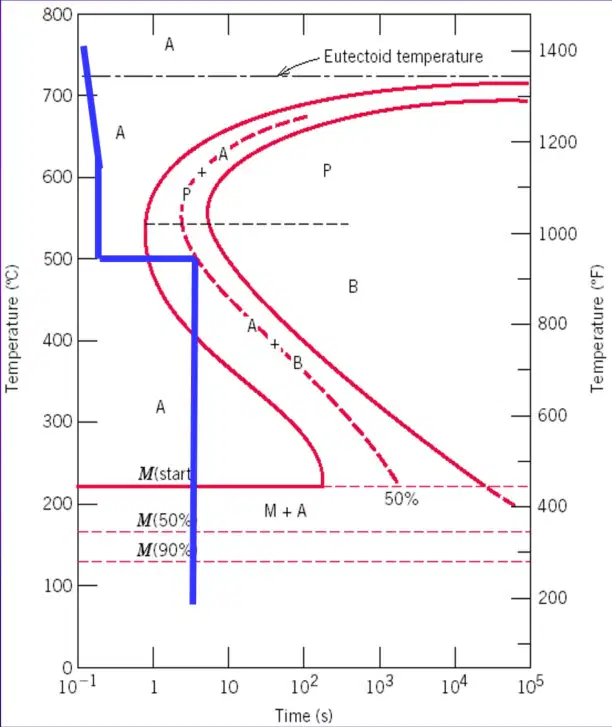
Please write down the steel microstructure by following the isothermal cooling curve on the TTT diagram:
Fully Martensite
Fully Bainite
50% Bainite +50% Martensite
50% Austenite +50% Martensite
50% Bainite +50% Austenite

Please write down the steel microstructure by following the continuous cooling Curve D on the CCT diagram:
Fully Martensite
Bainite + Martensite
Pearlite + Martensite
Fully Pearlite
Fully Bainite
Which one of the following is NOT true related to the elevated recrystallization temperature in hot working?
The effects of strain hardening are eliminated under this condition.
The metallurgical grain structure will be isotropic under this condition.
This condition may promote some undesired chemical reactions such as oxidation between the heated workpiece and the environment.
Assume that cold drawing process is used to make the steel pans and pots shown in the figure. The ductility of the steel at the deformed locations will be ___________ by this drawing process.
increased
decreased
hardly affected
In sheet metal bending, the metal is deformed __________.
below its yield strength
beyond its yield strength but below its tensile strength
beyond its tensile strength
beyond its tensile strength but below its yield strength
Which one of the following is NOT true regarding deformation processes?
All processing is done in the solid state.
The forces required are often very high.
Machinery and tooling can be quite expensive.
Unwanted regions are cut away so the amount of waste is large.

