
 Worksheets
Rocks and Minerals
Total questions: 50
Worksheet time: 31mins
Which would most likely cause molten rock material to become a glassy igneous rock?
cooling over a long period of time
cooling under high pressure
cooling on the earth's surface
cooling at great depth within the earth
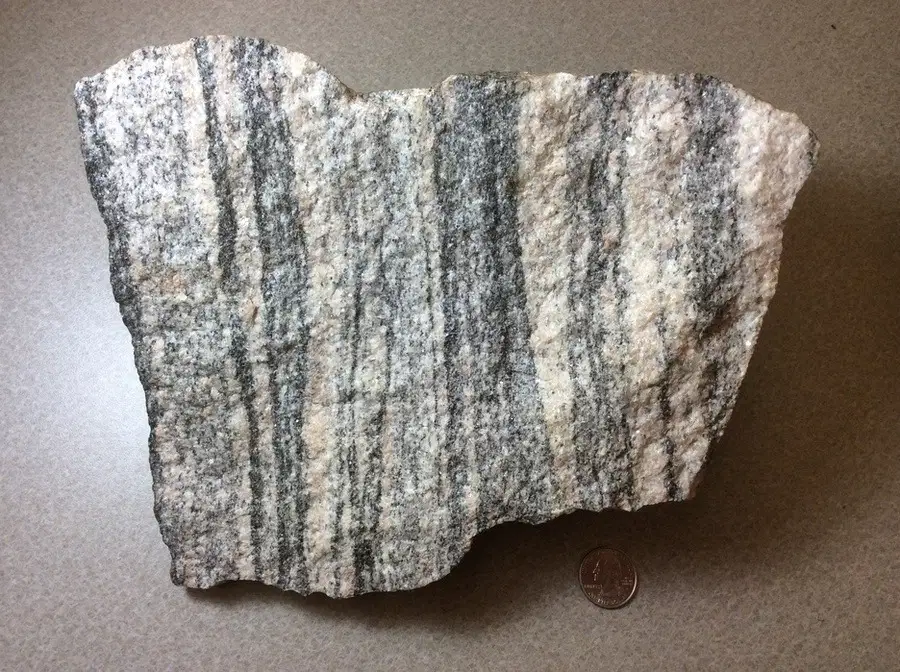
Determine the texture of the metamorphic rock:
Foliated
Non-Foliated
Examples of intrusive igneous rock are ______ and______ .
basalt / andesite
granite / diorite
obsidian / diorite
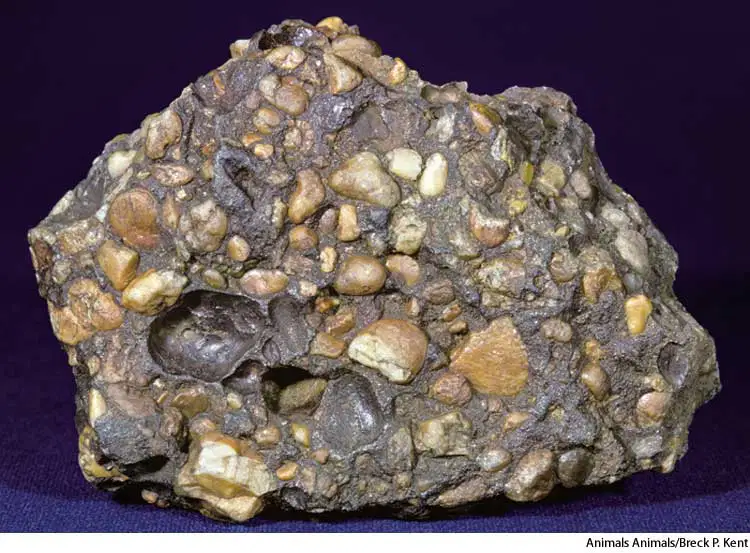
This rock is made of large bits of gravel cemented together. What type of sedimentary rock is it?
Clastic
Chemical
Organic
How is crystal size related to the rate a molten material cools
the faster it cools the smaller the crystal
the faster it cools the larger the crystal
the slower it cools the smaller the crystal
How do metamorphic rocks form?
Heat and Pressure
Compaction & Cementation
Cooling of Magma
Sediments & Glue
Sediments are formed from
Compaction and Cementation
Weathering and Erosion
Melting and Solidification
Heat and Pressure
What is the LEAST unreliable way to identify a mineral?
luster
streak
color
density
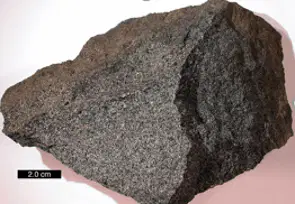
Which type of igneous rock has small, fine grains?
Extrusive
Intrusive
Crystals
It is determined using a scratch test.
luster
fracture
cleavage
hardness
It is how mineral reflects light from its surface.
luster
cleavage
color
hardness

This image represent _________.
The rock cycle
sedimentary rocks
metamorphic rocks
igneous rocks

Compaction and cementation will form in __________.
magma
metamorphic rocks
igneous rocks
sedimentary rocks
You find a fossil of the Mesosaurus. What rock type must it be?
bone
metamorphic rocks
igneous rocks
sedimentary rocks
If you were hiking around Mt. St. Helens (volcano) what type of rock would you most likely find would be?
sedimentary
igneous
metamorphic
Water carving away at the bank of a river is an example of ____________.
compaction
cementation
deposition
erosion
A mineral with the hardness of 10 more likely to ______________.
scratched by all other minerals
called as Talc
scratch all minerals
the weakest
If a mineral has the ability to break off in sheets uniformly, it would display the property of ____________.
cleavage
streak
luster
fracture
While testing a mineral you can scratch it with your fingernail. This means _____________________.
its harder than your nail
you need a manicure
its not a mineral
its softer than your nail
A __________ is a natural, nonliving substance that makes up rocks.
Sedimentary rock
Sediment
Mineral
Igneous Rock
When inside a volcano, the hot liquid that can cool to form rocks is called __________.
lava
magma
extrusive
intrusive
This rock started as molten magma. What type of igneous rock is this?
felsic
mafic
intrusive
extrusive
This rock used to be the bottom of an ocean millions of years ago. What type of rock is this?
igneous
metamorphic
sedimentary
If I say that a penny can scratch a rock, what property am I referring to?
luster
color
weight
hardness
The process for sedimentary rocks DO NOT include:
Cementation
Cooling
Deposition
Erosion
Two types of igneous rocks are:
Interior and exterior
Intrusive and extrusive
Inside and outside
Enter and exit


A precious stone that has been cut or polished.
fossil
cleavage
gem
luster
Sedimentary rocks may have these remains of an organism inside of it.
cleavage
gem
luster
fossil
What is the hardest mineral?
graphite
fluorite
diamond
gypsum

Heat and _____________ transformed living things into fossil fuels.
pressure
air
gas
water
TRUE about Minerals:
Inorganic
Naturally occuring
With chemical composition
All of the above
The basic building blocks of rocks:
Crystal
Acids
Magma
Minerals
Example of Extrusive rock:
Pumice
Gabbro
Diorite
Granite
4 processes in the formation of sedimentary rock (in chronological order)
(first to last)
compaction,
deposition,
weathering,
mass wasting
erosion,
decomposition,
compaction,
cementation
compoction, erosion,
cementation,
decomposition
erosion,
deposition,
compaction,
cementation
Examples of Metamorphic rock:
Gneiss
Limestone
Basalt
Gabbro


______________refers to the color of the mineral in its powdered form which may or may not be similar to the color of the mineral.
COLOR
STREAK
HARDNESS
LUSTER
It is the strong magnetic attraction of some minerals to some hand magnet (e.g. magnetite)
Crystal Form
Magnetism
Reaction to Acid
Taste
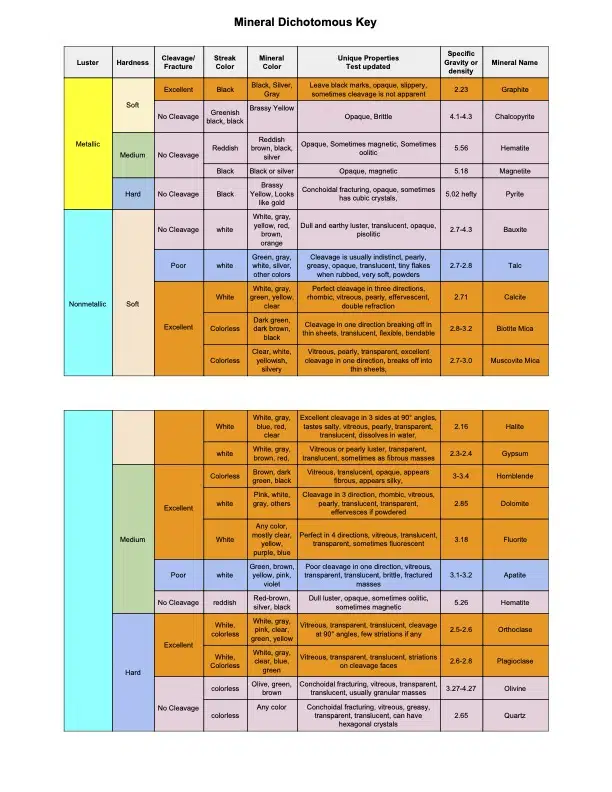
Using the Mineral Identification Key, Identify the following Mineral based on the following Data: Luster-Metallic, Streak Color- Greenish Black, Special Property-Brittle
Graphite
Chalcopyrite
Magnetite
Pyrite
What is the difference between fracture and cleavage in a mineral?
Cleavage = breaks along flat, smooth planes into a set shape,
Fracture = breaks in random, jagged edges.
Cleavage = breaks in random, jagged edges.
Fracture = breaks along flat, smooth planes into a set shape,
Fracture or cleavage of a mineral is determined by:
how long it took to form
the internal arrangement of atoms
temperature
the color of the mineral

