
 Worksheets
Body and its movements
Total questions: 20
Worksheet time: 10mins
write some animals which can adapt itself in mountain regions
(a)

These are curved bones are called the ______.
Lower muscles of hand
(a)
Functions of the skeleton include: (select as many as you think apply)
protection
homeostasis
respiration
support
movement
main parts include: bones, tendons, ligaments, cartilage
muscular system
skeletal system
respiratory system
nervous system
Which picture best shows a counter-balance?


The last two pairs of ribs are not attached in front and hence called floating ribs
True
False

What is the name of this bone?
Femur
Radius
Vertebra
Tibia

The forearm has 2 bones
True
False
How can fishes flow around easily in the water?
Due to small-sized body
Due to streamlined body
Due to the presence of thin skin
Due to the presence of scales on their body
Hinge joints are present in which of these
Fingers
Elbows
Ankles
All of these
Underwater divers wear fin-like flippers on their feet to
swim easily in water
look like a fish
walk on the water surface
walk over the bottom of the sea (sea bed).

Earthworm body secretes a______________substance to help the movement.
Rough
Slimy
Enzymes
Blood
5. Earthworm have a good grip on the ground due to the presence of ________
A) Legs
B) Tiny Bristles
C) Muscular foot
D) Rings
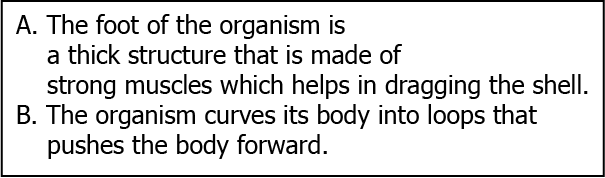
The table lists the characteristic features of the body movements of various organisms. Which organisms show these movements?
(a) A=fish, B=snail
(b)A=snail, B=snake
(c)A=bird, B=cockroach
(d)A=snake, B=earthworm
main parts include: brain, spinal cord, nerves
muscular system
circulatory system
circulatory/cardiovascular system
nervous system
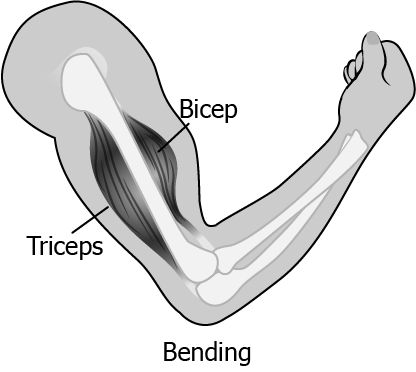
The image shows how the muscles help in the movement of the arm. Based on the image, what will be the length of the muscles during bending?
Both bicep and triceps relax
Both bicep and triceps contracts
The bicep contracts while triceps relax
The bicep relaxes while triceps contracts
Which picture shows a LOCOMOTOR MOVEMENT?


How many choices below are locomotor skills?
(a) Running
(b) Jumping
(c) Skipping
(d) Galloping
All of the above
None of the above
Only C
When the force of an object increases, so does its _______
acceleration
velocity
mass
inertia

