
 Worksheets
Study Guide for 8.E.2.1
Total questions: 12
Worksheet time: 6mins
What evidence would a scientist use to determine the age of rock in a layer?
Index Fossils
Living Fossils
Resin Fossils
Trace Fossils
In the geologic history of the Earth, which time is characterized by the dominance of reptiles and the presence of small mammals, birds, and flowering plants?
Cenozoic
Mesozoic
Paleozoic
Precambrian
Scientists discovered a 150 kilometer-wide crater near the Yucatan peninsula. The crater is believed to have formed from the impact of a giant asteroid 65 million years ago. How did this catastrophe affect Earth's environment at that time?
It altered the composition of soil in that area
It caused mass extinction of the life-forms of the time
It resulted in the start of extensive volcanic activity
It caused continents to collide with each other.
In a study, scientist concluded that the first chordates appeared on Earth right after the Precambrian Age. What statement supports this?
Fossils of the earliest chordates back to the first epoch of the geologic time scale.
Fossils of the earliest chordates date back to the first period of the geologic time scale.
Fossils of the earliest chordates date back to the second era of the geologic time scale.
Fossils of the earliest chordates date back to the third period of the geologic time scale.
Which geologic time period was the longest?
Cenozoic
Mesozoic
Paleozoic
Precambrian
A team of paleontologists discovered a fossil that formed when an organism was buried in sediments that changed into rock. The buried organism decayed and left an impression of its shape, which was filled with sand and mud before hardening into the shape of the buried organism.
What type of fossil did the paleontologists discover?
Cast Fossil
Mold Fossil
Petrified Fossil
Preserved Fossil
Which sequence shows the correct order of the geologic time periods from youngest to oldest?
Cenozoic, Mesozoic, Paleozoic, Precambrian
Precambrian, Paleozoic, Mesozoic, Cenozoic
Paleozoic, Mesozoic, Precambrian, Cenozoic
Mesozoic, Cenozoic, Paleozoic, Precambrian

Which marble in the model represents the OLDEST fossil?
Yellow
Green
Blue
Red
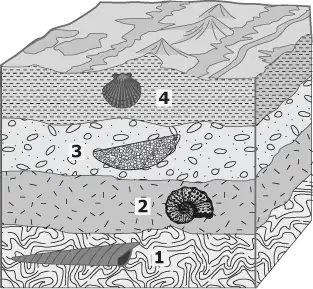
The image shows the unturned layers of sedimentary rocks with embedded fossils.
A student labels the fossils from 1 to 4. What could be true about the fossils?
Fossil 1 is younger than fossil 2
Fossil 1 is older than fossil 4
Fossil 3 is older than fossil 2
Fossil 3 is younger than fossil 4

A student lists the characteristics of an index fossil.
Which characteristics did the student list INCORRECTLY?
1
2
4
3
Which is the best explanation for how the scientists determined the span of each geologic era?
Scientist used the fossil record to determine when major geologic changes and mass extinctions occurred to mark the end of each era
Scientists chose specific species to track through fossils and when those species became extinct marks the end of an era
Scientists used accounts of Earth's climate from human history to determine when major changes in climate occurred to mark the end of an era
Scientists set a predetermined amount of time that every era stretches to mark the end of each era.

The diagram shows an outcrop with four layers labeled 1,2,3 & 4 from top to bottom. Each layer has a fossil labeled W, X, Y, and Z.
Based on law of superposition ________ is the OLDEST fossil in the shown outcrop.
Fossil W
Fossil Z
Fossil Y
Fossil X

