
 Worksheets
STAAR Body systems
Total questions: 23
Worksheet time: 12mins
Breaking down food for nutrients involves many body systems. A student made a partial list of the processes that occur.
• Salivary enzymes begin to break down starch molecules in food.
• Gastrointestinal enzymes are released in response to a hormone signal.
• Nutrients are absorbed into the bloodstream from the small intestine.
Which body systems interact most directly in the three listed processes?
Digestive
Integumentary
Muscular
Circulatory
Excretory
Immune
Excretory
Immune
Muscular
Circulatory
Digestive
Endocrine
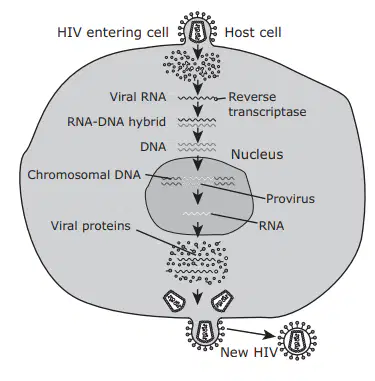
A diagram of an HIV infection is shown. Which conclusion about the HIV infection of a host cell is best supported by the diagram?
It takes place outside of living cells.
It relies on the host cell to reproduce.
It involves the process of meiosis.
It requires carbon dioxide.
An illness caused by a certain virus includes fever, rash, joint pain, red eyes, and headache. The virus is transmitted to people by infected mosquitoes. Symptoms quickly occur within three to twelve days after contracting the virus. There is no vaccine for this virus. Which description best explains the reproductive cycle of this virus?
Lytic, because the virus is transmitted by mosquitoes
Lysogenic, because there is no way to vaccinate against it
Lytic, because of the quick incubation time
Lysogenic, because the virus causes a fever
Which statement best describes an interaction between the muscular system and the respiratory system?
The hormone adrenaline causes blood vessels to contract and send more blood to major muscles.
Metabolic wastes generated by muscle cells are eliminated in urine.
The diaphragm contracts causing the chest cavity to expand, which draws air into the lungs.
Nutrients absorbed in the small intestine are transported in blood to the brain.
Which four body systems interact to allow a person to sneeze?
Muscular, immune, nervous, respiratory
Nervous, respiratory, circulatory, skeletal
Respiratory, endocrine, skeletal, circulatory
Lymphatic, skeletal, respiratory, muscular
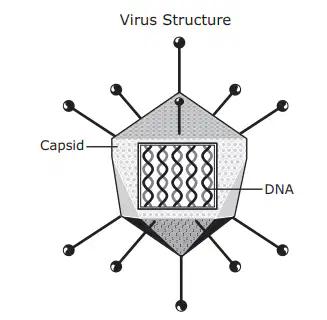
A student produces a labeled drawing of a virus for a presentation. The student states that the capsid has a function similar to the nuclear membrane found in animal cells. Which of these describes the similar functions of capsids and nuclear membranes?
Both transport proteins throughout the structures
Both provide energy for activities in the structures.
Both protect genetic information for the structures
Both code for the proteins needed for reproduction of the structures.
In a study of physical endurance, researchers observed significant increases in the heart rates and breathing rates of participants immediately after they engaged in strenuous exercise. Which statement best explains the increase in the heart rate and the breathing rate during exercise?
The water concentration in the blood increases.
Body cells require increased oxygen as energy is expended
Muscle cells increase in temperature and require fluid to reduce the temperature.
An increase in muscle activity causes increases in glucose levels in red blood cells.
The female reproductive and endocrine systems work interactively for which main purpose?
To maintain homeostasis by removing waste products from the body
To release neurotransmitters during times of stress
To control hormone levels to prepare the body for pregnancy
To exchange gases to support cellular aerobic respiration
In the 1880s, Louis Pasteur developed a method of weakening viruses. The weakened viruses could be injected into healthy individuals. How is this method effective in fighting viral diseases?
The immune system develops antibodies in response to the weakened viruses.
The weakened viruses attach to unaffected viruses in the host and interrupt the viral reproductive cycle.
The rate of genetic mutation in the host is decreased due to the introduction of weakened viruses.
Weakened viruses are unable to enter the host organism
An individual who participates in a long-distance run on a hot day will produce large quantities of sweat. As a result of the excessive sweating, the amount of urine produced by the kidneys will change. How will the kidneys respond to help the individual’s body maintain homeostasis?
The kidneys will decrease urine production so the body can maintain blood pH.
The kidneys will increase urine production to eliminate excess salt in the body.
The kidneys will decrease urine production to allow the body to conserve water.
The kidneys will increase urine production so the body can absorb more nutrient
The human body is composed of organ systems. Which list represents a system organized from least to most complex?
Heart - cardiac muscle - muscle tissue - muscle cell
Lung tissue - trachea - nostrils - circulatory system
Muscle cell - muscle tissue - biceps muscle - muscular system
Integumentary system - skin cell - hair - sweat glands
How do the circulatory system and immune system work together to respond to an injury?
Increased blood flow kills healthy cells which prevents infection at the site of the injury.
Increased blood flow removes infected cells from the body at the site of the injury.
Increased blood flow carries white blood cells to the site of the injury.
Increased blood flow allows for an increase in the exchange of O2 and CO2 at the site of the injury.
Which of these describes a difference between viruses and cells?
Cells contain protein, and viruses contain only carbohydrates
Viruses have flagella, and cells have only cilia.
Viruses have membranes made of proteins, and cells have membranes made of nucleic acid.
Cells reproduce independently, and viruses require a host to reproduce.
Which two body systems must directly interact for vertebrate organisms to exchange gases?
Skeletal system and muscular system
Excretory system and reproductive system
Circulatory system and respiratory system
Digestive system and immune system
Which statement best describes how a virus replicates?
A virus divides into two identical virus particles before infecting the host cell.
A virus enters a host cell and uses the materials from the host cell to produce new virus particles.
Multiple virus particles fuse and form a large particle that breaks apart, releasing new virus particles.
Multiple virus particles break down in comp
Biting flies can transmit diseases and cause loss of blood for animals in nature. Horses have developed behaviors to repel biting flies such as ear twitching, head tossing, leg stomping, and tail swishing. Which statement best describes the interaction between body systems that allows horses to repel biting flies?
The nervous system senses the biting flies and sends a signal to the muscular system to move.
The circulatory system senses the biting flies and sends a signal to the nervous system to move.
The muscular system senses the biting flies and sends a signal to the integumentary system to move.
The integumentary system senses the biting flies and sends a signal to the circulatory system to move.
Which sequence best describes an interaction between the integumentary and excretory systems that helps maintain homeostasis?
Heart rate increases Blood vessels constrict Blood pressure increases
Blood vessel is damaged Platelets begin to clump Blood vessel ruptures
Blood sugar levels rise Pancreas secretes insulin Blood sugar continues to rise
Body temperature increases Glands release sweat Body temperature decreases

Both the respiratory system and the digestive system involve the uptake of necessary molecules from an animal’s surroundings. Alveoli are tiny sacs that aid in the exchange of carbon dioxide and oxygen in the lungs. Intestinal villi are tiny projections along the lining of the intestines used to take in nutrients from food passing through. Which system must interact with the respiratory and digestive systems to transport gases and nutrients throughout the body?
Endocrine
Integumentary
Immune
Circulatory
The human immunodeficiency virus (HIV) often infects and destroys CD4 T cells. These CD4 T cells are one of many kinds of white blood cells that are an important part of the immune system. The most common danger related to the destruction of CD4 T cells is?
an increase in the risk of high blood pressure
an increase in the threat of diseases caused by microorganisms and viruses
a decrease in the flow of blood to vital organs
a decrease in the amount of oxygen being transported to tissues
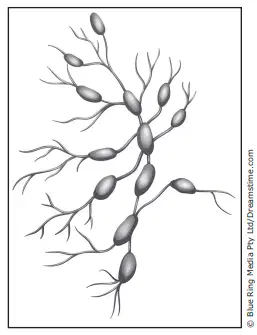
The picture shows bean-shaped glands called nodes. The clusters of cells in nodes include macrophages that break down viruses and other potentially harmful materials. Nodes also contain cells that produce protein particles capable of capturing harmful materials that flow in tissue fluid through the nodes. Different parts of the body are drained by nodes in different regions of the body. Which body systems are directly responsible for regulating these nodes and protecting the body from harmful materials in tissue fluid?
Immune and lymphatic systems
Digestive and nervous systems
Endocrine and digestive systems
Circulatory and nervous systems
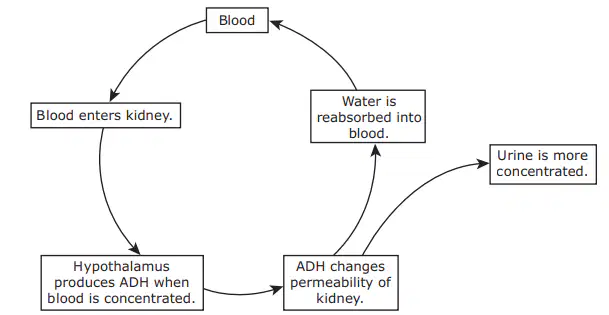
The diagram demonstrates a feedback process involving antidiuretic hormone (ADH). ADH increases the permeability of parts of the nephrons of the kidney, resulting in less water in the urine. Blood enters kidney. Blood Hypothalamus produces ADH when blood is concentrated. ADH changes permeability of kidney. Water is reabsorbed into blood. Urine is more concentrated. This feedback loop is likely to be activated when —
the body experiences dehydration
blood glucose levels are stable
body temperature drops
the urinary tract is infected
Which of the following is an example of the endocrine system directly interacting with the nervous system?
The vertebrae protect the spinal cord from injury.
Hormones provide feedback that affects neural processing.
Sensory receptors in bones send signals about body position to the brain.
The brain sends signals that control the speed at which food moves through the intestines
Recent studies in bone research indicate that using ultrasound on a broken bone can decrease the healing time by 25%. Which of these are the most basic levels of organization involved when a bone heals?
Cells and tissue
Cells and organ system
Organ system and organism
Tissue and organ system

