
 Worksheets
Key Features of Exponential Functions
Total questions: 24
Worksheet time: 2hrs 35mins
What type of pattern do exponential functions have?
Adds by the same number every time
Multiplies by the same number every time
Square roots all the inputs
Squares all the inputs
Which of the following is an exponential function?
y = x2
f(x) = 3x3
y=(−2)x
f(x) = 3x


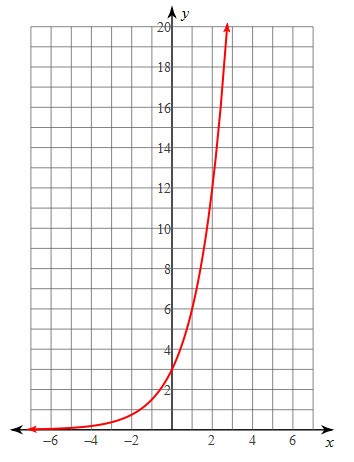

Look at the graph and answer each question.
Is the graph increasing or decreasing?
What is the y-intercept?
What is the asymptote?
Increasing
y-intercept: (0, 5)
asymptote: y = 0
Decreasing
y-intercept: (0, 5)
asymptote: y = 0
Increasing
y-intercept: (0, 5)
asymptote: y = 5
Decreasing
y-intercept: (5, 0)
asymptote: x = 0

What is the domain of the function?
(−5,∞)
(5,∞)
(−∞, −5)
(−∞,∞) or all real numbers


What is the range of this function?
x>4
All Real Numbers
y<4
y>4

Which of the following statements about the graph above is true?
The range is the set of all real numbers less than 0.
The domain is the set of all real numbers less than 0.
The domain is the set of all real numbers greater than 0.
The range is the set of all real numbers greater than 0.
if y=2x what is y when x = 0, 2, 4?
1, 2 and 8
1, 4 and 16
0, 4 and 8
1, 2 and 8
Identify the asymptote of the function −3(3)x+4
y = -3
y = 1
y = 4
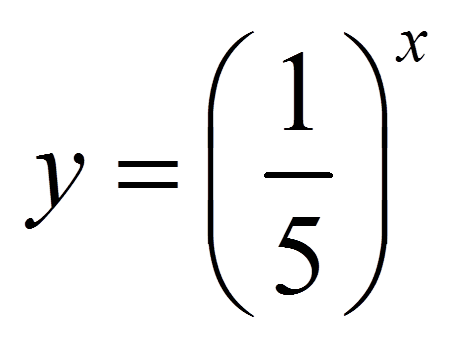

In exponential decay problems, the decay value is always....
More than zero, but less than 1
Less than zero
Greater than 1
Whatever you want it to be

How would you solve an exponential equation like the one below:
Rewrite 36 as 62
Set the exponents equal to each other
Rewrite 36 as 63
Multiply the exponents
Find f(-4) for f(x) = 2x
If you get a decimal answer, remember to convert it to a fraction in the calculator.
16
1/16
8
1/8
Find f(x)= 432 when f(x)=2(6)x
3
-4
Which equation is an exponential equation?
y=3x+15
y=0.5x+10
y=3(2)x
y=300−10x
2-2n = 26
Rewrite
361 as a power of 6.6
62
66
6−2

