
 Worksheets
Fingerprinting
Total questions: 26
Worksheet time: 16mins


Fingerprints remain the same throughout our lifetimes.
true
false
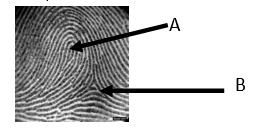
Which of the following substances creates a fingerprint?
Salts and sweat
Chloride
Sweat and oils
Glucose and hormones
Some detectives use ______________ powder and UV lights to help them find latent prints on multi-colored or dark surfaces.
black
fluorescent
magnetic powder
ninhydrin
In the super glue (or cyanoacrylate fuming) method, the glue is heated up in a sealed chamber that creates a vapor that turns the prints __________.
black
red
white
purple

A fingerprint not seen with the naked eye
Plastic
Patent
Latent
Minutiae print

The most common process of developing latent prints
Dusting
Silver Nitrate
photography
Black light

A fingerprint left on a hard surface that can be seen with the naked eye
Plastic
Patent
Latent
Minutiae print

A fingerprint left on a soft surface that can be seen with the naked eye
Plastic
Patent
Latent
Minutiae print
Which of the following reflects the percentage of fingerprint types in the human population?
5% loops
30% arches
65% whorls
5% whorls
30% arches
65% loops
5% arches
30% loops
65% whorls
5% arches
30% whorls
65% loops
Factors that can affect the quality of a fingerprint include all of the following EXCEPT:
Oils and sweat on the skin
Humidity of the air
The type of surface the print is left on
Whether or not an individual is right-handed or left-handed
A person is more likely to leave a fingerprint in a dry environment than they are in a humid environment.
True
False
The database that contains records of millions of fingerprints is
NIBIN
IAFIS
CODIS
ATF
Which of the following is the most important in determining a match for a fingerprint?
Having the same minutiae in the same locations
Having the same type (arch, loop, whorl) of fingerprint
Having the same type of minutiae but not necessarily in the same locations
Having the same number of ridges

How is ridge count determined in a fingerprint?
Count the number of bifurcated ridges in a fingerprint
Count the number of ridges in a delta
Count the number of ending ridges in a fingerprint
Count the number of ridges from the core to a delta
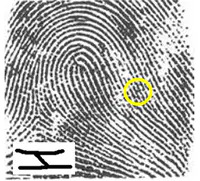
What type of minutia is represented in this picture?
Bifurcation
Bridge
Ridge ending
Island
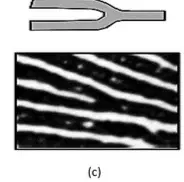
What type of minutia is represented in this picture?
Ridge ending
Bifurcation
Bridge
Island
Why is it possible for genetically identical twins to have different fingerprints?
They have different experiences such as environment and nutrition that lead to differences in their fingerprints.
Genetically identical twins would actually have identical fingerprints.
They have very slight differences in their genetic makeup.
They experience differences in position, motion, and other factors in the womb.

This fingerprint is a
plain arch
tented arch
tented loop
distal loop
What type of technology can be used to find latent prints at a crime scene?
Refraction
X-ray
UV light
Infrared radiation
What information is needed to determine if a loop fingerprint is radial or ulnar?
If the fingerprint came from the thumb or the pinky
If the fingerprint came from the right or left hand
If the print was latent or patent
If the fingerprint was complete or partial
Which of the following is NOT likely to by found in a fingerprint?
Substances, such as medication, that are ingested (put into the body through the mouth)
Substances that the individual may have handled recently
Pigments that are naturally present in our skin
Sweat and oils produced by the body

