Wayground logo

Free Printable Worksheets

Font size

S
M
L
XL
Worksheets

Ch 2 and 7 Quiz Review

Total questions: 30

Worksheet time: 15mins

Name
Class
Date
1.

Who is the scientist who proposed Continental Drift Theory?

a)
Albert Einstein
b)
Alfred Wegener
c)
Isaac Newton
d)
John Dalton
2.
Which of the following causes Earth's tectonic plates to move?
a)
Energy from the Sun
b)
Magnetic Pole Reversal
c)
Convection currents in the mantle
d)
Faults in Mountain Ranges
3.
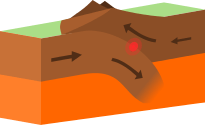
What type of event will occur at this boundary?
a)
Earthquake
b)
Volcano Eruption
c)
Tornado
d)
Mountain Building
4.
What type of plate boundary is this?
a)
Plate
b)
Divergent
c)
Convergent
d)
Transform
5.
A divergent boundary occurs when plates ....
a)
Pull apart
b)
Come together
c)
Slide past each other
d)
subducting
6.
What geologic feature/event you be most likely to find at a transform boundary?
a)
Earthquakes
b)
Volcanoes
c)
Mountains
d)
Rift Valleys
7.
What geologic feature/event would you most likely to find at a divergent boundary between two pieces of oceanic crust?
a)
Rift Valley
b)
Mid-Ocean Ridge
c)
Island Arc
d)
Flat land
8.
What geologic feature/event would you most likely to find at a convergent boundary between two pieces of continental crust?
a)
Volcano
b)
Mountain
c)
Rift
d)
Island Arc
9.
The core is mostly made up mostly of which elements?
a)
Oxygen and Silicon
b)
Silicon and Magnesium
c)
Nickel and Iron
d)
Iron and Magnesium
10.
A giant landmass that existed 200 million years ago
a)
Wegener
b)
Pangaea
c)
Archyopteryx
d)
Ammonite
11.

As you travel from the crust to the inner core, how would temperature, pressure and density of the material change?

a)

They would all increase

b)

They would all decrease.

c)

Nothing, the layers are made of the same material throughout

d)

Temperature would decrease, but pressure and density would increase

12.
What type of boundary occurs when two plates move away from each other?
a)
transform
b)
subduction
c)
convergent
d)
divergent
13.
Which type of crust is more dense?
a)
oceanic
b)
continental
c)
divergent
d)
pizza
14.
A trench forms at a _________ boundary.
a)
convergent
b)
divergent
c)
transform
d)
vertical
15.
What is the process in which hot molten rock rises, then cools and sinks back to the core?
a)
plate tectonics
b)
continental drift
c)
convection
d)
divergence
16.
A fault forms at a _________ boundary.
a)
transform
b)
divergent
c)
horizontal
d)
convergent
17.
What is happening at point B?
a)
subduction
b)
a divergent boundary
c)
convection
d)
an earthquake
18.

This type of boundary can be found along the San Andreas fault in California....

a)

divergent

b)

convergent

c)

transform

19.

Subduction means.....

a)

one plate goes under another plate

b)

two plates slide past each other

c)

two plate collide and form folded mountains

20.

Sea-floor spreading explains how.....

a)

new crust is created at a divergent boundary

b)

volcanoes are formed on continents

c)

deep sea trenches are formed

21.
The image illustrates what type of boundary?
a)
Divergent
b)
Convergent
c)
Transform
d)
Emergent
22.
Which layer is solid nickel and iron?
a)
Crust
b)
Mantle
c)
Outer core
d)
Inner core
23.
Which layer is the thinnest?
a)
Crust
b)
Mantle
c)
Outer core
d)
Inner core
24.
What is the correct order from the center of the earth to the surface of the earth?
a)
Crust, Mantle, Inner core , Outer core
b)
Crust, Mantle, Outer core , Inner core
c)
Inner core, Outer core, mantle, crust
d)
Outer core , Inner core, Mantle, Crust
25.

Where are the youngest rocks on Earth found?

a)

Along mid-ocean ridges

b)

Along transform boundaries

c)

On the edges of the continents

d)

Near ocean trenches

26.

How far do tectonic plates move each year?

a)

Meters per year

b)

Centimeters per year

c)

Kilometers per year

d)

Tectonic plates do not move

27.

What are the pieces of the Earth's surface called?

a)

Tectonic plates

b)

Puzzles

c)

Earthquakes

28.
Wegener’s proposal of a supercontinent was supported by:
a)
earthquake data
b)
seafloor magnetism
c)
rock, fossil, and climate data.
d)
convection currents in the mantle.
29.

A __________ forms where plates diverge on land.

a)

rift valley

b)

mid-ocean ridge

c)

mountain

d)

trench

30.
What is the thickest layer of the Earth?
a)
the crust
b)
the mantle
c)
the outer core
d)
the inner core