
Font size
 Worksheets
A LEVEL CONTROL AND COORDINATION
Total questions: 21
Worksheet time: 14mins

Just before a person starts to exhale, the composition of the air in an alveolus differs from the composition of the air in the trachea. How would the composition differ? (tick all that apply)
less oxygen
more oxygen
more carbon dioxide
more water vapour
less water vapour
Which of the following statements are true about negative feedback?
Most processes in the body are controlled by negative feedback.
Negative in this case means the opposite direction of the stimulus.
Negative in this case means something bad or problematic.
Goal is to return immediately to homeostasis.
Amplifies the change.

The I band is labeled here as _______.
AD
AC
BC
AB

What is the eye an example of?
a stimulus
a sense organ
a relay neuron
What is the purpose of the nervous system?
Control and communication of and between systems of the body.
To let you know when you when you should feel anxious about something.
How are hormones transported through the body?
Through the lymphatic system
Through the bloodstream
Through nerves
Through cell-to-cell contact
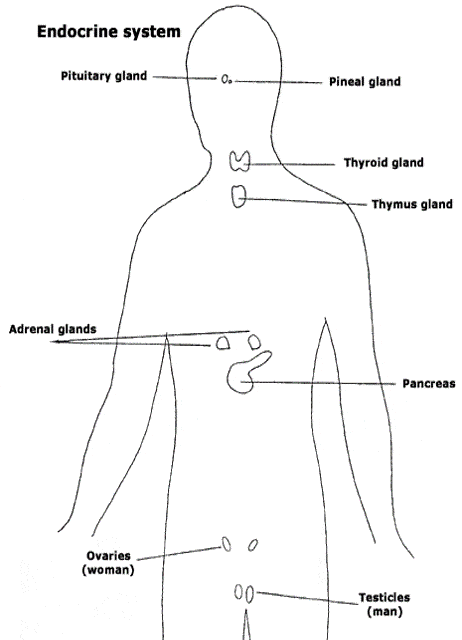

This is made up of the brain and spinal cord
Central Nervous System (CNS)
Peripheral Nervous System (PNS)
Autonomic nervous system
Somatic nervous system
What base does RNA have instead of Thymine?
(a)
The Z line is labeled here as _______.
BD
AC
AE
AB

This image shows a ________?
Sarcomere
Fascicle
Neuromuscular Juntion
Prime mover
When a myosin head engages with the active site on the other filament, this is known as a(n)
Sarcomere
Z-line
cross-bridge (power stroke)
M line
Which of the following is correct about refractory period? [check all that applies]
it ensures that action potentials are discrete events, no overlapping
it happens when repolarisation starts and ends when resting potential is reestablished
it ensures that the impulse can only travel in one direction
none of the above
When glucagon is released, which of the following occurs?
Glucose undergoes condensation reactions.
Glycogen undergoes hydrolysis.

Depolarization is occuring at number
1
2
4
5
Which type of neuron causes a muscle to contract in a reflex arc?
Motor Neuron
Sensory Neuron
Interneuron
Effector
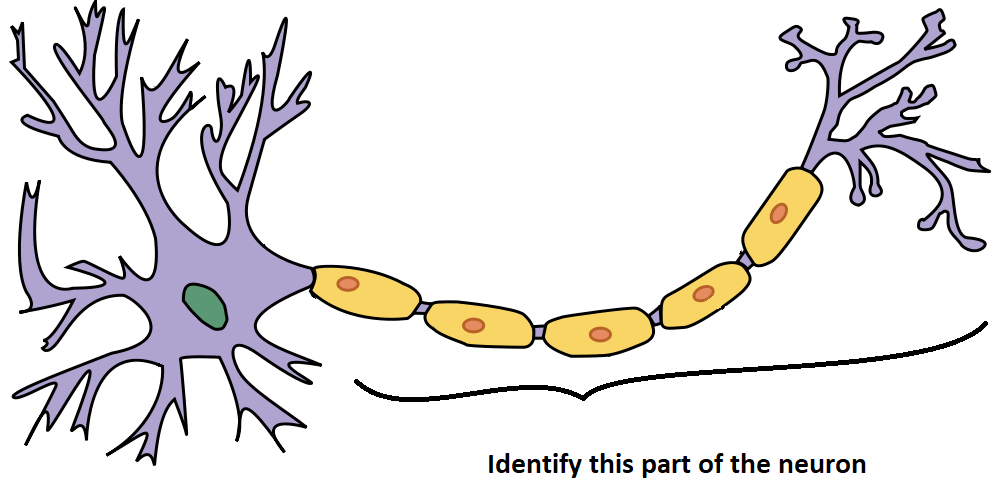
Nucleus
Cell Body
Axon
Node of Ranvier

All parts of the sensory system use ________.
receptors
muscle
motor
chemoreceptors

