
 Worksheets
Ancient China
Total questions: 60
Worksheet time: 31mins

China's civilization developed between which two rivers?
Yin and Yang
Chang Jiang and Yangtze
Shang and Zhou
Huang He (Yellow River) and Yangtze (Long River)
cultural diffusion
dyansty
emperor
pharoah


The ancient civilizations of China, Mesopotamia, and Egypt all developed...
because they were all surrounded by mountains.
because rivers deposited silt suitable for farming.
because of serious droughts that happened around them.
because of vast deserts that attracted settlers.
Why was The Silk Road important?
it was a military route.
it was a trade route that connected China with other civilizations.
it enabled silk made in the west to be brought to China.
it was the trade route followed by Christopher Columbus.
On which continent is China located?
Africa
South America
Asia
Europe
What were the rulers of Ancient China called?
Emperors
Lords
Noblemen
Pharaohs
Which dynasty is famous for first inventing writing?
Zhou
Shang
Han
Qin
VOCAB: The Zhou dynasty created new system of government in which nobles are granted the use of lands that legally belong to the their ruler in exchange for military service and protection of the people who live on the land. What is the type of government system called?
democracy
merit system
absolute monarchy
feudalism
system of moral beliefs based on the teachings of Confucius
Buddhism
Confucianism
legend
Silk Road
system of ideas and principles
legend
civilization
calligraphy
philosophy
A Chinese philosophy concerned with obtaining long life and living in harmony with nature
Naturism
Daoism
Legalism
Confucianism
Brownish yellow dirt that causes the Huang river to get its yellow color
Loess
Sand
Topsoil
Manure
What mountain ranges separates China from India?
The Alps
The Himalayas
The Andes
The Urals
What river is also called "China's sorrow" because of frequent flooding?
Huang He River (Yellow River)
Yangtze River
Tigris River
Ganges River
How was Chinese civilization affected by mountains and deserts?
They became wealthy.
They made it easier to travel.
They were isolated from other civilizations.
They made China easy to be attacked.
How did the Zhou dynasty justify their right to overthrow the Shang dynasty?
They claimed that the gods had given the Zhou the Mandate of Heaven.
They said the Shang king no longer honored his ancestors
They claimed that the oracle bones proved them to be the proper kings
They said there would be no more floods or famines under their rule.
The Shang Dynasty was
China's longest dynasty.
China's oldest dynasty.
China's most studied dynasty.
China's first dynasty supported by written and archaeological evidence.
From when does the Terracotta Army date?
200 AD
3200 BC
200 BC
1500 BC
Who was the Terracotta Army made for?
Confucius
Shi Huangdi
Li Sixum
Li Zhaotao
Which dynasty used legalism, strict laws, a centralized government, and expanded the territory of Ancient China?
Qin
Shang
Zhou
Han
Dynasty before the constant state of warfare and instability
Shang
Zhou
Qin
Han
dynasty connected to oracle bones
Qin
Zhou
Shang
Han
Feudalism is a system of relationships where ______________ was exchanged for ______________.
Land; loyalty
Money; money
Food; loyalty
Soldiers; money
Who was the legendary ruler of the Xia Dynasty?
Yu the Great
Shi Huangdi
Confucius
Yu the Okay
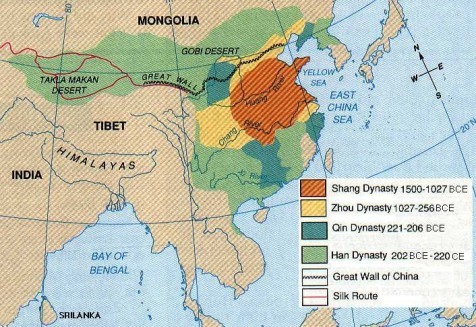
The political influence dynasties had was based on
Which statement best matches the values of Confucianism?
belief in the goodness of humanity, following rules, respect for elders, and fairness
monasteries and places of worship were built to support the participation of religion
worshipped many gods and ancestors, believe everything is one, believed in "chi" energy in the body
the idea of living or lasting forever
The Han Dynasty of China contributed which invention to society that is still used today?
paper
stirrups
steel plow
typewriter

How did the Silk Road contribute to the development of classical civilizations such as China, Persia, India, and Arabia?
The Silk Road provided employment opportunities across many civilizations as it was being constructed.
The Silk Road promoted a cultural exchange between China and the West and helped spread Chinese inventions.
The Silk Road helped to strengthen military protection for these ancient civilizations by creating a network of walls.
The Silk Road promoted travel for the masses among these civilizations. Men, women, and children began exploring the world.
Chinese scholar who wrote a book of wisdom called the Dao De Jing
Confucious
Lao Tzu
Shi Huangdi
Wu Ti
Which of the following is NOT one of the 5 key relationships of Confucianism?
Father-Son
Husband-Wife
Ruler-Subject
Uncle-Cousin

Which ancient site is this?
A)B)C)D)
The Pyramids
The Parthenon
The Colosseum
The Great Wall

The period from 475 BC until the unification of China under the Qin dynasty, characterized by lack of centralized government in China. It followed the Zhou dynasty.
Daoism
Han Dynasty
Warring States Period
Shane Dynasty

The Chinese dynasty (from 246 BC to 206 BC) that established the first centralized imperial government and built much of the Great Wall.
Shang Dynasty
Great Wall of China
Daosim
Qin Dynasty

World's longest man made structure built to keep invaders from the north out of China, started by the Qin Dynasty, expanded by the Han Dynasty.
Qin Dynasty
Gobi Desert
Shang Dynasty
Great Wall of China

What teachings did The Analects contain?
the teachings of Confucianism
the teachings of the Qin Dynasty
the teachings of the Zhou Dynasty
the teachings of Legalism
How did the mandate of heaven make governing the large land of ancient China easier?
It discouraged people from overthrowing a ruler because the gods would be against the new ruler.
It encouraged people to accept Chinese culture because the gods thought it was the best culture.
It encouraged people to accept the ruler because the ruler was chosen by the gods.
It discouraged people from accepting feudalism because the gods wanted everyone to be equal.
Ancient China guarded the secret to making a certain item, which created a high demand and made the item valuable. What trade item from China was of highest value?
Metal
Gold
Ink
Silk
True or false: Women were held in high regard and were respected on the same level as men in Ancient China.
True
False

What can you conclude from the fact that the Great Wall is still standing today?
China has never been successfully invaded
The wall still serves an important strategic purpose
There are still many nomadic tribes north of the Great Wall
It's still an important symbol of Chinese culture
Which Chinese dynasty re-built much of the Great Wall that still stands today?
Han
Ming
Tang
Qin
What did the emperor do when the Zhou capital was attacked?
He fought back.
He died.
He was taken prisoner.
He escaped and created a new capital.
Which is TRUE about The Warring States Period
It lasted over a thousand years.
There was no emperor at this time.
China was at war with Mongolia during this time.
None of the above.
During the Warring States Period, who was at war?
China and Mongolia
China and India
Different Chinese warlords and kingdoms
China and The United States
During the Warring States Period, what did each kingdom do to protect themselves?
They started building walls.
They started using airplanes.
They started building boats.
They started using attack dogs.

What is true about the Great Wall? (Check all that apply)
Many workers died making the wall.
Emperor Wudi constructed the wall during the Han Dynasty
It is Shi Huangdi's most remarkable and costly achievement.
It protected China from northern invaders.
How did the Han Dynasty end?
Revolts over heavy taxes, forced labor, and cruel policies.
The last leader was corrupt.
Weak rulers could no longer control powerful warlords.
It did not end.
The belief in the Zhou dynasty that the god of Heaven determined who should rule China
Mandate of Heaven
Mandate of god
Dynastic Cycle
Dynastic Rule
Ancient Chinese family relationships were strongly influenced by the teachings of
Confucius
Han Fei Tzu
Shi Huangdi
Wu- Ti
Which Religion did not come to China by the Silk Road?
Buddhism
Islam
Christianity
Daoism
None of the above, they all came to China by the Silk Road
What Ancient Chinese dynasty first began work on the Great Wall?
Han
Ming
Tang
Qin
Song

