Wayground logo

Free Printable Worksheets

Font size

S
M
L
XL
Worksheets

Bell Work 3-1-23

Total questions: 15

Worksheet time: 23mins

Name
Class
Date
1.

These cells do not have a true nucleus.

a)

Prokaryotic cell

b)

Eukaryotic cell

c)

Plant cell

d)

Nerve cell

2.

It is known as the powerhouse of the cell.

a)

ATP

b)

Ribosome

c)

Nucleus

d)

Mitochondria

3.

Match the following

a)

Mitochondria

1.

Converts chemical energy from food into a usable form - (power plant)

b)

Vacuoles

2.

Storage containers - Only found in plant cells

c)

Lysomes

3.

Breakdown lipids, carbs, proteins (Recycling center)

d)

Centrome

4.

Small region of cell that produces microtubles

e)

Centrioles

5.

Short microtubles arragned in a cylindrical tube

4.

Each human cell contains how many pairs of chromosomes?

a)

20

b)

21

c)

22

d)

23

5.
What does a food web represent?
a)
All connections of energy flow throughout all organisms in a habitat.
b)
The specific ways that mutualism is carried out.
c)
A single pathway or energy flow between organisms. 
d)
How carnivores get their food. 
6.

Fats, oils, and cholesterol are all examples of which macromolecule?

a)

Carbohydrates

b)

Proteins

c)

Lipids

d)

Nucleic Acids

7.

Amino acid is to protein as

a)

Complex sugar is to monosaccharide.

b)

DNA is to RNA.

c)

Sugar is to fat.

d)

Nucleotide is to nucleic acids.

8.

The waxy waterproof layer on the leaves and some stems of plants is called the _________________.

a)

root

b)

stomata

c)

petal

d)

cuticle

9.
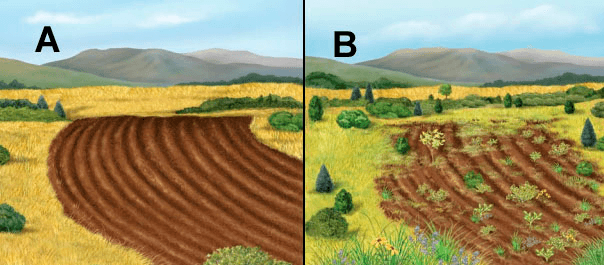
What type of succession is shown going from figure A to figure B?
a)
primary succession
b)
ecological succession
c)
secondary succession
d)
intermediate
10.

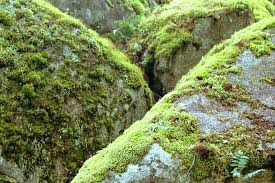
What are examples of pioneer species in a primary succession?

a)

Bushes and Shrubs

b)

Oak trees

c)

Mosses and Lichens

d)

A rose Bush

11.

Select the PRODUCTS of photosynthesis

a)

carbon monoxide

b)

H2O

c)

O2

d)

C6H12O6

e)

CO2

12.
What is diffusion?
a)
when molecules move 
b)
when molecules move from a high concentration to a low.
c)
no movement 
d)
molecules move everywhere
13.
Osmosis is the movement of _____ across a membrane.
a)
food
b)
energy
c)
oxygen
d)
water
14.
_______ regulates what enters and leaves a cell.  
a)
Cell Membrane
b)
Nucleus
c)
Mitochondria
d)
Cytoplasm
15.
What is the difference between active and passive transport?
a)
Active does not need energy and passive uses ATP (energy)
b)
Active uses ATP (energy) and passive does not need energy
c)
Active stores transport proteins and passive releases 
d)
Active uses hormones and passive does not