
 Worksheets
G9 Chemistry
Total questions: 193
Worksheet time: 3hrs 4mins
What period is Lead (Pb) in?
6
4
Metals
4A
What group is lead in?
6
3
Metal
4
What category is silicon (Si) a part of?
Metal
Nonmetal
Metalloid
Halogens
What Element is in period 4, group 5?
Antimony
Arsenic
Tin
Germanium
What period contains the element Plutonium (Pu)?
8
6
7
Plutonium doesn't exist
What group is Barium in?
2
1
Metals
Alkali metals
What is group name of the most reactive metals?
Noble gases
Halogens
Alkali metals
Alkaline earth metals
Which element conducts electricity the best?
Silicon
Fluorine
silver
Arsenic
The Periodic Table is a tool for scientists to predict the chemical behavior of elements.
True
False
Element located in period 6, group 3
Ruthenium
Thallium
Technecium
Hassium
Horizontal rows in the Periodic Table
Periods
Groups
Vertical columns in the Periodic Table
Periods
Groups
What is the atomic number of In?
56
23
53
49
Give the coordinates of the element Paladium
Period 10
Period 5
Period 4
Period 3
choose the correct statement
the vertical column in the periodic table is called period
the vertical column in the periodic table is called group
the horizontal row in the periodic table is not called period
none of the above
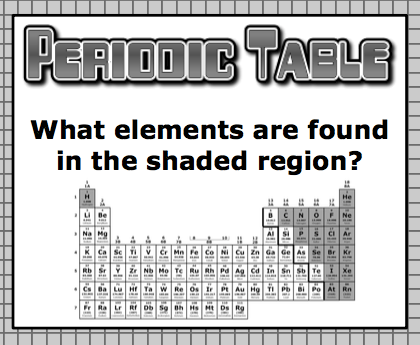
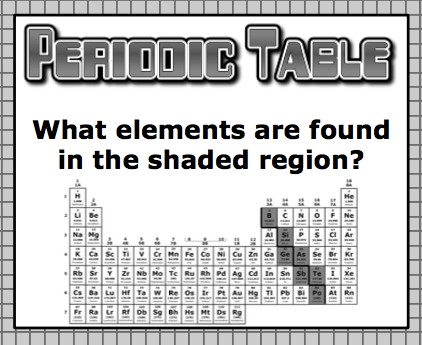
What are the three main groups of the periodic table?
groups
metal
nonmetals
metalloids
periods
Most elements on the periodic table are classified as ____________.
Gases
Metalloids
Metals
Nonmetals
Groups on the periodic table are arranged...
Vertically
Horizontally
Diagonally from bottom right corner
Diagonally from top right corner

Which accurately describes nonmetals?
Poor conductors of electricity
Often used in computer parts
Both malleable and ductile
Both dull and brittle

Which group on the periodic table is the most reactive?
Group 1
Group 2
Group 13
Group 18

What is the chemical symbol for Sodium?
S
So
Na
Ca

How many periods are there in the periodic table?
7
9
10
18

Each horizontal row on the periodic table is called a what?
Group
Row
Period
Family


True or False? The groups on a periodic table are the rows
True
False
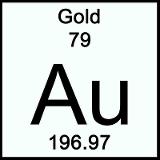
Which of the following is the abbreviation for the element gold?
Ge
Fe
Go
Au
scale
graduated cylinder
ruler
thermometer


You think you have found a diamond. Its mass is 5.28 g and its volume is 2 cm3. What did you find?
Marble
Quartz
Diamond
Gold
Platinum

While digging in the backyard, you find an old coin. Its mass is 26.76 g and its volume is 3 cm3. What is the coin made of?
Marble
Quartz
Copper
Gold
Platinum
A student measures the mass of an 8.0 cm3 block of brown sugar to be 12.9 g. What is the density of the brown sugar?
1.6 g/cm3
0.62 g/cm3
103.2 g/cm3
0.54 g/cm3
A chef fills a 50.0 mL container with 43.5 g of cooking oil. What is the density of the oil?
1.15 g/mL
0.87 g/mL
2,175 g/mL
6.5 g/mL
polyatomic ions
an element from Group 7
Calcium Oxide, CaO
Covalent Bond
Ionic Bond
Calcium Chloride, CaCl2
Covalent Bond
Ionic Bond
Why do ionic bonds form?
so the number of protons equals the number of electrons
to fill the outermost energy level to make the atom stable
so an atom can become unstable
If an aluminum atom has 13 protons (+) and 10 electrons (-), what is it's charge?
Al+3
Al+13
Al+10
Al-10
if NONMETALS are more likely to GAIN electrons, they will form ...
anions
neutral atoms
cations
In the chemical formula for an ionic compound, which item is written first?
positive ion (cation)
negative ion (anion)
subscript
it's alphabetical

The transfer of Valence electrons from a metal to a non metal is known as
Covalent Bonding
Metallic bonding
Molecular bonding
Ionic Bonding
A(n) _________ is an ion with a positive (+) charge.
anion
cation
ion
solute
polyatomic ions

Which block on this periodic table represents the transition metals?
s block
d block
p block
f block
Fe2+ and Fe3+ are both ions of iron. What is different about them?
they have different numbers of protons
they have different numbers of neutrons
they have a different charge
they are different elements

Where are the transition metals located on the periodic table?
blue square
red square
yellow square

What is the correct name for this compound?
fluorine chlorine
iron chloride
iron(II) chloride
iron(I) chloride

What is the correct name for this formula?
lead(IV) iodide
lead iodide
lead iodine
lead(I) iodide
What is the formula for iron(III) oxide?
FeO
Fe(III) O
Fe2O3
Fe3O2

What is the name of this ion?
fluorine 3
iron(III) ion
iron(III)

What is the name of this ion?
copper(I) ion
copper
copper(+1) ion
What is the formula for copper(I) oxide?
Cu2O
CuO
CO
C2O
What is the name of this compound? CaBr2
calcium(II) bromide
calcium(1) bromide
calcium bromine
calcium bromide
What is the name of this compound? Na2S
nitrogen(II) sulfide
sodium(II) sulfide
sodium sulfide
sodium(I) sulfide
FeCl3
What is the name of the following formula: Cu3N
copper nitride
copper (iii) nitride
copper (i) nitride
copper (iii) nitrogen (i)
The name of FeCl₂ is
iron chloride
iron (II) chloride
iron (I) chloride
iron dichloride
When naming ionic compounds with transition metals you need to include roman numerals to show the _____ of the metal..
atomic number
mass number
charge
ionization energy
Cu+2
In the compound TiO2, titanium has a charge of ______. Hint: The charge on "O" is -2. Use the charge on oxygen to determine the charge on Ti.
4+
2+
2-
4-

1s22s22p63s23p64s23d10


1s22s22p63s2
Choose the correct shortcut configuration for iodine.
[Ar]4s24d104p5
[Kr]5s24d105p5
[Xe]5s25d105p5
none of the above
Which area on the periodic table represents the electrons in the "d" sublevel?
representative elements
columns 3-8
rare earth elements
transition elements
Which of the following is not a correct designation for a sublevel?
zz
p
d
f

In reality, the only thing connecting two atoms together in a chemical bond is a bunch of ___
electrons
protons
photons
neutrons

Sodium has one valence electron and chlorine has ___
none
two
seven
eight

For water, each hydrogen atom has one valence electron, and oxygen has ___
four
five
six
seven

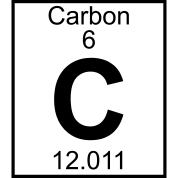
How many valence electrons does carbon have?
two
three
four
six


What two types of atoms make a covalent bond?
2 nonmetals
2 metals
1 metal and 1 nonmetal`
Ionic bonds are between
metals and nonmetals
2 metals
2 nonmetals


The structure of metals includes
metal atoms sharing electrons
metal ions bonded to non-metal ions
cations surrounded by free-floating electrons
metal atoms giving electrons to other metal atomes

What type of bond is this?
Ionic
Covalent
Metallic
Crystal

In scientific terms, anything that represents something else, whether it's physical or conceptual, is called a ___
theory
model
hypothesis
chemical bond

Which of the following explains this picture?
Atoms of the same type bonding to form an extended structure
Atoms of different types bonding to form a structure
Christmas lights

True or False: Some molecules will bond to other molecules, forming large structures.
True
False

This is an example of...
a simple molecule
an extended structure

This is an example of...
a simple molecule
an extended structure






This is the displayed formula for what covalent compound?
Water
Hydrogen peroxide
Hydrogen oxide
Ethanol

This is the displayed formula for what covalent molecule?
Water
Chlorine
Chloride
Ethanol
Metals have positive ions in a ‘sea of electrons’. Which metal atom provides the most electrons for the sea?
Aluminium
Sodium
Calcium
Magnesium
Which statement describes the structure of copper?
It has a lattice of negative ions in a ‘sea of electrons’.
It has a lattice of negative ions in a ‘sea of protons’.
It has a lattice of positive ions in a ‘sea of electrons’.
It has a lattice of positive ions in a ‘sea of protons’
The structure of copper is described as a lattice of positive ions in a ‘sea of electrons’.
Which statements are correct?
Copper has a high melting point because of the strong electrostatic attraction between the positive ions and the ‘sea of electrons’.
Copper is malleable because the layers of atoms in the lattice can slide over each other.
Copper atoms can be oxidised to form copper ions by losing electrons.
Copper is a metallic element.
Which statements about copper are correct?
Copper is malleable because layers of ions are in fixed positions and cannot move.
The structure of copper consists of negative ions in a lattice.
Copper conducts electricity because electrons can move through the metal.
Electrons hold copper ions together in a lattice by electrostatic attraction.
Which statement about metals is correct?
Layers of positive ions can slide over each other making metals malleable.
Metallic bonding consists of a lattice of negative ions in a sea of delocalised electrons.
Metallic bonding consists of a lattice of positive ions in a sea of delocalised negative ions.
Metals conduct electricity because positive ions are free to move.
Which statement describes metallic bonding?
The attraction between a lattice of negative ions and delocalised protons.
The attraction between a lattice of positive ions and delocalised electrons.
The attraction between delocalised protons and electrons.
The attraction between oppositely charged ions.
Which statement about metals is not correct?
Metals are malleable because the metal ions can slide over one another.
Metals conduct electricity because electrons can move through the lattice.
Metals consist of a giant lattice of metal ions in a ‘sea of electrons’.
Metals have high melting points because of the strong attraction between the metal ions.

The diagram shows metallic bonding.
Which labels are correct?
X: atomic nucleus
Y: outer electron
X: metal atom
Y: mobile electron
X: metal cation
Y: mobile electron
X: positive ion
Y: negative ion
Which of the following materials is an example of a 3-D covalent lattice?
Copper
Diamond
Carbon dioxide
Potassium chloride

Which is the correct molecular structure for carbon dioxide?


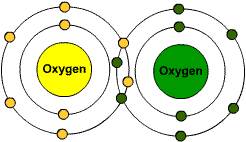
Which Lewis Dot Model drawing correctly shows an O2 molecule?


All of these structure formulas are correct, except for ___?
a.
b.
c.
d.

Which of the elements in the picture has correct electron dot notation?
1
2
3
4


What shape would a molecule have if it has 2 bonded pairs and 1 lone pair around its central atom? (It may help if you sketch this out)
Linear
Trigonal planar
Tetrahedral
Bent

What is the name of this molecule's shape?
Bent
Linear
Tetrahedral
Trigonal pyramidal

What 3-D shape would this molecule have: H2S ?
bent
tetrahedral
linear
trigonal pyramidal

What is the name of this molecular shape?
trigonal pyramid
tetrahedral
bent
trigonal planar

What 3-D shape would this molecule have?
Trigonal planar
Pyramidal
Tetrahedral
Bent
What 3-D shape would this molecule have?
tetrahedral
trigonal planar
trigonal pyramid
bent
Which best describes a triple bond?
3 shared pairs of electrons
3 shared electrons
a central electron with 3 atoms bonded around it
If an alkane has 10 carbon atoms, how many hydrogen atoms will it have?
20
22
40
42
Methyl group has the molecular formula
CH4
CH3
CH
CH2

Name this molecule:
pentane
hexane
heptane
octane

Name this molecule:
pentane
hexane
heptane
octane

Name this molecule:
pentane
hexane
heptane
octane

Name this molecule:
pentane
hexane
heptane
octane

Name this molecule:
methane
ethane
propane
butane

Name this molecule:
methane
ethane
propane
butane

Name this molecule:
methane
ethane
propane
butane

Name this molecule:
methane
ethane
propane
butane
is the alkene with 3 carbons in its chain.
Ethene
Propene
Methene
Decene
Is a characteristic of alkyles
Triple Bonded
Double Bonded
Single Bonded
Saturated

Is the name of the representation in the image
Condensed Formula
Line Diagram/Skeletal Formula
Structural Formula
Molecular Formula
The formula for ethene is
C2H4
C2H6
CH4
C3H6

