wayground logo

Free Printable Worksheets

Font size

S
M
L
XL
Worksheets

Quiz Practice

Total questions: 27

Worksheet time: 21mins

Name
Class
Date
1.
Which of the following sequences corresponds to a correct trend in ionization energy?
a)
Cl > S > P > Al
b)
Sr > Ca > Mg > Be
c)
Rb > K > Na > Li
d)
Rb > Sr > I > Xe
2.
Which element has the greater ionization energy?
a)
Strontium
b)
Boron
3.
Which element has the greater ionization energy?
a)
Lead
b)
Silicon
4.
Put the following in order of increasing ionization energy:Neon, Lithium, Carbon
a)
Lithium, Carbon, Neon
b)
Carbon, Lithium, Neon
c)
Neon, Carbon, Lithium
d)
Lithium, Neon, Carbon
5.
Put the following in order of increasing ionization energy:Tellurium, Sulfur, Selenium
a)
Tellurium, Sulfur, Selenium
b)
Selenium, Sulfur, Tellurium
c)
Sulfur, Selenium, Tellurium
d)
Tellurium, Selenium, Sulfur
6.
Put the following in order of increasing ionization energy:Cobalt, Tungsten, Ruthenium
a)
Tungsten, Ruthenium, Cobalt
b)
Cobalt, Tungsten, Ruthenium
c)
Ruthenium, Cobalt, Tungsten
d)
Cobalt, Ruthenium, Tungsten
7.
Put the following in order of increasing ionization energy:Sodium, Oxygen, Boron
a)
Sodium, Boron, Oxygen
b)
Oxygen, Boron, Sodium
c)
Sodium, Oxygen, Boron
d)
Oxygen, Sodium, Boron
8.

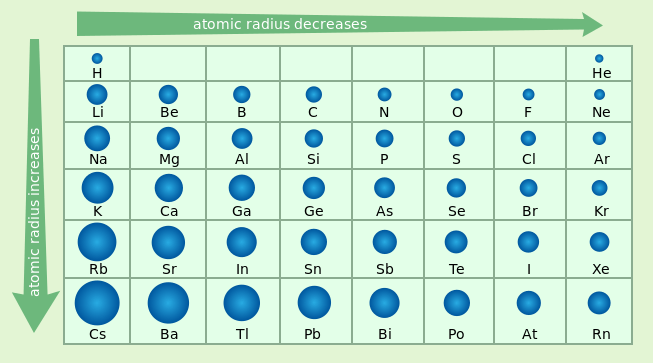
Which atom has a larger atomic radius based upon their relative positions on the periodic table?

a)

Sodium

b)

Argon

9.

What will occur as we go down the group? (choose all answer that applies)

a)

Shielding effect increase

b)

Size of atom decrease

c)

The attraction between the nucleus and valence electrons decrease

d)

Shielding effect decrease

10.
As you move down the periodic table atoms get bigger.  This is because ____________.
a)
The atoms have more mass.
b)
The atoms have more protons.
c)
The atoms have more energy levels
d)
The atoms have more nuetrons
11.
As you move across the periodic table atoms tend to get smaller because, ______________.
a)
the atoms have more mass.
b)
the atoms have less mass
c)
the atoms have more protons.
d)
the atoms have less electrons.
12.
Which atom has the largest atomic radius?
a)
potassium
b)
rubidium 
c)
francium
d)
cesium
13.
Which of the following will have a lower ionization energy than Scandium (Sc)?
a)
Helium (He)
b)
Titanium (Ti)
c)
Calcium (Ca)
d)
Magnesium (Mg)
14.

An electron that resides in the outermost energy level of an atom

a)

periodic trend

b)

electron shell

c)

ionic radius

d)

valence electron

15.

The period that an element is in on the periodic table, tells you what?

a)

Number of protons

b)

Number of electrons

c)

Number of valence electrons

d)

Number of energy levels

16.

How many valence electrons does this atom have?

a)

4

b)

2

c)

1

d)

3

17.

How many valence electrons does the element have?

E1 = 943

E2 = 1,950

E3 = 3,852

E4 = 5,492

E5 = 23,085

E6 = 26,791

E7 = 30,024

a)

1

b)

2

c)

3

d)

4

e)

5

18.

The first seven ionisation energies of element M are 786, 1577, 3229, 4356, 16080, 19790 and 23780 kJ mol-1. In the Periodic Table, element M is in group

a)

3

b)

2

c)

12

d)

14

19.
Which element has the greater ionization energy?
a)
Lead
b)
Silicon
20.

Which element can have the following ionization energies: 100, 700, 900, 1000?

a)

K

b)

Mg

c)

O

d)

F

21.
What creates a SHIELDING EFFECT by interfering with the attractive forces between the protons and the electrons.
a)
nucleus
b)
valence electrons
c)
core electrons
d)
protons
22.
As you move down a group, shielding 
a)
increases because there are more  orbitals
b)
increases because there are more protons
c)
decreases because the atomic radius increases
d)
stays constant because the number of valence electrons stays the same
23.
Which of the following elements has the largest shielding effect?/
a)
Li
b)
Na
c)
K
d)
Rb
24.
As you move down the periodic table atoms get bigger.  This is because ____________.
a)
The atoms have more mass.
b)
The atoms have more protons.
c)
The atoms have more energy levels
d)
The atoms have more nuetrons
25.

Which of these has the largest atomic radius?

a)

oxygen

b)

fluorine

c)

sulfur

d)

chlorine

26.

Atomic radius generally increases as we move __________.

a)

down a group and from right to left across a period

b)

up a group and from left to right across a period

c)

down a group and from left to right across a period

d)

up a group and from right to left across a period

27.

Order the following from smallest to largest atomic radius:

Ra, Be, Ca, Rb, H

a)

Ra, Be, Rb, H, Ca

b)

Rb, H, Ca, Be, Ra

c)

Ra, Rb, Ca, Be, H

d)

H, Be, Ca, Rb, Ra