
 Worksheets
review
Total questions: 63
Worksheet time: 32mins
Name
Class
Date
1.
What is the 1st Amendment?
a)
Speedy CIVIL trial
b)
No Sheltering Soldiers in your home
c)
No Cruel or Unusual Punishment
d)
Freedom of Religion, Assembly, Press, Petition, Speech
2.
What is the 10th Amendment
a)
Freedom of Religion, Assembly, Press, Petition, Speech
b)
No Self Incrimination; Due process
c)
State Power; rights not given to federal government are reserved for the states
d)
Policemen need warrants and probably cause for searches and seizures
3.
What is the 2nd Amendment?
a)
Speedy Civil trial
b)
No sheltering soldiers in your home
c)
Right to Bear Arms
d)
People Power
4.
What is the 9th Amendment?
a)
Speedy Civil Trial
b)
No sheltering soldiers in your home
c)
Right to Bear Arms
d)
People Power, rights not listed in the constitution are still protected
5.
What is the 8th Amendment?
a)
No Self Incrimination; Due process
b)
No Cruel or Unusual Punishment
c)
No Sheltering Soldiers in your home
d)
Right to Bear Arms
6.
What is the 3rd Amendment?
a)
No Self Incrimination; Due process
b)
No Cruel or Unusual Punishment
c)
No Sheltering Soldiers in your home
d)
Right to Bear Arms
7.
What is the 7th Amendment?
a)
Right of trial by jury in civil cases.
b)
People Power
c)
Right to Bear Arms
d)
Freedom on Religion
8.
What is the 5th Amendment?
a)
Right to due process of law, freedom from self-incrimination, double jeopardy.
b)
No quartering of soldiers.
c)
Right of trial by jury in civil cases.
d)
Powers reserved to the states.
9.
What is the 4th Amendment?
a)
Freedom from unreasonable searches and seizures.
b)
Freedom of religion, speech, press, assembly, and petition.
c)
Rights of accused persons, e.g., right to a speedy and public trial.
d)
Powers reserved to the states.
10.
What is the 6th Amendment?
a)
Right to due process of law, freedom from self-incrimination, double jeopardy.
b)
Right of trial by jury in civil cases.
c)
Rights of accused persons, e.g., right to a speedy and public trial.
d)
Other rights of the people
11.

The rights shown below are considered unalienable because –
a)
the government cannot take them away
b)
they were approved by Parliament
c)
the Magna Carta had granted them to all free men
d)
they were the rights of Englishmen that colonists assumed they had
12.
What is a change to the Constitution called?
a)
Bill of Rights
b)
A Bill
c)
A treaty
d)
Amendment
13.
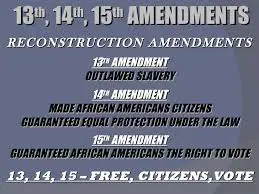
What is an appropriate title for this chart?
a)
Reconstruction Amendments
b)
State Changes to the Constitution
c)
Civil War Decisions
d)
Confederate Amendments
14.
The first ten amendments to the U.S. Constitution are important because they
a)
establish a system of checks and balances in the federal government
b)
provide protection for the rights and liberties of individuals
c)
provide guidelines for the structure of the federal government
d)
list the powers that are reserved for state governments
15.
What is “freedom of the press”?
a)
The right of anyone to hold whatever opinion they want
b)
The right to bear arms
c)
The right to criticize the government if you want to
d)
Right for the news media to investigate and report any issue they want
16.
Abolitionists were allowed to speak their views on slavery because
a)
free speech is guaranteed in a democratic society
b)
they were trying to get freedom of speech made into law
c)
they were promoting women’s rights.
d)
abolitionists were responsible for democratic ideals.
17.
Why is the freedom of speech important in a democratic society?
a)
To ensure that everyone agrees with the way the government is running things.
b)
To allow criticism of the government without fear of punishment.
c)
To allow the opinions of the important and influential Americans to be heard.
d)
To make sure that the government does not interfere with the media.
18.

The items in the picture are rights guaranteed in the?
a)
5th Amendment
b)
3rd Amendment
c)
1st Amendment
d)
9th Amendment
19.
The branch of government that makes the laws, and includes Congress is the:
a)
Executive Branch
b)
Legislative Branch
c)
Judicial Branch
20.
Life, liberty and the pursuit of happiness are examples of –
a)
Amendments
b)
Principles
c)
Unalienable rights
d)
Grievances
21.
What was the INITIAL reason so many European explorers sailed to the Americas?
a)
To find new trade routes to Asia
b)
To form Military alliances
c)
To spread Christianity to Africa
d)
To find new sources of cheap labor
22.
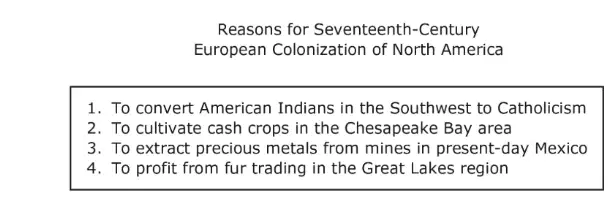
Which of these describe the primary reason for French colonization?
a)
1
b)
2
c)
4
d)
3
23.
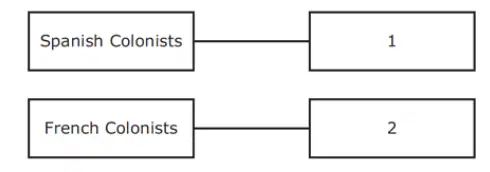
Which pair of actions best completes this graphic?
a)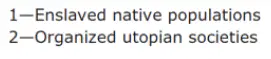
F
b)
G
c)
H
d)
J
24.
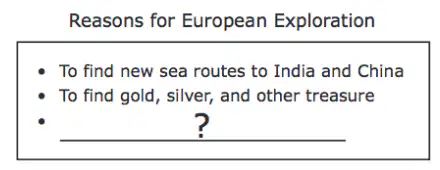
Which reason best completes this list?
a)
spread democratic ideals
b)
improve efficiency
c)
locate potential military allies
d)
claim new territory
25.
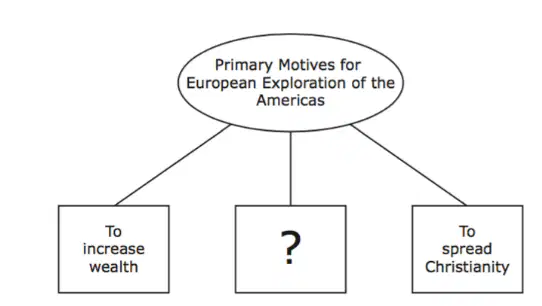
Which motive best completes the diagram?
a)
to promote free enterprise
b)
to extend democracy
c)
to expand empires
d)
to found utopian communities
26.
Which of the following was a primary reason France sought to colonize North America?
a)
to reduce overpopulation in Europe
b)
to create communities founded on religious tolerance
c)
to profit from trading in furs and other goods
d)
to create joint ventures with other European powers
27.
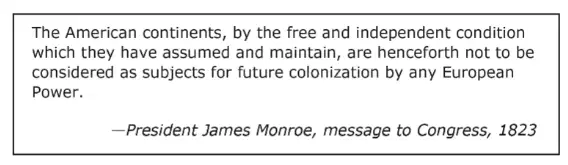
What was the main reason President Monroe made this statement?
a)
To strengthen political alliances with European allies
b)
To address European competition for natural resources
c)
To increase US military Readiness for European expansionism
d)
To prevent European intervention in countries near the United States
28.
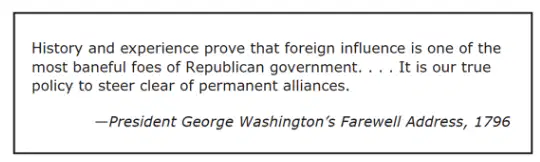
The ideas expressed in this quote is that the United States should avoid
a)
Becoming involved in the political Affairs of other countries
b)
Being a part of a global trade Network
c)
Establishing US territories overseas
d)
Allowing US citizens to emigrate
29.
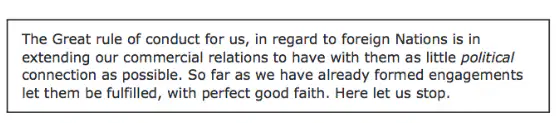
Which of the following is a source of this statement on foreign policy?
a)
George Washington's farewell address
b)
The Monroe Doctrine
c)
Abraham Lincoln's first inaugural address
d)
Federalist Papers
30.
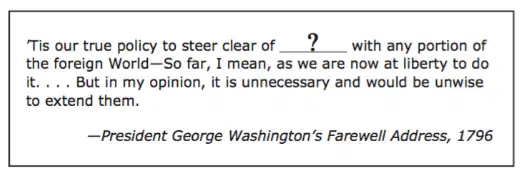
Which phrase completes this excerpt?
a)
Colonial settlements
b)
Protective tariffs
c)
Permanent alliances
d)
Territorial disputes
31.
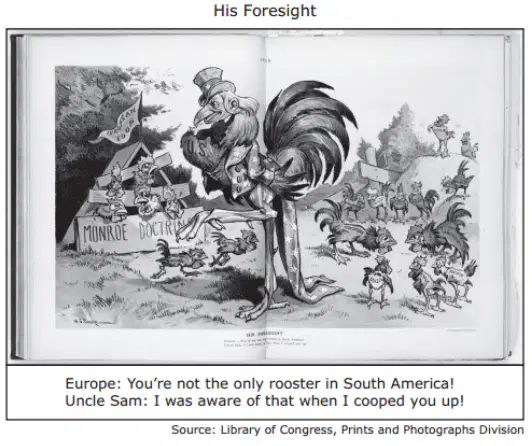
The US foreign policy Illustrated in this cartoon was intended to
a)
Prevent further European colonization in the Western Hemisphere
b)
Deter Spain from inciting Revolutions in former US colonies
c)
Encouraged European powers to invest in Latin America
d)
Keep the war between France and Spain from spreading to Latin America
32.
Which of these best summarizes the Monroe Doctrine?
a)
The immigration of Europeans to the United States must be discouraged
b)
International Peace can be maintained without complicated alliances
c)
The power to nullify federal laws is necessary to preserve sovereignty
d)
Further colonization of the Americans by European countries is prohibited
33.
How did the Cotton Gin contribute (help) to the expansion of slavery?
a)
reduced the number of slaves needed to grow cotton
b)
increased the time needed to cultivate (grow and pick and prepare for sale) the crop
c)
increased the profitability of slavery (more slaves = more $)
d)
reduced the demand for raw cotton (less people used the product)
34.
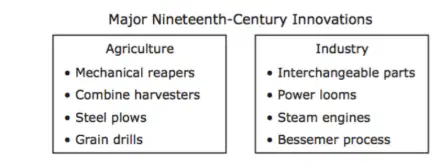
These innovations in agriculture and industry resulted in -
a)
Higher consumer costs (consumer = buyers)
b)
Decreased profits for investors (people who have paid into the business)
c)
Less consumer choice
d)
more efficient production of goods
35.
How did life change during the Industrial Revolution?
a)
manufacturers instituted (put in place) a 5 day work week
b)
Labor laws required factories to provide a safe working environment
c)
Education was required to work in industries
d)
production of goods transitioned (changed) from being made in the home to being made in factory systems
36.
What impact did the War of 1812 have on the United States?
a)
Manufacturing increased because a British blockade forced the country to start manufacturing their own goods
b)
Small farmers benefited from higher export prices for grain crops
c)
Britain no longer controlled any lands in North America which allowed the United States to expand across the entire continent
d)
New trade alliances resulted in increased foreign investment (interest)
37.
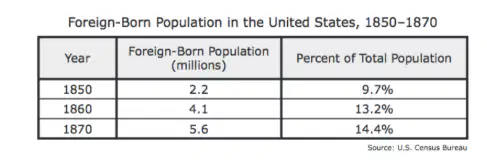
Thinking about the factors of Industrialization, what was one result of the trend shown in this table was the -
a)
new available labor force (workers)
b)
creation of specialized trade guilds (group of same specialized workers)
c)
decrease in educational opportunities for women
d)
increase in production costs for factory owners
38.
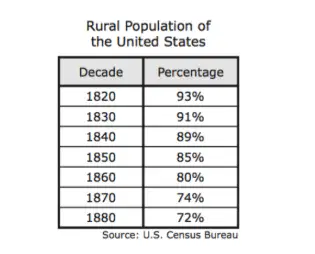
Why do we see a decrease in rural population from 1820 to 1880?
a)
The potato famine caused a lot of people to die from lack of food
b)
Many people migrated from the United States to other countries
c)
More people moved to the city (urban) to pursue (look for) new job opportunities
d)
New inventions caused a decrease of food production in rural areas
39.
Urbanization is
a)
moving from urban areas to rural areas
b)
the development of industries
c)
moving from rural areas to urban areas
d)
the basic structure and organization of a country
40.
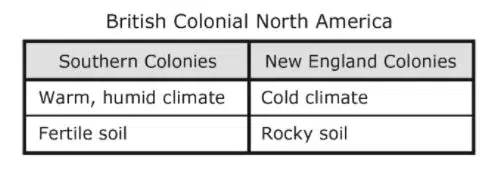
The geographic factors in this table led primarily to the-
a)
funding of trade schools in some colonies
b)
development of different economies in the two regions
c)
establishment of import taxes in some colonies
d)
pattern of differences in the two regions
41.
Boston and New Orleans were both founded as-
a)
port cities
b)
farming communities
c)
industrial centers
d)
military outposts
42.
How did geography influence the early economic development of New York, Boston, and Charlestown?
a)
Long coastlines offered abundant natural resources
b)
proximity to flooding rivers limited development
c)
Natural Harbors provided access to markets
d)
extreme climates limited productive activity
43.
Boston, Massachusetts, and San Francisco, California, are geographically similar in that they BOTH-
a)
have a Mediterranean climate
b)
are located near active volcanoes
c)
have a hot desert climate
d)
are located on a coast
44.
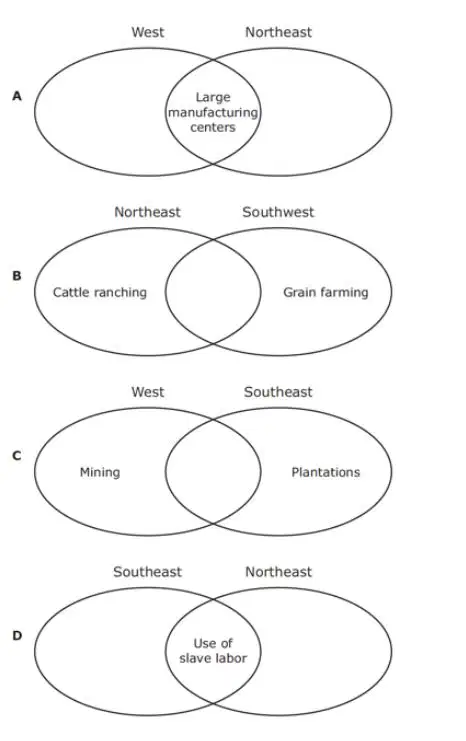
Which diagram correctly compares two regions of the United States during the mid-nineteenth century?
a)
A
b)
B
c)
C
d)
D
45.
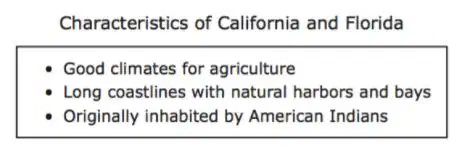
Which of these characteristics also describes these two states?
a)
founded as work colonies for debtors
b)
former slave states
c)
were havens for religious dissenters
d)
Former Spanish colonies
46.
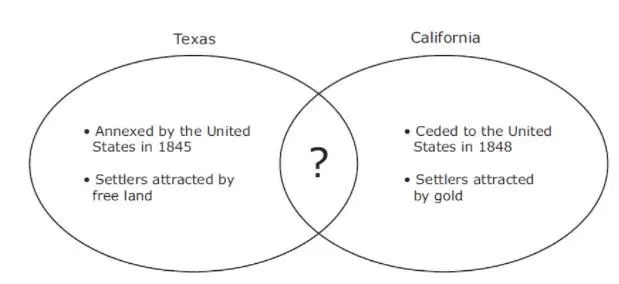
Which of the following best completes the diagram above?
a)
slaveholding state
b)
bordered by the Pacific
c)
Formerly part of Mexico
d)
Dependent on heavy industry
47.
Which factors encouraged more immigrants to settle in northern states than southern states during the mid-nineteenth century?
a)
Northern states had lower population densities
b)
Citizenship requirements in southern states were not as strict
c)
Southern states had smaller industrial sectors
d)
Governments in northern states were less corrupt
48.
Which excerpt from the US Constitution best illustrates the principle of popular sovereignty?
a)
"Each House should be the judge of elections, returns, and qualifications of it's own members"
b)
"The House of Representatives shall be composed of Members chosen every Second year by the people of the United States..."
c)
"The Senate shall chuse their other officers, and also a President pro tempore..."
d)
"The Times, Places, and Manner of holding elections for Senators and Representatives shall be prescribed in each state by the Legislature thereof..."
49.
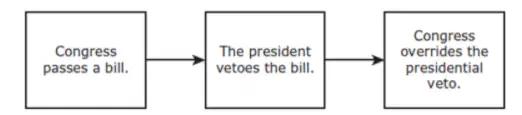
Which principle of U.S. government is illustrated in the sequence shown below?
a)
Judicial Review
b)
Checks and Balances
c)
Popular Sovereignty
d)
Federalism
50.

Which principle of the U.S. government is clearly reflected in the amendment below?
a)
Checks and Balances
b)
Federalism
c)
Separation of Powers
d)
Due Process
51.
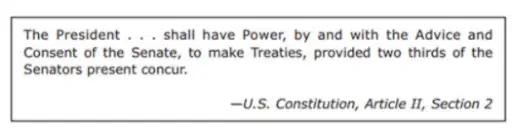
This excerpt provides one example of which constitutional principle?
a)
Federalism
b)
Checks and Balances
c)
Popular sovereignty
d)
Individual Rights
52.
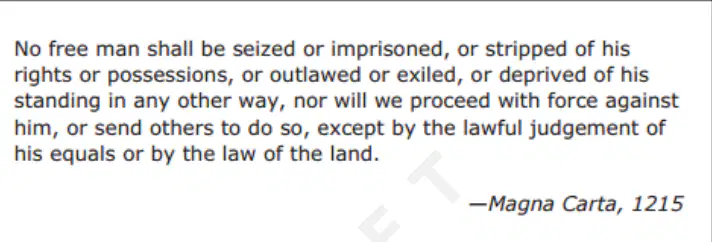
Which political idea was influenced by this provision of the Magna Carta?
a)
Federalism
b)
Due Process
c)
Bicameral Legeslative
d)
The Social Contract
53.

Which document was the focus on this presentation?
a)
A. The Mayflower Compact
b)
B. The Articles of Confederation
c)
C. The Virginia Declaration of Rights
d)
D. The Declaration of Independence
54.
Which phrase best represents the U.S. principle of republicanism?
a)
The creation of a Congress to carry out the will of the people
b)
The establishment of courts to interpret laws and government actions
c)
The division of power between a federal government and state governments
d)
The power of a court to declare a law unconstitutional
55.
Why is the Battle of Saratoga considered a turning point in the Revolutionary War?
a)
A. The British victory extended the fighting for another year.
b)
B. The American defeat led many soldiers to desert the Continental army.
c)
C. The British defeat marked the beginning of a steady decline in British military superiority.
d)
D. The American victory convinced France to ally with the United States.
56.
First and Last Name
4 lines
57.
How did immigrants most contribute to the rapid industrialization of the United States during the early-to -mid -1800's?
a)
By serving as an inexpensive source of labor
b)
By raising the money needed for investment
c)
By introducing skilled craftsmanship in cottage industries
d)
By designing the methods used t mass produce goods.
58.
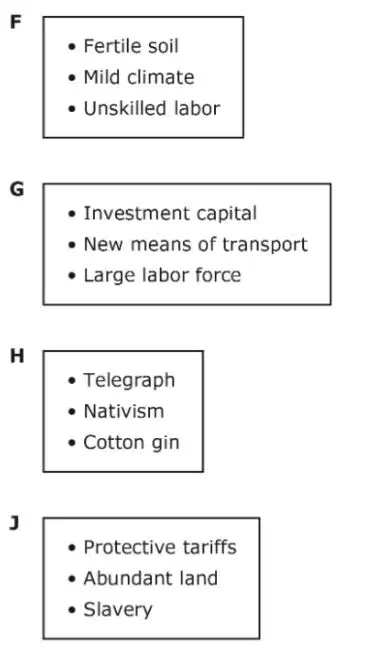
Which Box lists three factors that contributed most to the rapid industrialization and urbanization of the United States?
a)
F
b)
G
c)
H
d)
J
59.
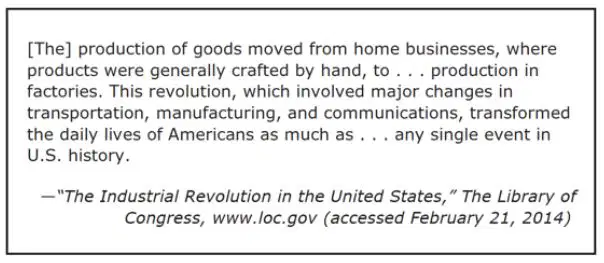
Which of the following was most responsible for the revolution described in this excerpt?
a)
Expanded public education
b)
Rapid technological innovation
c)
Increased government spending
d)
Rapid territorial expansion
60.
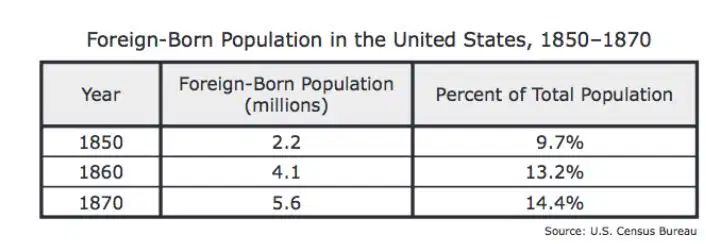
One result of the trend shown in this table was the--
a)
expansion of available labor
b)
creation of specialized trade guilds
c)
decrease in educational opportunities for women
d)
increase in production costs for manufacturers.
61.
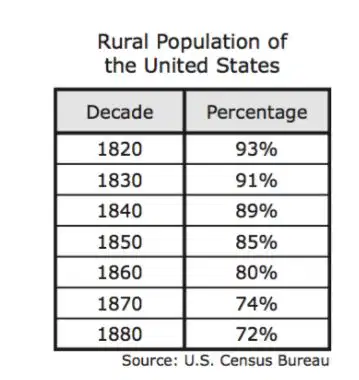
Which factor accounts for this trend?
a)
The Second Great Awakening motivated people to join reform movements.
b)
Manifest Destiny inspired many people to become homesteaders.
c)
Jacksonian Democracy allowed more people to vote in elections.
d)
The industrial Revolution encouraged people to pursue jobs in cities.
62.
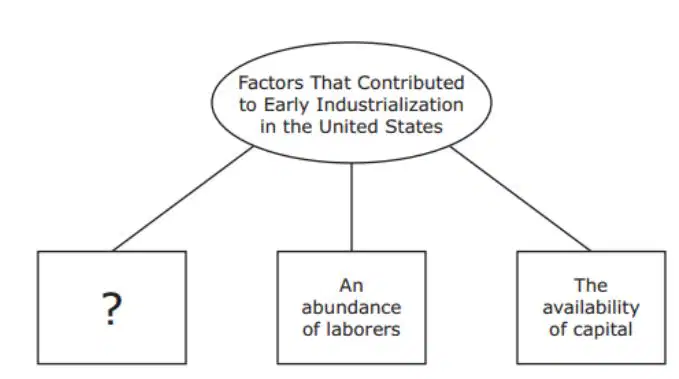
Which factor best completes this diagram?
a)
New transportation systems
b)
Increased government regulation
c)
A decline in agricultural production
d)
The growth of labor unions
63.
How did the development of the factory system encourage urbanization?
a)
Manufacturers produced goods to export overseas
b)
Labor unions were formed to protect mill workers
c)
Workers moved closer to manufacturing centers
d)
Industrialists invested in cotton plantations
100 %

