
 Worksheets
Physics Midterm Review Units 1 & 2
Total questions: 130
Worksheet time: 11hrs 50mins
Which sentence is the claim?
Air is matter.
We found that the weight of the ball increases by .5lbs each time we pumped more air into it.
This shows that air has weight, one of the characteristics of matter.
Which sentence is the evidence?
Air is matter.
We found that the weight of the ball increases by .5lbs each time we pumped more air into it.
This shows that air has weight, one of the characteristics of matter.
Which sentence is the reasoning?
Air is matter.
We found that the weight of the ball increases by .5lbs each time we pumped more air into it
This shows that air has weight, one of the characteristics of matter.
Which of these is relevant evidence to this claim: Plants in bigger pots will grow taller.
The researchers placed plants in pots of different sizes and let them grow for one month.
Some plants grow taller than others when grown in large pots.
According to the data, a plant grown in a 5 cm pot only grew to be 4 cm tall, where as a plant in a 10cm pot grow to be 8 cm tall.
The researchers observed 10 plants total, 5 planted in smaller pots and 5 planted in larger pots.
Which reasoning explains the following evidence? "According to the data, a plant grown in a 5 cm pot only grew to be 4 cm tall, where as a plant in a 10cm pot grow to be 8 cm tall."
When plants are placed in a bigger pot, the roots have more room to spread out, making it more optimal for a plant to grow taller.
Sometimes, plants just enjoy being in a bigger pot. When a plant enjoys its pot more it will grow taller
No one really knows why, it just happened.
The evidence supports the claim that plants grow taller in a bigger pot because a plant grown in a 5 cm pot only grew to be 4 cm tall, where as a plant in a 10cm pot grow to be 8 cm tall.
Which options provide relevant evidence to support the claim that students who get less sleep are more likely to perform poorly in academics. (Select up to two)
According to the study, students who went to sleep later, causing them to get less sleep, scored an average of 30% lower on their exams.
The claim of an article I read in another class was that students who sleep less do poorly on tests.
Students reported feeling more sluggish over all, making it hard to focus and do well on their exams.
According the the study, the kids were sleepy. When I am sleepy, I also do poorly on my assignments.
Which reasoning explains the following evidence? "According to the study, students who went to sleep later, causing them to get less sleep, scored an average of 30% lower on their exams."
When a person has had less sleep they can have a harder time remembering things, focusing, and reading. All of these can result in mistakes on an exam which could explain the lower score.
When a person has had less sleep they are often in a bad mood. Exams also put people in a bad mood.
I got an A on my last history test after studying all night, so maybe they did the experiment with people who are bad at studying?
The evidence supports the claim that people who get less sleep do poorly on exams because students who went to sleep later, causing them to get less sleep, scored an average of 30% lower.
If the prompt is, "Is there a best color notebook to use for your science class?", which of the following would make a good claim?
Yes, there is a best color but I'm not telling.
There is no single "correct" color to use for a science notebook.
There is only one correct color to use as a notebook for any subject.
I have always used purple notebooks for science class.
If the prompt is, "Do students who sleep get better grades?
No, students who sleep do not study.
Students who are well rested are likely to be able to focus, remember information, and participate in class.
I will test this by sleeping in class.
Yes, I think so.
What does CER stand for
Certainty, Experience, Reality
Circular, Experiment, Rotation
Crime, Expedition, Revolution
Claim, Evidence, Reasoning

What is a quantitative observation you can make about the picture you just saw?
The blocks are made of wood
That they block are light brown
The blocks are about 15.5 cm long
That the block longer than they are wide and wider than they are tall

Which is a qualitative observation made about this forest?
The average tree diameter is 500 cm
The light that filters through the trees are in the 510 nm range
The forest floor is a healthy green color
Average height of the trees is 50 ft.
Match the following quantities and units of measurement
kilograms
mass
Meters
Length
Degrees Celsius
Temperature
Liters
Volume
Seconds
Time
Match the following quantities and units of measurement
Milligrams
mass
Millimeters
Length
Degrees Kelvin
Temperature
Milliliters
Volume
Milliseconds
Time

A student recorded that the metal bar is 7.1 cm long. what part of this measurement is the uncertainty digit?
There are no uncertainty digits.
1 is the uncertainty digit
7 is the uncertainty digit
Both 7 and 1 are uncertainty digits
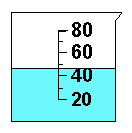
Which of the following is the best estimate of the volume of the liquid including the uncertainty digit? The volume markings on the beaker are in Milliliters.
48 mL
48.2 mL
48.25 mL
50 mL

What is mass of the measurement above including the uncertainty digit?
21.16 g
21.164 g
21 g
21.1643 g

What is the length of this object including your uncertainty digit?
3.2 cm
3.12 cm
3 cm
3.219 cm

What is the temperature indicated by this thermometer? Include your uncertainly digit.
24.2 °C
24.05 °C
24 °C
25 °C
A student measures this metal bar. Which of the following is an accurate measurement including the uncertainty digit?
7 cm
7.1 cm
7.05 cm
7 km
Identify independent, dependent and control variables for the following experiment:
Does the amount of candy offered as payment affect how much laundry my little sister will fold?
Candy offered (measured in pieces)
Independent Variable
Pairs of socks folded
Dependent Vaiable
amount of time after eating a meal
Control Variable
Identify independent, dependent and control variables for the following experiment:
Does the height above the ground a phone is dropped from affect how much damage the screen has from the drop?
height above the ground
Independent Variable
Size of cracks in the screen
Dependent Vaiable
Surface the phone is dropped onto (stone tiles, wood floors, carpet, grass).
Control Variable
Choose the best hypothesis for "What is the effect of putting Cooking Spray on the bottom of a sled?"
I think I will fall off the sled more often.
If I put Cooking Spray on the bottom of my sled then the sled will get very hot while it slides.
If I put Cooking Spray on the bottom of my sled it will be more slippery and let me slide faster

A scientist hypothesizes the the temperature at which an alligator's egg is incubated will determine whether the alligator will be male or female. The independent variable is
the male alligators
the gender of the alligator
the temperature
the incubator

A scientist hypothesizes the the temperature at which an alligator's egg is incubated will determine whether the alligator will be male or female. The dependent variable is
the temperature
the size of the baby alligators
the incubator
the gender of the baby alligators

A students was doing an experiment using the scientific method. One plant is placed in dim light and the other is placed in bright light. Every three days the student plans to count the green leaves. Which would be a good hypothesis for this experiment?
Neither plant will grow, they only grow in sunlight
If plants are places in bright light, then they will grow more green leaves than in dim light.
If plants are place in clay pots, then they will grow more green leaves than plastic pots.
If plants are in warmer temperatures, then they will grow more green leaves.
What materials would be needed to conduct the following experiment "What is the effect of putting Cooking Spray on the bottom of a sled?" Select all that are correct.
Cooking Spray
A snowy hill to slide down and the distance the sled will move.
A sled with a rider
A stopwatch or phone to find how long it takes to slide down the hill.
A cool teacher
What materials would be needed to conduct the following experiment "How does the brightness of a grow light affect how many leaves a plant grows?" Select all that are correct.
At least two plants
A room with a stable temperature
Dim and bright grow lights
A stop watch
Sunny Weather
Re order the following steps to create an experimental procedure to test the hypothesis that plants will grow more leaves in bright light.
Select 8 plants of the same type and size and place 4 in the dim light and 4 in the bright light.
Clip each plant so that they have the same number of leaves.
Allow the plants to grow for three months with all plants getting the same amount of water and fertilizer
Count the number of leaves on each plant and record this number.
Place your data into a visual organizer like a graph or table to show your results.
Re order the following steps to create an experimental procedure to test the hypothesis that chocolate ice cream has more mass than vanilla ice cream
Select 20 measuring cups, measure and record the mass of each one.
Carefully fill each cup so that 10 are filled with vanilla and 10 are filled with chocolate
Record the mass of each filled cup and then subtract the mass of the measuring cup to find the mass of the ice cream.
Average the masses of the 10 cups of vanilla ice cream. Then average the masses of the 10 cups of chocolate ice cream.
Report your findings and clean up
Find the average of the numbers below:
3, 2, 1, 3, 2, 1, 3, 2, 1, 3, 2, 1
3
2
1
4
Find the average of the numbers below:
1, 8, 7, 5, 6, 4, 7, 6
5
5.5
6
6.5
Find the average of the numbers below:
20, 30, 24, 32
26.5
27.5
27
27.5

Student A
Student B
Student C
Cannot be determined

High Accuracy & High Precision
High Accuracy & Low Precision
Low Accuracy & High Precision
Low Accuracy & Low Precision
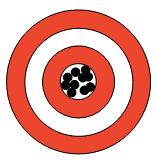
This bullseye demonstrates...
High Accuracy & High Precision
High Accuracy & Low Precision
Low Accuracy & High Precision
Low Accuracy & Low Precision
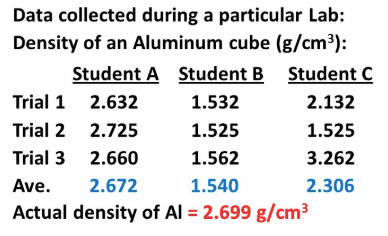
Which student is the most ACCURATE?
A
B
C
A group of students are using a ruler to measure the diameter or a power cable. Which of the following is a possible source of error? (select all three correct answers)
The students do not keep the wire straight and measures a diagonal section.
Three different students measure the wire power cable and then average their results.
The students don't place one side of the cable at the zero on the ruler and forget calculate the change from start to finish.
The students use the inches side of the ruler but record their result as centimeters.
A group of students are using a scale to measure the mass of a cookie. Which of the following is a possible source of error? (select both correct answers)
The students forget to zero the scale between trials
The students take turns putting the cookie on the scale.
The students use the same cookie for every trial.
A students takes a bite out of the cookie between trials.
Which of the following could be sources of error for future labs in our class that you might not be able to control or avoid? Mark all that apply.
Hint: These sources of error are the reason we conduct multiple trials and then average the results.
Measuring incorrectly with our tools.
Not reading the directions before starting.
imperfect equipment introducing random variables
lack of practice with procedures leading to small mistakes by the experimenter.
Reorder the following units from largest to smallest
Kilogram
gram
centigram
milligram
Reorder the following units from largest to smallest
Kilometer
meter
centimeter
millimeter
Convert 23 centimeters into meters
0.023m
2300m
0.23m
23,000m
Convert 1 kilometers into millimeters
1,000,000 mm
1,000 mm
0.001 mm
0.000001 mm
Convert to scientific notation:
520,000,000
52 x 107
5.2 x 10⁷
5.2 x 10⁸
0.52 x 10⁹
.000457
457 x 106
457 x 10-6
4.57 x10⁴
4.57 x 10⁻⁴
The distance from Venus to Earth is 2.61 x 10⁸ kilometers. What is this distance in standard notation?
261,000
261,000,000
261.8
26,100,000,000
Rank the following from the largest to smallest measurements of distance
1 km
1x10² m
1 m
1 cm
1 mm
Rank the following from the largest to smallest measurements of distance
1 km
1 m
1 cm
1 mm
3.2x10⁻⁵ m
Rank the following from the largest to smallest measurements of distance
1x10³m
3 m
1x10⁻²m
3 mm
3.2x10⁻⁵ m
Which of the following are Scalar Quantities (select all that apply)
Time
Velocity
Displacement
Mass
Which of the following are Vector Quantities (select all that apply)
Time
Velocity
Distance
Mass
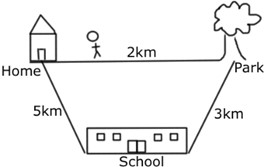
Jerry walked from home to school, then from the school to the park. What is his total distance?
2 km
5 km
8 km
10 km

If you walk from your home in the figure above to the library and then to the park. What is your displacement
0.75km
1.35km
1.7km
2.0 km
Her distance and displacement are both zero.
Her distance is zero, but her displacement is 200 meters.
Her distance is 200 meters, but her displacement is zero.
Her distance and displacement are both 200 meters.
v
The variable for Velocity
sm
The Units for Velocity
t
The variable for time
s
The unit for time
v=tΔd
The equation for finding velocity
Δd=v⋅t
The equation for finding displacement from velocity
t=vΔd
The equation for finding time from velocity
Δ
The symbol for change
Jose walked 4 km in a straight line at 2 km/hr. How long did Jose walk for?
2 hours
8 hours
0.5 hours
2 km
A vehicle travels 2345 m in a straight line toward the evening sun for 315s. What is its velocity?
7.44 m/s
0.13 m/s
738,675 m/s
7.44m
What the car's displacement be after traveling with a velocity 18 m/s travel for 3600 seconds?
77.7 km
64.8 km
51.7 km
67.7 km

What is the independent variable for this graph?
iPhone Charging Speed
Time (minutes)
Capacity (% charged)
The origin

What is the dependent variable for this graph?
Leona's Job Earnings
Newspapers Delivered
Total Pay (dollars)
There isn't one.

What is the IV?
Hours of Sunlight Exposure
Number of Tomatoes on Each plant
Size of the tomatoes
number of clouds each day

If you were graphing this table on a grid that had 10 available spaces horizontally and vertically which of the following options would make the easiest to read and most accurate graph?
every horizontal space is worth 4.5 hours. Every vertical space is worth $0.5
every horizontal space is worth 1 hours. Every vertical space is worth $36
every horizontal space is worth 5 hours. Every vertical space is worth $10
every horizontal space is worth 0.5 hours. Every vertical space is worth $4.5
If you were to graph this data set and your graph had 10 vertical lines to place your data on, how much would each line need to be worth to get an easy to read graph?
Each line should always be worth 1 and I can use a ruler to extend the graph space.
If I count by twos it will be easy to estimate the odd numbers half way between lines and I'll have enough space.
I can place 3 on the first line, 8 on the second, 11 on the third, 8 again on the fourth. I'll only need 6 of the lines.
The first number is 3 so I should count by 3s.

Which data table matches the graph.


Which data table matches the graph.


Which graph matches the data table?


Which statement below accurately represents the graph?
as the hours worked increases the dollars earned increases at an increasing rate
as the dollars earned increases the hours work decreases.
as the hours worked increases the dollars earned increases at a constant rate
as the hours worked increases the dollars earned decreases at a constant rate
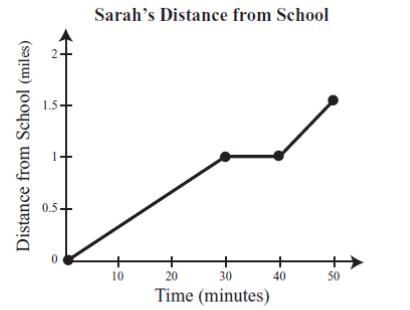
Which of the following is the best interpretation of the graph shown?
Sarah travels towards school at a slower constant rate for 30 min, is stopped for 10 min, and then travels quickly for 10 min
Sarah travels away from school at a slower constant rate for 30 min, is stopped for 10 min, and then travels quickly for 10 min
Sarah speeds up as she moves away from school, except where she got stuck at a red light.
Sarah has a friend who lives 30 minutes away from school.

Which dot diagram best reflects the motion shown?


Match the dot diagrams to the motions shown in the animation
Red Car
Green Car

Blue Car

The observer watching them

Which dot diagram best reflects the motion shown?
Match the following Dot Diagrams with the type of motion they show

At Rest

Moving with a Constant Velocity
Speeding Up

Slowing Down
Match the following Graphs with the type of motion they show

At Rest

Moving with a Constant Velocity

Speeding Up

Slowing Down
Match the following Graphs with the type of motion they show

At Rest

Moving with a Constant Velocity

Speeding Up

Slowing Down
Match the following Data Tables with the type of motion they show

At Rest

Moving with a Constant Velocity

Speeding Up

Slowing Down
Which diagrams show acceleration
Which Graphs show Constant Velocity?


Which data tables show acceleration?


Match the following terms with a good description of them
An observable and measurable truth.
Fact
An explanation of why observed patterns happen
Theory
A description of what effect will happen because of a given cause
Law
A prediction based on past evidence and experimentation
Hypothesis
Match the following ideas with why they are important to science
By observing this we gain the information we need to ask good questions and test our ideas.
Fact
By learning this we can connect observed cause and effect relationships to bigger ideas and predict outcomes from similar events.
Theory
By using this we can reliably predict the outcome to specific events.
Law
By forming this we gain a starting point to conduct an experiment and learn more.
Hypothesis
Watch as Blake begins to run. What happens to the sheets of paper under his feet? Why?
Mira como Blake comienza a correr. ¿Qué pasa con las hojas de papel bajo sus pies? ¿Por qué?
Blake runs so fast that the paper appears to move backwards but actually stays still
When Blake moves forward, the air moved into the space he had been and pushes the paper around.
When Blake pushes backwards on the paper the paper pushes forward on him. The paper moves backward and Blake moves forward.
Newton was wrong.
When you jump up, you push the earth downwards. Why does this cause you to move upwards?
You don't move upwards, you stay where you are and push the earth down. The earth isn't standing on anything so it easily moves.
The question is wrong because you can't push the earth downwards. To jump you pull yourself upwards.
Don't overthink it. it just works.
When you push down on the earth it pushes back up on you. The upward force of the earth in reaction to your downward push makes you move up.
A player throws a ball. Which of the following correctly describes the applied and reaction forces?
The player pushing on the ball is the applied force. The ball pushing on the player is the reaction force.
The ball pushing on the player is the applied force. The player pushing back on the ball is the reaction force.
The player's hand moving is the applied force. The ball moving is the reaction force.
The player pushing on the ball is the applied force. The wind pushing on the ball is the reaction force.

When you drop a rubber ball on the floor it bounces back. During the bounce, which of the following describes the applied and reaction forces correctly?
The ground pulled the ball down (applied force) but the air pushes it back up (reaction force)
Gravity pulled the ball down (applied force) and when it hits the ground the ground pushes it back up (reaction force)
The air pushes the ball upward (applied force) while the person pushes it down (reaction force).
Darth Vader pulls it down (applied force) but Obi-wan pushes it up (reaction force).

Is there an outside force acting to create the motion you see in the animation?
The object's speed does not change, so there is no force
The direction the object moves is changing, there must be an outside force.
The center of the object doesn't move, so there is no outside force.
The object is above the ground, there is a downward force.

Which statement best summarizes the scientific concept shown in the cartoon?
A falling body accelerates at a constant speed.
The motion of an object is constantly changing due to magnetic forces.
The force of friction causes an object in motion to move faster.
A body in motion will remain in motion unless influenced by an outside force.

What best describes the balance of forces (net force) acting on the barbell while the weightlifter holds it steady (at rest) above his head?
The object is not in motion, so there the forces are balanced.
It is heavy, so the downward force must be stronger.
It is heavy but he is strong, so the upward force must be stronger
It you push and pull at the same time it will move to the side.
to confuse other scientists
to keep the theory interesting and fresh
to keep the theory as accurate and effective as possible
to make sure the general public does not understand the theory
Which of the following best describes how Newton's second law predicts what will happen to the acceleration of an object when the mass of an object increases?
If the mass increases the object will accelerate more.
If the mass increases the object's acceleration will not change.
The acceleration should decrease when the mass increases
If the mass increases, the force increases as well.
Which of the following best describes how Newton's second law predicts what will happen to the acceleration of an object when the net force acting on object increases?
If the net force increases the object will accelerate more.
If the net force increases the object's acceleration will not change.
The acceleration should decrease when the net force increases
If the mass increases, the net force increases as well.
In order for the acceleration of an object to decrease which of the following must happen (select both correct options).
The net force acting on the object increases.
The net force acting on the object decreases.
The mass of the object increases (mass is added to the object).
The mass of the object decreases (mass is removed from the object).
Which of the following mathematically describe Newton's Second Law? There can be more than one correct option.
Fnet=m⋅a
Fnet=F1+F2+...
a=tΔv
a=mFnet
If the net force acting on an object is multiplied by 3, and the mass of the object stays the same, what happens to the acceleration of the object?
The acceleration stays the same because the mass stayed the same
The acceleration is multiplied by 9
The acceleration increases by 3s2m because of addition
The acceleration is divided by 3
If stuff is added to increase an object's mass to three times what it was before, but the net force used to accelerate the object stays the same, what happens to the acceleration of the object?
The acceleration stays the same because the net force the same
The acceleration is multiplied by 3
The acceleration decreases by 3s2m because of subtratction
The acceleration is divided by 3
Predict the change in acceleration that will be experienced if the net force acting on an object is doubled AND the mass of the object is also doubled.
The acceleration stays the same because the increased net force is balanced by the increased mass.
The acceleration is multiplied by 2 because the Net force is multiplied by 2.
Newton's second law cannot be used to predict this outcome.
The acceleration is divided by 2 because the mass is divided by 2
An 5kg object is being pushed with a net force of 10N. Which of the following shows the correct resulting acceleration?
2 s2m
0.5 s2m
50 s2m
5 s2m
An object is pushed with a net force of 6.0N. This results in an acceleration of 1.5 s2m . What is the mass of the object?
9.0 kg
4.0 kg
0.25 kg
4.5 kg
An 9.0 kg object is accelerated at 1.3 s2m . What was the magnitude of the net force which acted on it?
10.3 N
6.9 N
0.14 N
11.7 N

During which of the following intervals is the object experiencing an unbalanced net force
For the entire time from point A to Point B
For the entire time from point B to Point C
For the entire time from point C to Point D
For the entire time from point D to Point E

The table shows the speed of each car recorded at each second. Which car(s) traveled are experiencing a balanced net force for the entire 4 seconds?
A
B
C
D

During which intervals is the object not experiencing a net force (or is experiencing a net force of zero
A to B, D to E and G to H
B to C, D to E, and F to G
C to D, E to F and G to H
There is no point on the graph where the net force is balanced.

A student is investigating acceleration using balls with different masses. The student pushes each ball on a flat surface and records its acceleration. The table shows his observations.
The students then predicted the acceleration of a ball with 10kg of mass. Which of the following predictions includes good reasoning based on the data provided?
A ball with a mass of 10 kilograms will have an acceleration of 3.3 S2m because that is the largest acceleration recorded.
A ball with a mass of 10 kilograms will have an acceleration of 5.0 S2m because that is the double the acceleration of the 20kg ball and this ball has half of that mass.
A ball with a mass of 10 kilograms will have an acceleration of 1.25 S2m because that is the half the acceleration of an object with 20kg of mass and 10 is half of 20.
The student did not record a ball with 10kg of mass so it is impossible to predict if one will roll or have an acceleration at all.

The graph shows the velocity versus time for 4 different cars on a race track. If all four cars have the same mass, which one experiences the largest net force?
A
B
C
D
The graph shows the velocity versus time for 4 different cars on a race track. If cars B, C, and D all experience the same net force, which car has the most mass?
B
C
D
Which of the following descriptions of net force best matches the graph shown?
(By tradition a force pushing to the right is written as positive and one pushing to the left is written as negative).
The net force goes to the right for two seconds, is balanced for two seconds, goes to the right stronger for one, is balanced again for three seconds, then is pushed to the left for 2 seconds.
The net force goes to the left for two seconds, is balanced for two seconds, goes to the left stronger for one, is balanced again for three seconds, then is pushed to the right for 2 seconds.
The object is pushed to the right with a net force at all points except from 8.0 seconds to 12.0 seconds.
The object is pushed to the left with a net force at all points except from 8.0 seconds to 12.0 seconds.
Which pair of graphs both accurately show an object experiencing a positive net force?


The table shows the speed of each car recorded at each second. If the cars have an equal mass, which one experienced the largest net force?
A
B
C
D

Which of the following descriptions matches the graph shown?
The object experiences a negative net force, then a positive net force, then a negative net force, then a balanced net force and then a positive net force.
The object experiences a positive net force, then a balanced net force, then a negative net force, then a balanced net force and then a negative net force.
The object does not move because it ends at 0.
The object experiences a balanced net force, then a positive net force, then a balanced net force, then a negative net force and then a positive net force.

How doe the pictures show heat transferring from the earth's surface into and throughout the air?
The air closer to the land always moves to the water and then rises into the sky, so cold air in the sky always falls to the land.
The air closer to the water always moves to the land and then rises into the sky, so cold air in the sky always falls to the water.
The air closer to the warmer surface moves up and away from that surface while the colder air falls and moves into the space that was left by the rising air
The air closer to the colder surface moves up and away from that surface while the hot air falls and moves into the space that was left by the rising air

Which of the following terms is used to describe the following situation:
Two fluids, one warm and one cold, mix. The warm fluid rises and the cool fluid sinks
Conduction
Convection
Seismic
Tectonic
Mantle

How doe the pictures show heat transferring from the earth's outer core into and throughout the Mantle?
The Mantle never moves, it is a single solid layer
The core lights some of the mantle on fire and it explodes upwards making volcanos.
The core heats the mantle lower down, which rises up and pushes colder mantle out of its way, the cold mantle then falls down into the space left by the rising mantle
The core cools the mantle lower down, which rises up and pushes hotter mantle out of its way, the hot mantle then falls down into the space left by the rising mantle

What happens to the crust at the places where the movement of the mantle splits (going left and right at the same time?)
Friction between the Mantle and the Crust causes a force to pull the crust in the direction of the moving mantle, causing plates to move apart.
Friction between the Mantle and Crust cause a force to shake the plate causing earthquakes
Friction between the mantle and plate sucks the plate down under the mantle causing magma to erupt
The rising mantle pushes up making mountains.

Which of the following terms describes the following situation:
Friction from the rising magma pulls the crust apart and then more magma rises into the gap. The new crust is higher up than the old crust to gravity pulls it down. The friction from the magma and gravity work together to pull the plates apart
Magma Flow
Slab Pull
Gravity Sled
Ridge Push
Which of the following terms describes the following situation:
When tectonic plates collide, the denser plate subducts. The crust rocks are denser than the mantle rocks, so gravity pulls it further down. This combination pulls the rest of the plate.
Subduction Slam
Slab Pull
Convection Tug
Ridge Push

A map of the mantle if the crust didn't exist
How the continents looked when they were part of Pangea
How the continents are arranged today
A fun world for a new Star Wars movie to happen on

According to the theory of continental drift, why do the coastlines of Africa and South America appear to fit together so well?
Africa and South America used to be joined together, but split apart long ago.
Africa and South America are drifting towards each other and will soon fit together perfectly.
Ocean currents on either side of the Atlantic have eroded the coastlines into the same shape.
Africa and South America are currently the same place but were once two different places

Lystrosaurus was a slow-moving, plant-eating reptile that lived over 250 million years ago. Fossils of Lystrosaurus have been found in the brown areas shown below. How is this explained by the existence of Pangaea?
Lystrosaurus swam across the oceans from one continent to another.
Lystrosaurus drifted on rafts of vegetation from one continent to another.
Africa, Antarctica, and India used to be joined together into a single landmass.
The fossils are actually of three different reptiles that look very similar.
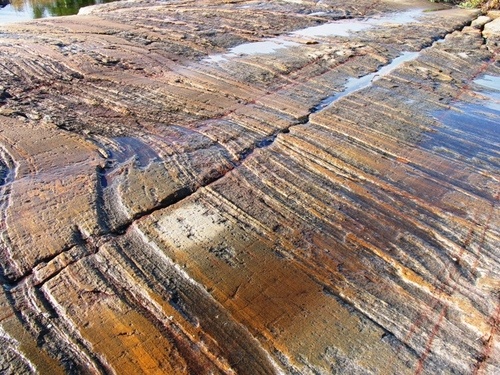
This is a picture of glacial scratches found in Africa. Which of the following statements best explains the presence of these glacial scratches?
Africa has always been near the equator
Africa was once in an area of the Earth that had a very cold climate
The equator of earth used to get cold while the poles would get hot. The climate moved but the earth did not.
Many small earthquakes happened which just look like glacial scratches
Which of the following is the correct order of the Earth's layers moving inward to the center.
Crust
Mantle
Inner Core
Outer Core
Mantle
Outer Core
Inner Core
Crust
Inner Core
Outer Core
Crust
Mantle
Outer Core
Inner Core
Mantle
Crust
Which of the following best describes the crust?
A hot liquid layer between 2,900 and 5,100km deep
A hot layer of plastic solid that is involved in the creation of new crust.
A thick solid rocky layer, older in the ocean than on the continents
A thin, solid, rocky layer, denser and younger in the ocean than on the continents
Which of the following best describes the Mantel?
A hot liquid layer between 2,900 and 5,100km deep
A hot layer of plastic solid that is involved in the creation of new crust.
A thick solid rocky layer, older in the ocean than on the continents
A thin, solid, rocky layer, denser and younger in the ocean than on the continents
Which of the following best describes the Outer Core?
A hot liquid layer between 2,900 and 5,100km deep
A hot layer of plastic solid that is involved in the creation of new crust.
A thick solid rocky layer, older in the ocean than on the continents
A thin, solid, rocky layer, denser and younger in the ocean than on the continents
Which of the following best describes the way seismic waves move through various matierals
Seismic waves always slow down over time
Seismic Waves always speed up over time
Seismic waves travel slower through hotter materials and faster through colder materials
Seismic waves travel slower through colder materials and faster through hotter materials

Which of the following is an accurate observation about the movement of seismic waves through the earth's mantel?
The waves do not always travel the same speed through the mantel which means that parts of the mantel have different temperatures
The waves do not always travel the same speed through the mantel because there are multiple types of waves in the mantel
The waves do not travel the same speed through the mantel because the moon is moving
The waves do travel the same speed through the mantel but there are additional layers we haven't discovered

The different speeds of seismic waves throughout the layers of the earth is proof that
We think there are layers because of errors in our data that we haven't been about to fix.
Layers have different colors which affect the speed the waves travels.
Layers have different average temperatures and composition which affects the speed the wave travels
Layers have different depths and waves change speed as they travel further

Which of the following seismic wave data sets is most likely to indicate a Volcano


Which of the following best explains how the motion of the mantel leads to new crust?
Cold spots in the Mantle lead to sinking areas which pull crust down causing valleys which then need to be filled.
Hot spots cause part of the mantle to rise and push apart old crust, creating new crust where the magma cools
Cold spots cause part of the mantle to rise and push crust pieces together, leaving holes in which magma can cool and become new crust
Hot spots in the mantle lead to slow moving areas which get covered up by cold spots, causing mountains.
What happens when the mantle pushes oceanic crust into the continental crust?
Since the continental crust is more dense, it subducts. This crust is very dry which makes the area at this boundary a desert
Since the oceanic crust is more dense, it gets subducts. This brings sea-water which causes the mantle to get colder and more solid
Since the continental crust is more dense, it subducts. This crust is very dry and gets hot as it moves so it melts into magma
Since the oceanic crust is more dense, it subducts. This brings sea-water which causes a reaction and makes magma

