
 Worksheets
astro quiz
Total questions: 79
Worksheet time: 40mins
A solar system contains ?
a primarily planets
large amounts of gas and dust but very few starts
large amounts of gas, dust, and stars
a single star and planets
thousands of super clusters
A galaxy contains ?
primarily planets
large amounts of gas and dust but very few stars
large amounts of gas, dust, and stars
a single star and planets
thousand of super clusters
how many centimeters are there in one kilometer ?
100
1000
10,000
100,000
1*10^6
scientific notation is used in science because
it make it easy to write large or small numbers
all astronomical distances are expressed in metric units
it makes conversations between units easy
all of the above
none of the above
the avg distance from earth to the sun is
1 ly
1 million km
1 million miles
1 billion km
1 AU
If light takes 8 minutes to reach earth from the sun and 7.3 hours to reach pluto, what is the approximate distance from the sun to pluto?
55 AU
7.3 AU
7.3 ly
0.6 ly
the sun is
a star
1 AU from earth
more than 100 times the diameter of earth
all of the above
If the nearest star is 4.2 light-years away then
the star is 4.2 million AU away
the light we see left the star 4.2 years ago
the star must have formed 4.2 billion years ago
the star must be very young
the star must be very old
the milky way galaxy
contains about 100 stars
is the largest known object to the universe
is about 75,000 light years in diameter
is located about 2.2 million light years from the sun
Which of the following is the largest ?
the diameter of earth
the diameter of the moon
the diameter of the sun
the diameter of Jupiter
the distance from earth to the sun
Which arrangement is in order of increasing size, left to right ?
planet, galaxy, star, solar system
planet, star, galaxy, solar system
planet, star, solar system, galaxy
solar system, galaxy, star, planet
the milky way galaxy
contains about 100 billion stars
is about 100 light years in diameter
is the largest know object in the universe
is located about 2.2 million light years from the sun
What does the size of the image of a star in a photograph tell us about the star ?
the diameter of the star
the brightness of the star
the mass of the star
the temperature of the star
the distance of the star
Which sequence is correct when ordered by increasing size ?
earth, solar system, milky way, galaxy clusters
solar system, earth, galaxy clusters, milky way
earth, milky way, solar system, galaxy clusters
galaxy clusters, solar system, milky way, earth
how is a planet different than a star ?
planets are larger than stars
planets reflect light while stars make their own light
stars move faster in the sky than planets
planets are brighter than stars
if we say that object is 1000 light years away we see it
as it looked 1000 years ago
as it would appear to our ancestors 1000 years ago
as it looked 1000 light years ago
as it is right now, but it appears 1000 times dimmer
The average distance from the earth to the sun is 1AU
true
false
The nearest star is 1ly from the solar system
true
false
A light year is the distance light travels in one year
true
false
A kilometer contains 1 million meters
true
false
the metric system is a decimal system
true
false
The sun is a star in the milky way galaxy
true
false
The local group contains the sun and only about two dozen other stars
true
false
A super cluster refers to a large group of stars within the milky way
true
false
A kilometer is a longer measure of distance than a mile
true
false
Mars is farther from the sun than the earth
true
false
In one way of naming stars, a ______ letter indicates its brightness relative to the other stars in the constellation
English
Arabic
Greek
Cyrillic
A constellation must consist of a number of stars, all
at the same distance from the earth
at various different distances from the earth
within a boundary in the same general angular area of the sky
constellations are made of planets only
Although the constellation originated in Greek and Middle Eastern mythology, the names are
English
German
Russian
Chinese
Latin
The names of stars usually come from
ancient Arabic
ancient English
Latin
Russian
Chinese
______ is the brightest star in the constellation of Ursa Majoris
B Ursa Majoris
Y Ursa Majoris
a Ursa Majoris
Ursa Majoris is the name of the brightest star
Seen from the northern latitudes, the star Polaris
is never above the horizon during the day
always sets directly in the west
is always above the northern horizon
is never visible during winter
is the brightest star in the sky
An observer on Earth's equator would find
Polaris directly overhead
Polaris 40* above the northern horizon
that the celestial equator coincides with the horizon
the celestial equator passing directly overhead
that the ecliptic coincides with the horizion
The celestial equator is
A) a line around the sky directly above earth's equator
B) the dividing line between the north and south celestial hemispheres
C) the path that the sun appears to follow on the celestial sphere as the earth orbits the sun
a and b
a and c
the _____ is the point on the celestial sphere directly above any observer
north celestial pole
south celestial pole
zenith
celestial equator
asterism
An observer on the northern hemisphere watches the sky for several hours. Due to the motion of the earth, this observer notices that the stars near the north celestial pole appear to move
counter clockwise
clockwise
from left to right
from right to left
nearly vertically upward
You live at a latitude of 73*N. What is the angle between the northern horizon and the north celestial pole
73
27
17
5
You live at a latitude of 39*S. What is the angle between the southern horizon and the south celestial pole
45
23.5
39
51
If the north celestial pole appears on your horizon, what is your latitude
90*N
90*S
0*
45*N
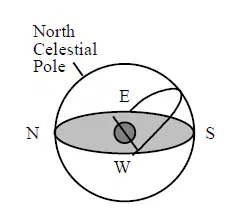
what is the approximate latitude of the observer in the diagram to the left
90*N
90*S
50*N
50*S
0*
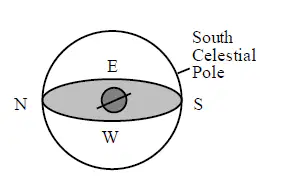
what is the approximate latitude of the observer in the diagram to the left
20*N
20*S
70*N
70*S
0*

An observer in the northern hemisphere takes a time-exposure photograph of the night sky. If the illustration depicts the photograph taken by the observer, which direction was the camera pointing?
straight north
straight east
straight south
straight west
straight up

An observer in the northern hemisphere takes a time-exposure photograph of the night sky. If the illustration depicts the photograph taken by the observer, which direction was the camera pointing?
straight north
straight east
straight south
straight west
straight up

An observer in the southern hemisphere takes a time-exposure photograph of the night sky. If the illustration depicts the photograph taken by the observer, which direction was the camera pointing?
straight north
straight east
straight south
straight west
straight up
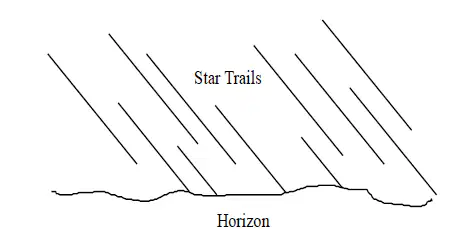
An observer in the southern hemisphere takes a time-exposure photograph of the night sky. If the illustration depicts the photograph taken by the observer, which direction was the camera pointing?
straight north
straight east
straight south
straight west
straight up
What causes summer here in the northern hemisphere? In the summer, at this point
the earth is closer to the sun
the earths northern hemisphere is tilted toward the sun
the earths northern hemisphere is tilted away from the sun
when its winter in the northern hemisphere, it is ____ in the southern hemisphere
winter
summer
spring
fall
the sun moves ____ along the ecliptic among the stars
eastward
westward
the sun does not appear to move
which of the following causes seasons on the earth
the earth being closer to the sun during our summer and farther during our winter
the sun's varying light output
the tilt of the earth's axis
the eleven-year sunspot cycle
The summer solstice is the point on the ecliptic where the sun
crosses the celestial equator moving north
crosses the celestial equator moving south
is the farthest north of the celestial equator halting its northward movement
is the farthest south of the celestial equator halting its southward movement
As seen from the earth, the sun appears to move ____ along the ____ among the stars
eastward, celestial equator
westward, celestial equator
eastward, ecliptic
westward, ecliptic
At the time of the winter solstice the sunlight is at a lower angle and thus is ____ thas (as) in the start of summer
less intense
more intense
the same intensity
Precession of the rotation axis of earth is caused by
the force of gravity from the sun and moon on earth's equatorial bulge
the force if gravity from the sun and jupiter on the earth's moon system
the magnetic field of earth
the impact of asteroids
Precession of the rotation axis of earth takes ____ to complete a cycle
24 hours
one year
260
26,000
260,000
The elliptical shape of the earth's orbit varies with time and takes ____ to complete a cycle
24 hours
one year
260 years
26,000
100,000
In the Milankovitch theory, the elliptical shape of the earth's orbit, its axis tilt, and axis precision vary with time. These combined at times to create _____ on earth.
day and night
seasonal temperature variations
daily temperature variations
ice ages
the constellation
Does the appearance of the constellation follow a seasonal pattern ?
Yes, during a summer night many of the constellations you can see are different from those you can see on a winter night
No, all of the constellations are on any clear night of the year
Yes. As the year progresses, the constellations move to different areas of the sky.
Yes, during a winter night all the constellations you can see are different from the ones that appear during a summer night.
which of the following statements correctly describes the relationship between stars and constellations
Every star is located in a constellation
Only stars close to the ecliptic (the Earth's orbital plane) are located in constellations.
Only the brighter stars are in constellations.Only the brighter stars are in constellations.
Only those stars that were visible to the ancient Greeks are located in constellations.
How much of the night sky is north of the celestial equator?
Less than one-half, because of the tilt of the equator to the ecliptic plane.
More than one-half, because of the precession of the poles.
Exactly one-half.
All of the night sky.
If you point toward the zenith right now and then point there again 6 hours later, you will have pointed twice in the same direction relative to
your horizon.
the Sun
the Moon.
the fixed stars.
If an observer walks north toward increasing latitude, the number of circumpolar stars would
remain constant.
decrease.
increase.
Unknown unless you also state the longitude of the observer.
If you were standing on the Earth’s equator, which of the following points in the sky would pass through your zenith at some time during one full day (24 hours)?
The north celestial pole
The summer solstice
The vernal equinox
The ecliptic pole
If the Sun passes directly overhead on at least one day per year, then
you are within 23½° latitude of the equator.
you are within 66½° latitude of the equator.
you must be exactly on the equator
you could be anywhere because this occurs at least once per year at any location on the Earth.
In Brazil, the longest period of daylight occurs during the month of
December.
March.
September.
June.
If you are standing at the Earth’s North Pole, which of the following would be located at the zenith?
The nadir
The star Vega
The celestial equator
The north celestial pole
For stars in the same constellation they
probably formed at the same time
must be part of the same cluster of stars in space
must have been discovered at about the same time
may actually be very far away from each other
During the month of June the north celestial pole points towards Polaris but during the month of December it points
just north of Polaris.
just south of Polaris.
towards the star Vega.
towards the star Thuban.
still towards Polaris.
If the Earth’s angular period of rotation doubled, but the period of revolution stayed the same
the night would be twice as long.
the night would be half as long.
the year would be half as long.
the year would be twice as long.
The Greeks created the constellations
true
false
The Greek letter designation conveys information about a star's location and brightness.
true
false
The celestial equator always passes directly overhead
true
false
The celestial equator always crosses the horizon at the east point and west point
true
false
Navigators can find their latitude by measuring the angle from the northern horizon to the north celestial pole
true
false
As earth rotates, circumpolar stars appear to move counterclockwise around the north celestial pole
true
false
the phases of the moon are caused by its ___ and ____
spherical shape ; orbital motion around the earth
spherical shape; orbital motion around the sun
cubical shape; orbital motion around the sun
cubical shape; orbital motion around Earth
spherical shape; orbital motion around the sun
A waxing crescent moon is visible
near the western horizon just after sunset
near the eastern horizon just before sunrise
near the eastern horizon just after sunset
near the western horizon just before sunrise
The first quarter moon rises
at about noon
at sunset
at sunrise
at about midnight
The ____ moon is visible above the western horizon a couple of hours before sunrise
waning gibbous
waxing gibbous
waxing crescent
waning crescent
The moon moves about ____ eastward in the sky each night
1*
5*
13*
27.3*

