
 Worksheets
DNA Unit Test Review
Total questions: 25
Worksheet time: 13mins
What did the Griffith experiment conclude?
That mice don't have DNA
DNA holds the genetic information and code
That the ribosomes hold the genetic information and code
That DNA is in the shape of a double helix
What did Watson and Crick's experiments discover?
That DNA holds and carries genetic information
That DNA is in the shape of a double helix
That there are different types of RNA
That radiation is harmful
What does the Transforming Principle state?
That bacteria can incorporate itself with DNA to produce more bacteria
That DNA is in the shape of a double helix
That DNA stores and carries genetic information
That only RNA can leave the nucleus
What is the monomer of nucleic acids?
Nucleotides
DNA
Carbohydrates
Ribosomes
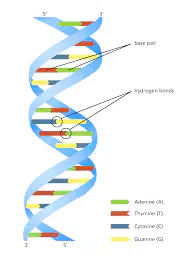
What are the bonds connecting nitrogen bases?
Hydrogen bonds
Phosphate groups
Nitrogen bonds
Carbon bonds
What makes DNA semi-conservative? (Choose all that apply)
DNA uses one stand of new DNA and one stand of old DNA
DNA coils up so it doesn't take up much space
DNA only uses 4 nitrogen bases
DNA is not semi convservative

Does this image represent Prokaryotic DNA replication or Eukaryotic replication?
Prokaryotic
Eukaryotic
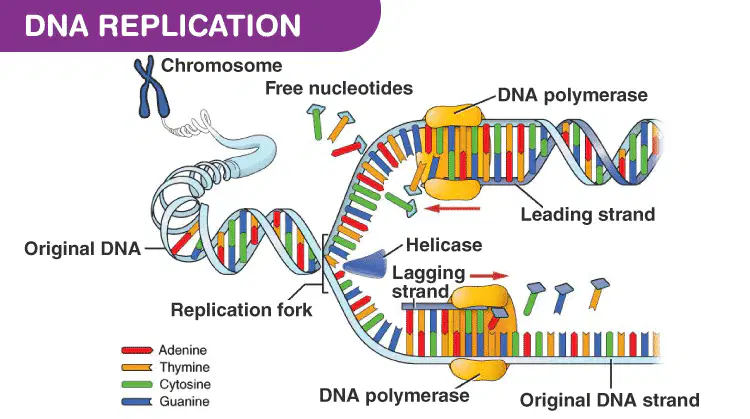
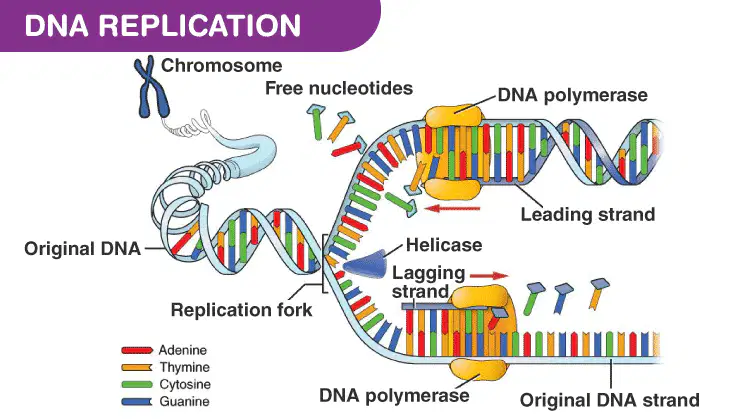
Does this image represent Eukaryotic DNA replication or Prokaryotic DNA replication?
Eukaryotic
Prokaryotic
What role do Helicase play?
They separate nucleotides
They make up the shape of DNA
They build protiens
They build ribosomes
What function do DNA polymerase enzymes perform?
Copy the nucleotide code to make proper copies
Separate the double helix of DNA
To create hydrogen bonds
They create proteins
What are the three types of mutation?
Substitution
Insertion
Deletion
Synthesis
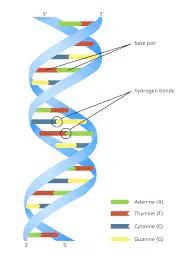
What does this image represent?
DNA
RNA
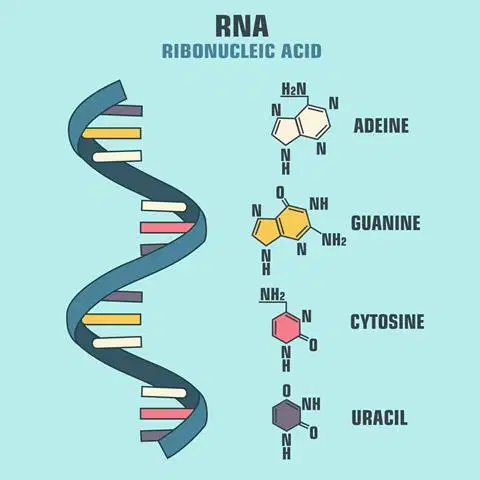
What does this image represent?
DNA
RNA
What are the three types of RNA
mRNA
tRNA
rRNA
yRNA
What turns DNA into RNA?
Protein synthesis
Transcription
Translation
Polymerase
What turns interprets RNA into strings of amino acids
Protein synthesis
Transcription
Translation
Polymerase
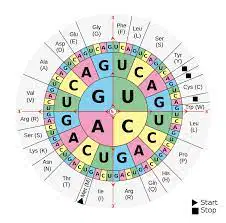
Which of these is a codon chart?

What does the central dogma explain?
DNA-->RNA
-->Protein
Transcription
Translation
DNA-->RNA-->
mRNA-->rRNA
What is the function of RNA polymerase enzymes?
To create synthesize RNA from a DNA template
To create mRNA
To create ribosomal RNA
To create proteins
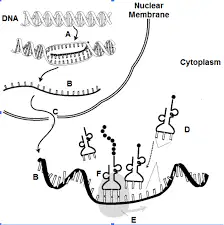
What would A represent?
Transcription
DNA
mRNA
Amino Acid
What would B represent?
Transcription
DNA
mRNA
Amino Acid
What would C represent?
Translation
DNA
mRNA
Amino Acid
What would D represent?
Translation
DNA
tRNA
Amino Acid
What would E represent?
Translation
DNA
tRNA
Ribosome
What would E represent?
Translation
DNA
tRNA
Ribosome

