
 Worksheets
Motion check in quiz
Total questions: 23
Worksheet time: 13mins
Distance
The total length travelled
How far an object is from its starting point in a straight line
Location of an object relative to a defined zero point

What is Vector definition?
A quantity that has magnitude and direction
A vector that has longitude and direction
A quantity that has magnitude and scalar
A vector that has direction and angle
A person walks 50 metres directly north, stops, and then travels 32 metres directly south. What is their displacement?
82 metres north
18 metres north
28 metres north
What is acceleration?
an increase in speed
a decrease in speed
a change in direction
all of these are examples
Label each as a "scalar" or a "vector"
scalar (kg)
mass
scalar (s)
time
scalar (kg/m^3)
density
vector (N)
force
vector (m/s)
velocity

Describe the object's motion from A to B
Speeding Up
Slowing Down
Constant Speed
Not Moving
Describe the object's motion from D to E:
Speeding Up
Slowing Down
Constant Speed
Not Moving

What was the total distance travelled during her journey?
0 km
25 km
50 km
75 km

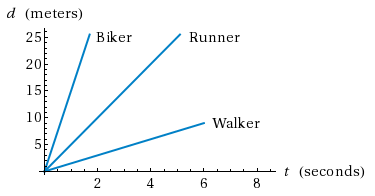
Which person moved the fastest in 3 seconds?
biker
runner
walker
they are all moving equally
The gradient of a velocity-time graph represents (a) .
The area under a velocity-time graph represents (a) .

Which section represents a steady speed?
A
B
C
D

You can calculate the slope of a velocity-time graph.
If you calculate the slope of the graph between two points, what would that tell you?
The velocity of the object.
The distance travelled by the object.
The acceleration of the object.
The mass of the object
Part B of the graph is from 25s to 35s. Which of these statements is true about Part B?
The object is at rest.
The object is accelerating (its velocity is increasing)
The object is decelerating (its velocity is decreasing)
The object is moving at a constant velocity.
Part D of the graph is from 55s to 95s. During Part D, the velocity values are all negative. What does negative velocity mean?
The object is slowing down.
The object is moving in the opposite direction now.
Part E of the graph is from 95s to 105s. Which of these statements is true about Part E?
The object's velocity values are negative.
The object's velocity values are positive.

Calculate the acceleration in section A
(a)

Calculate the acceleration in section C.
(a)

Calculate the distance travelled in section B.
(a)

Calculate the distance travelled in section D
(a)

Calculate the distance travelled in section C.
(a)

