
 Worksheets
FS-06: Water in Food
Total questions: 35
Worksheet time: 25mins
The phase of matter with a definite volume but no definite shape is a
The phase of matter with a definite shape and definite volume is a
solid
liquid
gas
Gases have ...
a definite shape and definite volume
no definite shape and no definite volume
a definite shape and no definite volume
The phase of matter in which the atoms are moving freely and are very far apart
solid
liquid
gas
What best describes the motion of molecules in a liquid?
flowing past each other
moving freely in all directions
Removing energy (cooling) causes the atoms to
spread apart
move closer together
get larger
get smaller


The water droplets on the outside of this glass of water is showing the following phase change


What phase change is represented by the dry ice in this picture- which changes from a solid to a gas?
evaporation
condensation
sublimation
melting
What phase change occurs due to losing heat energy?
freezing

Three containers with the same amount of the same material are shown below. Which container has the substance with the highest amount of energy?
The container on the left
The middle container
The container on the right
All have an equal amount of energy
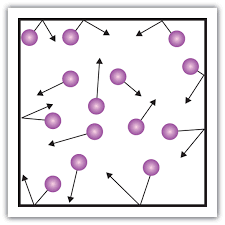
What state of matter?
Solid
Liquid
Gas
What is the phase change of a solid to a liquid?
freezing
melting
boiling
condensation
Change from Liquid to Solid is called ...
fusion
Freezing
sublimation
evaporation
Three containers with the same amount of the same material are shown below. Which container has the substance with the lowest amount of energy?
The container on the left
The middle container
The container on the right
All have an equal amount of energy
Suppose you pour a glass of ice water and set it on the kitchen table. After a few minutes, the outside of the glass will be covered with drops of water. Why did this happen?
Oxygen in the air cooled and condensed onto the cold glass.
Water vapor in the air cooled and condensed onto the cold glass.
Water vapor in the air cooled and evaporated onto the cold glass.
Water seeped through pores in the glass.
When heat is added to a liquid, what occurs?
Liquid molecules begin to condense to form a solid.
Liquid molecules are being slowed down to become a gas.
Liquid molecules speed up and begin to spread out to become a gas.
Liquid molecules begin to slow down to become a solid.
Alex noticed that a metal door that sticks on hot days does not stick when it cools off at night. This is because the metal contracts as it cools. The reason for this is that, as the metal cools, the atoms
become smaller and take up less space.
slow down and move closer together.
merge together to form fewer atoms.
speed up and move farther apart.
Which of the following occurs when a container of gas is heated?
The pressure inside the container changes the composition of the gas.
The pressure inside the container stays the same.
The pressure in the container decreases.
The pressure in the container increases.
If volume is constant, the relationship between temperature and pressure is
Direct
Inverse
Unrelated
If the pressure of a gas is increased and its volume remains constant, what will happen to its temperature?
It depends on the type of gas.
It will remain the same.
Increase
Decrease
As the temperature of a gas decreases, what else also decreases?
The number of gas particles
The pressure of the gas
The mass of the gas
The size of the gas particles

Changing the _________ can change the state of matter.
Shape
Matter
Temperature
Pressure
Pressure also has an impact on the ____ __ ____.
Pressure And Temperature
State of matter
We often think of the states of matter changing from solid to liquid or liquid to gas based on the temperature, but the ______________ also has an impact on the state. In most cases, the higher the pressure, the higher the _________________ needed to change the state. (Please write your answer as (_____,_______ )
(a)

Walking on hot sand with your bare feet is an example of the transfer of thermal energy. Why?
Hot sand transfer thermal energy to colder feet and feet get warm
Hot feet transfer thermal energy to colder sand and feet get cold
Increasing the temperature of a gas will _______ the pressure.
increase
decrease
not affect
If the temperature of a gas decreases, the pressure will _______.
increase
decrease
remain the same

