
Font size
 Worksheets
level 3 mock test
Total questions: 19
Worksheet time: 3hrs 10mins
1 Explain the categories described in the Water Supply (Water Fittings) Regulations 1999.
• Erroneous measurements
• Contamination
• Undue consumption
State the equipment needed to measure flow rate at an outlet.
Explain why multiple Cold Water Storage Cisterns (CWSC) must be coupled or connected if they are supplying a building consuming large quantities of water
State the difference between Direct and Indirect boosted cold water systems
State three mechanical backflow devices.
6 State the Fluid Category risk for each appliance according to Water Supply (Water Fittings) Regulations 1999.
• Hose union tap
• Washing Machine
• Rain Water Harvesting
Hot water systems can be divided into two categories, centralised and localised. Give a brief explanation and example of each category.
Explain how unvented systems above 15 Litres allow for the expansion of water.
Explain three installation requirements of an unvented hot water cylinder.
What is the maximum length of the D1 discharge pipework on an unvented hot water system (UVHWS).
Explain the operating principles of the following central heating components:
a) Zone valve
b) Automatic by-pass
c) Low loss header.
State which regulation sets the provision for conservation of fuel and power
Describe the terms below in relation to heat loss in a dwelling.
A Ventilation.
B Building fabric.
Describe two advantages of underfloor heating.
Complete Table 1 by stating the maximum distances, in metres, from the soil stack to the appliance when installing the waste pipework.
1. 32mm
2. 40mm
3. 50mm
Discuss the installation requirements of a WC macerator within a dwelling
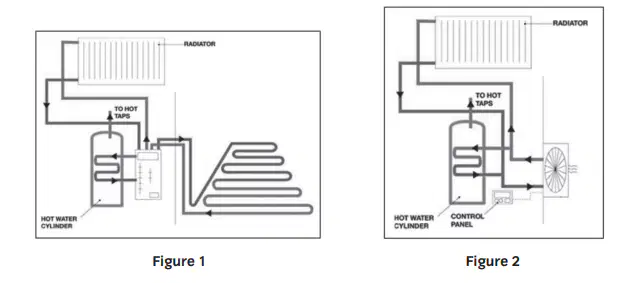
Identify the two heat producing micro renewable systems shown in Figures 1 and 2 below.
Explain the working principles of ‘Grey Water Harvesting’ and ‘Rain Water Harvesting’
Discuss the commissioning process on sanitation systems

