
 Worksheets
Human Body Review Quizziz
Total questions: 15
Worksheet time: 8mins
Name
Class
Date
1.
1.When different gases are exchanged in the lungs and then transported throughout the body, the systems working together are the
a)
respiratory and integumentary
b)
respiratory and circulatory
c)
respiratory and digestive
d)
respiratory and sensory
2.
2.Which term describes the maintenance of a steady internal state of the body?
a)
excretion
b)
respiration
c)
homeostasis
d)
growth
3.
3.Which sequence lists the levels of organization in the human body from simplest to most complex?
a)
organ system- tissue- cell- organ
b)
organ- organ system- tissue- cell
c)
tissue- cell- organ- organ system
d)
cell- tissue- organ- organ system
4.
4.In addition to the brain what structures are a part of the nervous system?
a)
lungs and heart
b)
liver and spleen
c)
spinal cord and nerves
d)
arteries, veins, capillaries
5.
5.Which three systems of a rabbit's body must be working together for the rabbit to run away from a fox?
a)
circulatory, endocrine, and endocrine
b)
digestive, excretory, and reproductive
c)
muscular, endocrine, excretory
d)
nervous, skeletal, and muscular
6.
7.How is the circulatory system related to the digestive system?
a)
The brain stem controls the heart rate
b)
Stomach muscles contract and expand
c)
Blood carries nutrients to the body
d)
The pharynx is a passageway for air and food
7.
8.Running is an activity that causes the cells in the muscular system to use oxygen quickly. Carbon dioxide levels in the blood increase. This causes the nervous system to signal which of these systems to respond?
a)
digestive
b)
circulatory
c)
nervous
d)
endocrine
8.
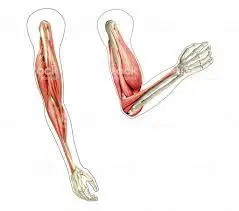
9.The diagram below shows a human arm bending at the elbow. Which two body systems most directly cause the arm to bend?
a)
skeletal and muscular
b)
reproductive and endocrine
c)
respiratory and excretory
d)
nervous and digestive
9.
10.Which of the following describes the main purpose of the human digestive system?
a)
Breaking down foods for absorption into the blood
b)
Exchange oxygen and carbon dioxide in the lungs
c)
Release energy from sugars within the cells
d)
Carry nutrients to all parts of the body
10.
11.What type of receptors detect pressure, movement and tension?
a)
Chemical Receptors
b)
Mechanical Receptors
c)
Electromagnetic Receptors
d)
Homeostasis Receptors
11.

13.The diagram illustrates the process of photosynthesis. Which statement best describes the function in Step 1?
a)
Taking in water
b)
Capturing energy
c)
Producing sugars
d)
Releasing oxygen
12.

14.The diagram shows parts of the human body. These parts work together to help you digest the food you eat. Which term best describes the entire group of parts that are labeled?
a)
cells
b)
tissue
c)
organ
d)
organ system
13.
15.Carbon dioxide that is produced by cells is removed from the body primarily by which body system?
a)
digestive
b)
excretory
c)
immune
d)
respiratory
14.
16.What is the main function of the nervous system?
a)
Collects and processes information
b)
Breaks down food that the body uses for energy
c)
Carries oxygen, water, and nutrients to all the cells of the body
d)
Takes in oxygen and releases carbon dioxide
15.
17.A student wants to investigate how exercise affects heart rate. She measures her heart rate sitting still, immediately after doing jumping jacks, and immediately after running. What is the dependent variable in her experiment?
a)
Type of exercise
b)
Number of jumping jacks
c)
Heart rate
d)
Amount of time between exercises
100 %

