
NEW
Font size
 Worksheets
Apposition, Maturation, and Root Development
Total questions: 10
Worksheet time: 5mins
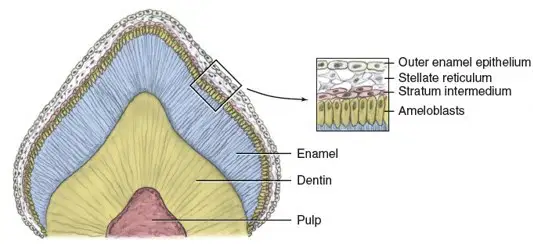
A primary tooth can begin to erupt into the oral cavity with the formation of:
Hertwig Epithelial Root Sheath (HERS)
Reduced Enamel Epithelium (REE)
Cervical Loop
Tomes Process
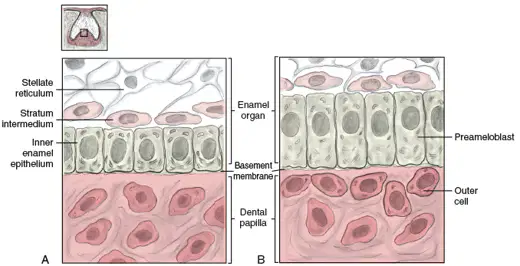
The movement of the nuclei of the inner enamel epithelial cells (IEE) is called:
Reciprocal induction
Amelogenesis
Dentinogenesis
Repolarization

Which parts of the tooth are secreted in successive layers during the apposition stage?
Enamel, dentin, and cementum
Enamel and dentin
Enamel and cementum
Dentin and cementum
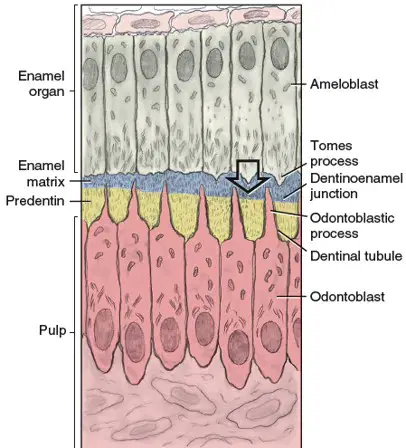
The process by which ameloblasts begin the appositional growth of enamel matrix is called:
Dentinogenesis
Maturation
Amelogenesis
Reciprocal induction

(Fill in the blank) shapes the root of a tooth and determines the number of roots a tooth will have.
Epithelial Rests of Malassez
Hertwig Epithelial Root Sheath (HERS)
Cervical Loop
Reduced Enamel Epithelium (REE)

Alveoli are tooth sockets that are formed from the mineralization of the ectomesenchyme of the:
Dental Sac
Dental Papilla
Enamel Organ
PDL
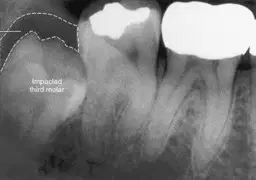
An odontogenic cyst that forms from the REE after the crown has completely formed is called:
Concescence
Odontoma
Nasmyth Membrane
Dentigerous cyst
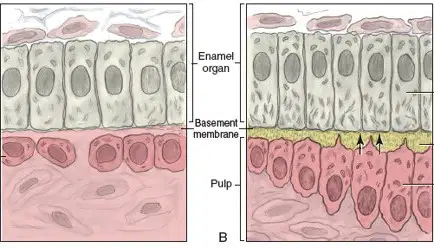
The outer cells of the dental papilla are induced by (fill in the blank) to differentiate into odontoblasts.
Cementoblasts
Basement membrane
Preameloblasts
Ameloblasts

Cells from the distintigrated HERS that are located in the mature periodontal ligament are called:
Epithelial Rests of Malassez
Preameloblasts
Odontoblasts
Cementoblasts
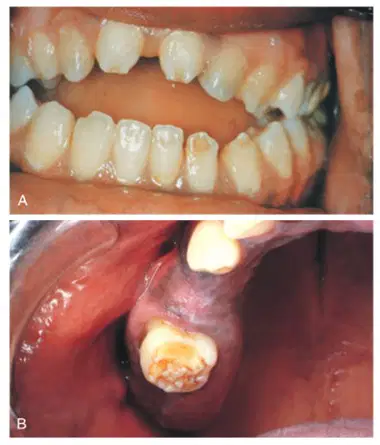
(Fill in the blank) results from the reduction in the quantity of enamel matrix.
enamel hypocalcification
enamel hypoplasia
amelogenesis imperfecta
dentinogenesis imperfecta

