wayground logo

Free Printable Worksheets

Font size

S
M
L
XL
Worksheets

The Body in Motion: CQ1

Total questions: 105

Worksheet time: 1hrs 21mins

Name
Class
Date
1.
What is the name for the connector that attaches bone to bone?
a)
ligament
b)
tendon
c)
patella
d)
string
2.
What is the name for the connector that attaches muscle to bone?
a)
ligament
b)
tendon
c)
patella
d)
string
3.

Which of the following is not a function of bones?

a)

Protection

b)

Blood cell formation

c)

Storage

d)

Absorption

4.
The skeletal system is composed of what as well as bones?
a)
Joints, ligaments, and tendons
b)
Joints, ligaments, and cartilage
c)
Cartilage, ligaments, and tendons
d)
Ligaments and joints
5.
The adult skeletal system is composed of how many bones?
a)
216
b)
371
c)
206
d)
199
6.
What do the bones create?
a)
white blood cells
b)
platlets
c)
red blood cells
d)
flying turkeys
7.
Which type of joint give you the largest range of motion?
a)
pivot
b)
ball-and-socket
c)
hinge
d)
gliding
8.

What bone is highlighted?

a)

Skull (Cranium)

b)

Mandible

c)

Scapula

d)

Clavicle

9.

What bone is highlighted?

a)

Skull (Cranium)

b)

Scapula

c)

Clavicle

d)

Mandible

10.

What bone is highlighted?

a)

Skull (Mandible)

b)

Clavicle

c)

Mandible

d)

Scapula

11.
Which muscle type is found in your stomach, bladder, and intestines?
a)
Skeletal
b)
Smooth
c)
Cardiac
d)
Straight
12.
Which type of muscle is found in your heart?
a)
Skeletal
b)
Smooth
c)
Cardiac
d)
Straight
13.
Which muscles are involuntary?
a)
skeletal
b)
cardiac
c)
smooth
d)
smooth and cardiac
14.
When a muscle contracts, it _______
a)
gets longer
b)
gets shorter
c)
gets thinner
d)
grows hair
15.
Skeletal muscles are attached to the _________.
a)
Stomach
b)
Lungs
c)
Bones
d)
Involuntary Muscles
16.
Muscles always work in _____
a)
pairs
b)
groups of 3
c)
bones
d)
joints
17.
Voluntary muscle is
a)
muscle that has to be told when to move
b)
muscle that moves automatically
c)
muscle that needs to be stretched regularly
d)
muscle that makes up the heart and stomach
18.
How many Muscles are in the Skeletal System?
a)
500
b)
over 600
c)
300
d)
200
19.
A muscle that straightens part of your body is called a(n)...
a)
Extensor
b)
Flexor
20.
What is the name of this muscle?
a)
Trapezius
b)
Deltoid
c)
Abdominal
d)
Pectoralis
21.
What muscle is this?
a)
Pectoralis
b)
Triceps
c)
Obliques
d)
Rectus Abdominus
22.
What muscle is this?
a)
Gastrocnemius
b)
Quadriceps
c)
Pectorals
d)
Trapezius
23.

What muscle is highlighted?

a)

Lats

b)

Trapezius

c)

Hamstrings

d)

Calves

24.

The antagonist to the quadriceps is the

a)

bicep

b)

hamstring

c)

gastrocnemius

d)

quadriceps

25.

During a bench press which are the stabilizer muscles?

a)

pectoralis major

b)

triceps

c)

rear deltoids

d)

biceps

26.

An isometric contraction is where no movement takes place, because the load on the muscle exceeds the tension generated by the contracting muscle. This occurs when a muscle attempts to push or pull an immovable object.

a)

True

b)

False

27.

A concentric contraction is a contraction in which the muscle decreases in length (shortens) against an opposing load, such as lifting a weight up.

a)

True

b)

False

28.
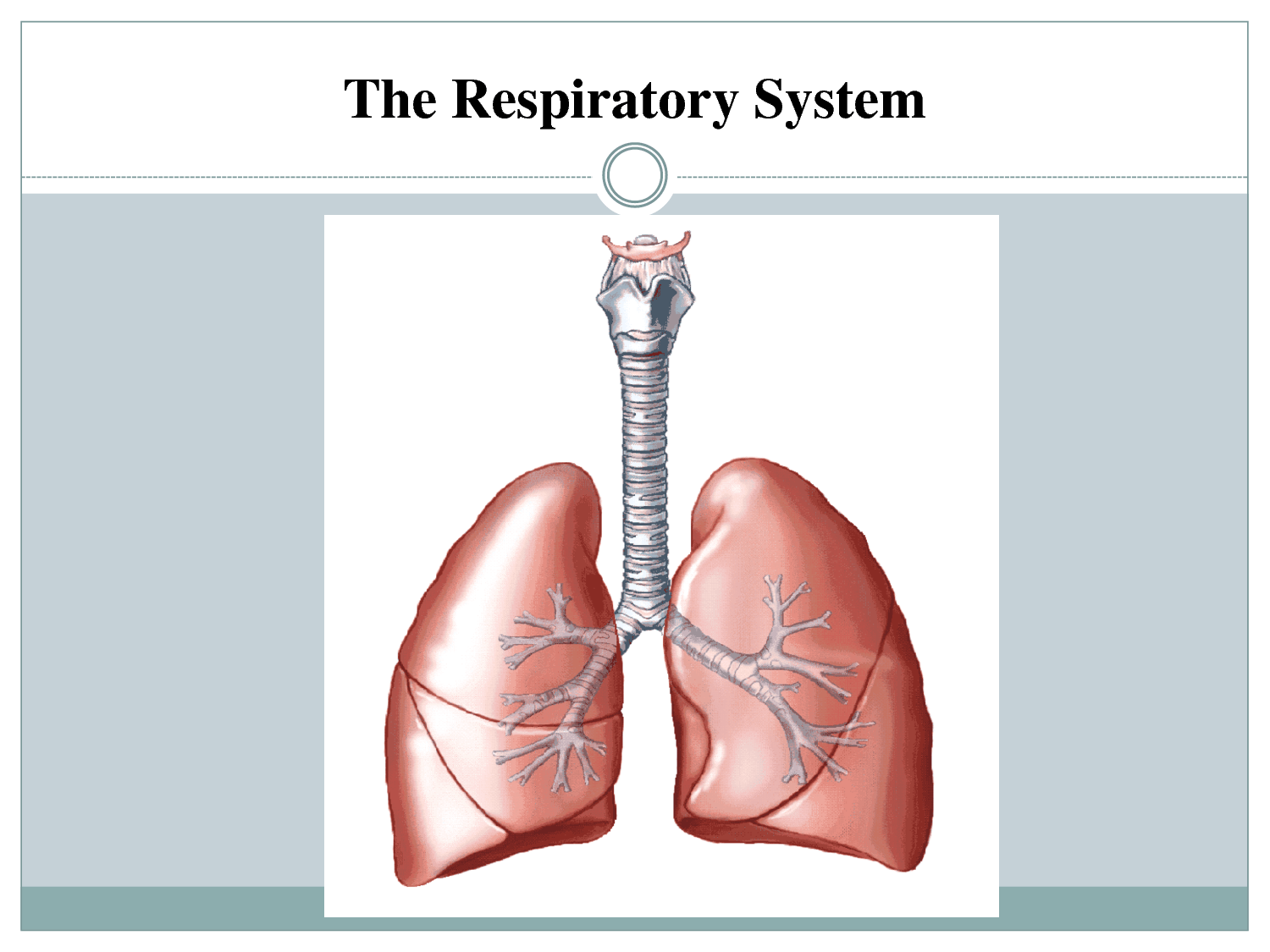
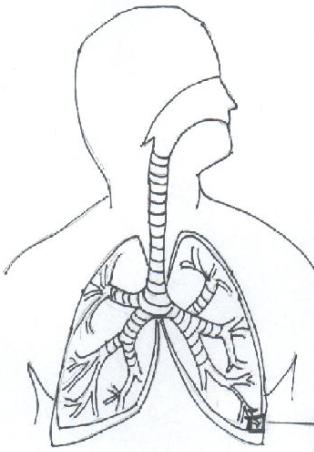
What is the main function of the respiratory system?
a)
to provide oxygen and remove carbon dioxide from the body
b)
to bring oxygen to the body
c)
to break down food and absorb nutrients
d)
to remove oxygen from the body and deliver carbon dioxide
29.
What are the main organs of gas exchange in the respiratory system?
a)
diapragm
b)
lungs
c)
trachea
d)
bronchi
30.
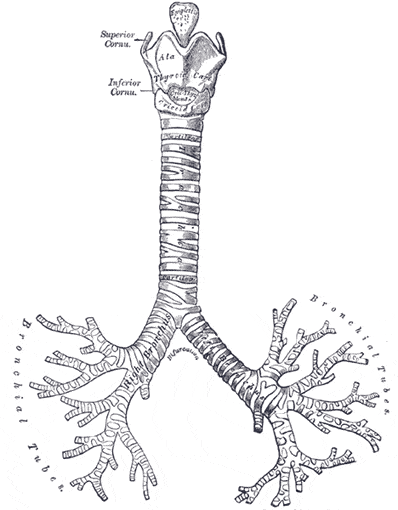
What is the function of the bronchi?
a)
Transport air from nose to lungs
b)
Transport air from trachea to lungs
c)
Transport air from lungs to alveoli
d)
Transport air from alveoli to blood
31.
Within the lungs, the exchange of oxygen and carbon dioxide occurs between the ___ and the capillaries. 
a)
trachea 
b)
bronchi 
c)
alveoli
d)
diaphragm
32.
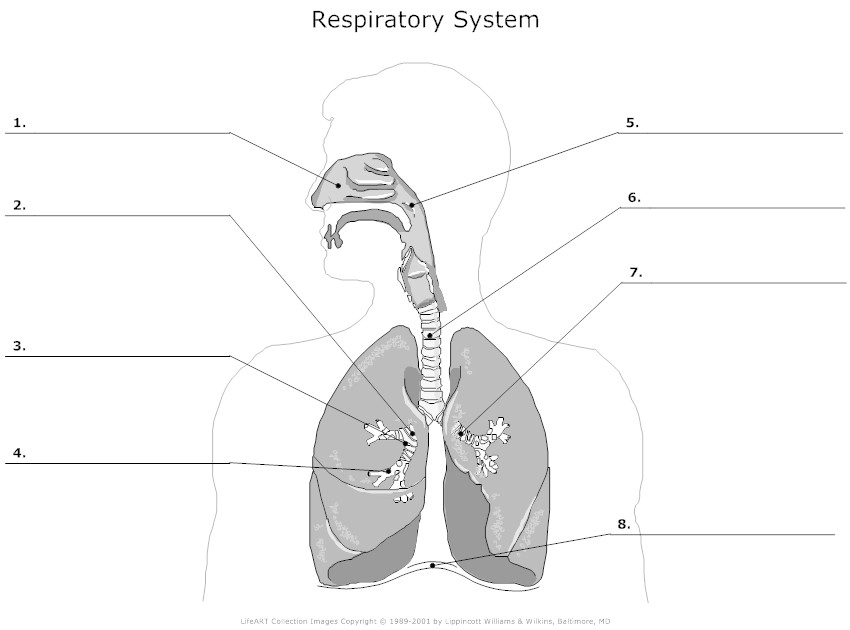
Name the organ label # 6. 
a)
alveoli 
b)
bronchi 
c)
trachea 
d)
lungs 
33.
What is tube that is also known as your wind pipe?
a)
esophogus
b)
bronchi
c)
trachea
d)
alveoli
34.
The passageway that is shared by both the digestive and respiratory system is the....
a)
larynx
b)
pharynx
c)
trachea
d)
nose
35.
The beginning of the respiratory system that warms and moistens the air.
a)
trachea
b)
nose
c)
bronchi
d)
diaphragm
36.
What is the small flap of tissue called that covers the air-only passage when we swallow?
a)
Bronchioles
b)
Larynx
c)
Alveoli
d)
Epiglottis
37.
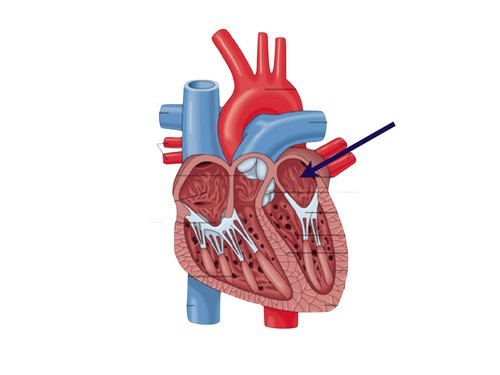
Identify
a)
Left atrium
b)
Right atrium
c)
Left ventricle
d)
Right ventricle
38.
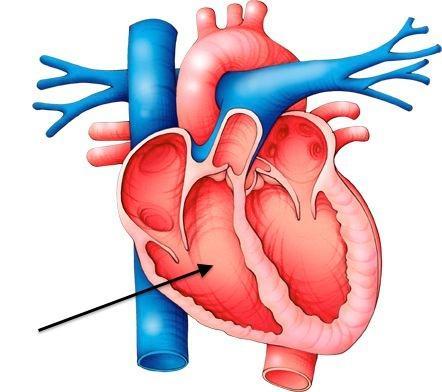
Identify
a)
Left atrium
b)
Right atrium
c)
Left ventricle
d)
Right ventricle
39.
The heart has ___ chambers.
a)
1
b)
2
c)
3
d)
4
40.
This chamber of the heart RECEIVES blood returning from the body
a)
Right Atrium
b)
Right Ventricle
c)
Left Atrium
d)
Left Ventricle
41.
Thin-walled vessels that allow for the exchange of O2 , CO2, nutrients and wastes between blood cells or air sacs in the lungs
a)
Arteries
b)
Veins
c)
Capillaries
42.
What does Deoxygenated mean?
a)
Oxygen-rich
b)
Blood flow
c)
Oxygen-poor
d)
Water Flow
43.
A flap of tissue that prevents blood from flowing backward
a)
Aorta
b)
Atrium
c)
Septum
d)
Valve
44.
Carry blood away from heart; mostly oxygen-rich
a)
Arteries
b)
Veins
c)
Capillaries
45.
What is pulmonary circulation?
a)
Blood travelling to and from the lungs
b)
Blood travelling to and from the body
c)
A blood clot in the lungs
d)
The vessel that brings blood to the lungs
46.
Blood circulation from the heart to the rest of the body is called
a)
Full body
b)
Systemic
c)
pulmonary
d)
heart to lung
47.
What is the main function of the artery?
a)
It controls your brain and your thought process.
b)
They carry oxygen- poor blood BACK to the heart.
c)
Arteries carry oxygen- rich blood AWAY from the heart.
d)
It receives information (senses) and sends messages to the body about how to react to things.
48.
Which is NOT a function of the circulatory system?
a)
deliver O2 and nutrients to cells
b)
remove CO2 and wastes from cells
c)
break down carbohydrates into glucose
d)
transport other materials through body
49.
Structure(s) that keep the blood flowing in one direction.
a)
Valve(s)
b)
Septum(s)
c)
Neuron(s)
d)
Bronchiole(s)
50.
arteries, veins, and capillaries are three types of __________
a)
heart valves
b)
blood vessels
c)
cells
d)
veins
51.
What is the Circulatory System also known as?
a)
The heart
b)
Cardiovascular System
c)
Nervous System
d)
Aorta
52.
What do Red-Blood cells do?
a)
Carry oxygen from the lungs to the body cells and  transport carbon dioxide from the cells back to the lungs
b)
keeps blood flowing in one direction to the heart and prevent blood from flowing backwards
c)
Collects  blood from the capillaries and drain it into the veins
d)
Bring nutriients to the cells and carries away waste materials.
53.
What does blood do?
a)
Carries Water to cells
b)
Carries Oxygen to cells
c)
Carries Food to cells
d)
All of the above 
54.

Blood pressure is the measurement of the pressure of the blood in the artery.

a)

True

b)

False

55.

Which of the following are generally the body's immediate response to exercise?

a)

Increased Cardiac output

b)

Increased ventilation rate

c)

Reduced blood pressure

d)

Increased Heart Rate

56.
a)
Quadriceps
b)
Satorius
c)
Hamstring
d)
Gastronecmius
57.
a)
Latissmius Dorise
b)
Erectors
c)
Deltoids
d)
Abdominal
58.
a)
Abdominal
b)
External Oblique
c)
Erectors
d)
Satorius
59.
a)
Tricep
b)
Deltoid
c)
Hamstring
d)
Bicep
60.
a)
Trapezius
b)
Gluteals
c)
Deltoid
d)
Hamstring
61.
a)
Hamstrin
b)
Quadricep
c)
Tibialis Anterior
d)
Gastrocenmius
62.
a)
Hamstring
b)
Quadriceps
c)
Gastronecmius
d)
Satorius
63.
a)
Biceps
b)
Triceps
c)
Occuli
d)
Trapezius
64.
What kind of muscle do you move on purpose?
a)
voluntary
b)
involuntary
c)
cardiac
d)
heart
65.
What ties muscles to bones?
a)
cartilage
b)
tendons
c)
ligaments
d)
flexors
66.
Where are smooth muscles?
a)
lungs
b)
heart
c)
stomach
d)
all of these answers are true
67.
Skeletal muscles are attached to _________.
a)
organs
b)
heart
c)
bones
d)
lungs
68.

One muscle _______ and the other _______.

a)

works, works harder

b)

works, relaxes

69.
tissue that connects bone to bone
a)
ligament
b)
tendon
c)
tissue
d)
muscle
70.
Standing on tip toe
a)
Dorsiflexion
b)
Plantar flexion
c)
Inversion
d)
Eversion
71.
Flexion...
a)
Decreases angle of the joint
b)
Increases angle at the joint
c)
Moves limb away from midline
d)
Moves limb toward midline
72.
Movement of a limb toward the body midline
a)
Abduction
b)
Flexion
c)
Adduction
d)
Pronation
73.
Movement of bone around its longitudinal axis (ball and socket joint)
a)
Circumduction
b)
Flexion
c)
Rotation
d)
Supination
74.
What do your bones protect?
a)
organs
b)
skin
c)
muscles
d)
feelings
75.

In this picture, what is represented in multi-colors?

a)

Carpals

b)

Tarsals

c)

Phalanges

d)

Radius

76.

What are the bones colored in red called?

a)

Femur

b)

Tibia

c)

Fibula

d)

Patella

77.

One of the two lower leg bones, highlighted in red, this is called your _________________?

a)

Tibia

b)

Fibula

c)

Patella

d)

Femur

78.

In this picture which of the two lower arm bones is highlighted in red?

a)

Ulna

b)

Radius

c)

Phalanges

d)

Humerus

79.
What are functions of the skeleton?
a)
Protection
b)
Blood cell production
c)
Movement
d)
All of these
80.

What movement does the hip perform in the exercise moving from the left image to the right image?

a)

extension

b)

flexion

c)

rotation

81.

An increase in joint angle is termed ______________.

a)

Flexion

b)

Extension

c)

Elevation

82.

In the upward phase of a bicep curl, the antagonist is the

a)

Bicep

b)

Tricep

c)

Deltoid

d)

External obliques

83.

In the downward phase of a squat the agonist is the

a)

Hamstrings

b)

Quadriceps

c)

Gastrocnemius

d)

Gluteus maximus

84.

The origin of the muscle is the fixed attachment

a)

True

b)

False

85.

The insertion of the muscle is the movable part

a)

True

b)

False

86.

Which of the following is NOT a dimension of health?

a)

Physical

b)

Social

c)

Healing

d)

Spiritual

87.

What are the 5 action areas of the Ottawa Charter?

4 lines
88.

The Sociocultural Factors in determining health are:

a)

knowledge and skills, attitudes, genetics

b)

family, peers, media, religion and culture

c)

employment, education and income

d)

access to health services and technology

89.

When referring to the degree of control individuals have over their own health, determinants can either be __________ or _____________

(a)  

90.

The Socioeconomic Factors in determining health are:

a)

Employment, education and income

b)

knowledge and skills, attitudes and genetics

c)

access to health services and technology

d)

family, peers, media, culture, religion

91.

In reference to the Ottawa Charter, Rest areas/ driver reviver stations set-up to help combat fatigue is an example of:

a)

Developing Personal Skills

b)

Building Health Public Policy

c)

Strengthening Community Action

d)

Creating Supportive Environments

92.

The Health Promoting Schools framework is an example of what type of Health Promotion approach?

a)

Individual/ Behavioural

b)

Preventative

c)

Public Health

d)

Neither A, B or C

93.

The Individual Factors in determining health are:

a)

Access to health services and technology

b)

employment, education, income

c)

family, peers, media, religion, culture

d)

knowledge and skills, attitudes, genetics

94.

Identify the 5 groups of people that are responsible for Health Promotion.

4 lines
95.

What is the WHO definition of "health"

4 lines
96.

Immunisation is an example of what type of Health Promotion approach?

a)

Individual/ Behavioural

b)

Preventative

c)

Public Health

d)

Neither A, B or C

97.

The Environmental Factors in determining health are:

a)

Knowledge and skills, attitudes, genetics

b)

Family, Peers, Media, Culture, Religion

c)

Employment, Education, Income

d)

Geographical location, Access to health service and technology

98.

What are the 3 principles of social justice?

4 lines
99.

Health Education is an example of what type of Health Promotion approach?

a)

Individual/ Behavioural

b)

Preventative

c)

Public Health

d)

Neither A, B or C

100.

"Perceptions of health are socially constructed". What does this statement mean?

4 lines
101.

Using 2 key syllabus terms, explain how a person's health status can be placed on a continuum.

4 lines
102.

In reference to the Ottawa Charter, 40km/h speed limits around schools is an example of:

a)

Developing Personal Skills

b)

Building Health Public Policy

c)

Strengthening Community Action

d)

Creating Supportive Environments

103.

In reference to the Ottawa Charter, Media Campaigns that seek to increase knowledge of the risks faced by drivers is an example of:

a)

Developing Personal Skills

b)

Building Health Public Policy

c)

Strengthening Community Action

d)

Creating Supportive Environments

104.

What is health promotion?

4 lines
105.

In reference to the Ottawa Charter, construction of pedestrian bridges across major roads is an example of:

a)

Developing Personal Skills

b)

Building Health Public Policy

c)

Strengthening Community Action

d)

Creating Supportive Environments