
 Worksheets
Social Studies 8 3rd Quarter
Total questions: 164
Worksheet time: 2hrs 7mins
TRUE OR FALSE.
A. Renaissance was born in Italy.
B. Renaissance is a Greek word that means "rebirth".
A is true;
B is false.
A is false;
B is true.
All statements are true.
All statements are false.
All are factors that led to Renaissance except:
strategic location of Italy
wealthy cities dominated the trade industry
spreading Christianity in Asia
stable political structure

He was the "Father of Humanism".
Martin Luther
Francesco Petrarch
Lorenzo Medici
Niccolo Machiavelli
All are characteristics of a Renaissance man except
well-mannered
irrational
expert in different field
reasonable

He was the "Father of Modern Political Theory".
Martin Luther
Francesco Petrarch
Lorenzo Medici
Niccolo Machiavelli

He is an Italian statesman, banker, and poet who is enthusiastic and a patron of art.
Martin Luther
Francesco Petrarch
Lorenzo Medici
Niccolo Machiavelli
Explain the quote shared by Niccolo Machiavelli.
“THE END JUSTIFIES THE MEANS,”
TRUE OR FALSE.
A. Humanities are philosophical views that man was the center of his own universe so he should be a rational being.
B. Humanism is the study of languages, literature, arts, history, and philosophy..
A is true;
B is false.
A is false;
B is true.
All statements are true.
All statements are false.
TRUE OR FALSE.
A. Humanists revived ancient classical Greek & Roman literature.
B. Humanists believed to be a human, you need to be a thinker.
A is true;
B is false.
A is false;
B is true.
All statements are true.
All statements are false.
Which of these statements describes a change brought about by the Renaissance?
Society was dominated by the church.
Society began to value individualism.
Society was focused on warfare.
Society was dominated by lords.
Which of these statements reflects an influence of the Renaissance?
dominance of the church
constant feudal warfare
lack of any governance
increased interest in the arts
Cheaper book prices
Increase in education
Increase in parchment usage
Rapid spread of ideas


Why is this period of human history considered a “rebirth” period?
time of faith renewal
time of academic freedom
time of change in beliefs
time of trade depreciation
Which of these men of the Renaissance was known equally for his art as well as inventions?
Rueben
Leonardo da Vinci
Michelangelo
Aristotle
Use the information in the list to answer the question.
The Spirit of Humanism
• stressed the importance of the individual
• valued the knowledge produced by the Greeks and Romans
• sought a balance between intellect and religious faith
Which other point belongs in this list?
strengthened the feudal system
inspired Renaissance creativity
opposed to the code of chivalry
provided support for the Inquisition

What is one way that Medieval and Renaissance artists differ?
Renaissance art focuses more on religion
Medieval artists were more realistic
Renaissance artist turned to Roman and Greek works for inspiration
They are the same
It contains propositions contesting the Indulgences.
Diet of Worms
95 Theses
Reformation
Papal Bull

A German priest and lecturer at the University of
Wittenberg in Germany started the Protestant Reformation.
Martin Luther
Francesco Petrarch
Lorenzo Medici
Niccolo Machiavelli
TRUE OR FALSE.
A. Reformation is a movement that protects the policies of the Catholic Church.
B. Many kings supported the Reformation.
A is true;
B is false.
A is false;
B is true.
All statements are true.
All statements are false.
All are causes of reformation happened in the 15th century except:
Requiring knights to join the Crusades
Changing
perspectives
during the
Renaissance
Corruption in
tax collection
of the Church
Granting
indulgence
What did Martin Luther do to the papal bull?
disseminated it to the public
burnt it publicly
questioned all the writings written on it
returned it to the pope
TRUE OR FALSE.
A. Papal Bull contains announcements and other ecclesiastical writings.
B. Papal Bull is a Bible written by the Pope.
A is true;
B is false.
A is false;
B is true.
All statements are true.
All statements are false.
What happened in the Diet of Worms during 1521?
King Charles exiled Martin Luther for starting the revolution of farmers in Germany.
King Charles released his verdict for the reformation made by Martin Luther.
King Charles invited Luther for a
meeting to explain his ideas and ask for
forgiveness.
King Charles gave support to Martin Luther for his reformation against Catholic Church.
TRUE OR FALSE.
A. Edict of Worms declared Martin Luther a heretic and excommunicated him.
B. Edict of Worms prohibited and banned all his books and teachings.
A is true;
B is false.
A is false;
B is true.
All statements are true.
All statements are false.
What do you mean by heretic?
What did Martin Luther accomplish while staying at Castle of Wartburg?
writing the 95 theses against indulgence
translating the New Testament in German language
burning the Papal Bull to decline the teaching of Catholic Church
encouraging people to form a group against King Charles V
TRUE OR FALSE.
A. Martin Luther translated the New Testament in the German language so his fellow citizen can understand his claim.
B. He established Lutheranism wherein German and Latin should the languages be used in holy mass.
A is true;
B is false.
A is false;
B is true.
All statements are true.
All statements are false.
TRUE OR FALSE.
A. Calvinism is inspired by the teachings of Lutheranism.
B. It believed that a limited number of souls only will be granted salvation.
A is true;
B is false.
A is false;
B is true.
All statements are true.
All statements are false.
It advocates the baptism and church membership of adult believers only.
Anabaptist
Lutheranism
Presbyterian
It believes that there should be a separation of church and state.
Anabaptist
Lutheranism
Presbyterian
It believes that God selected a limited number of souls to grant salvation.
Anabaptist
Lutheranism
Presbyterian
It believes in Sola Fide – By Faith Alone; Sola Gratia – By Grace Alone; and Sola Scriptura – Scripture Alone published by the scholar Theodore Engelder.
Anabaptist
Lutheranism
Presbyterian
All are the things the Catholic Church did to counter the reformation except
They formed the Council of Trent.
They formed Inquisition.
They formed a prophetic dialogue with the Protestants.
Indulgence was stopped.
TRUE OR FALSE.
A. The Anabaptists believed that only adult members can be baptized.
B. It is believed that the church and state should be reunited in character formation.
A is true;
B is false.
A is false;
B is true.
All statements are true.
All statements are false.
Anabaptists are against the following teachings of Lutheranism except
baptizing babies without understanding the faith in God
eating of bread as a representation of the body of Christ
following the laws and command of the state leaders
separating of church and state
All are the things the Catholic Church did to counter the reformation except
Indulgence was stopped.
Only the church will discuss the Bible.
The Pope will not accept papal states.
Priests should not
marry a woman.
All are the things the Catholic Church did to counter the reformation except
They formed the Council of Trent.
They formed Inquisition.
They formed a prophetic dialogue with the Protestants.
Indulgence was stopped.
What was the effect of reformation to religion in the Renaissance period?
disappearance in religious unity
disappearance of corruption in church
disappearance of hierarchy in church
disappearance of believers
Why did the Chuch Inquisition establish?
It was to support missionaries to share the word of God.
It was designed chiefly to combat Protestantism.
It provided explanations to the inquiry of the Protestants.
It reformed law to rebuild unity in the church.
How did Ignatius Loyola help in spreading the word of God?
established schools and hospitals
translated the Bible in different languages
established the Society of Jesus
translated the New Testament in English
It is the acquisition of partial or full political control over the country.
Absolutism
Colonialism
Feudalism
Mercantilism
All are factors of the Age of Exploration except
advancing in nautical technology
flourishing of the interests in inquiry and curiosity
publishing the "The Travels of Marco Polo"
understanding the culture and geography of the world
Which among the following countries started the exploration?
England
France
Netherlands
Spain
Portugal
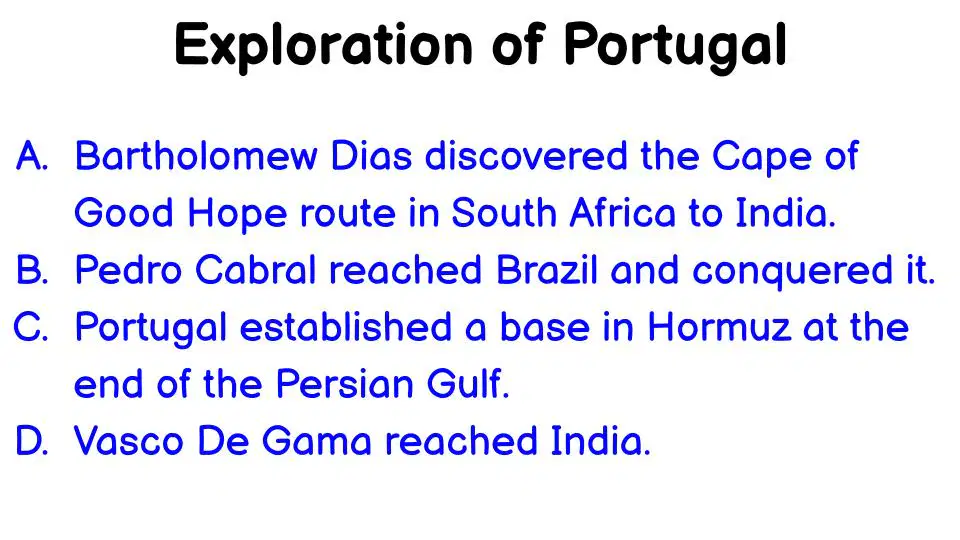
Arrange the exploration of Portugal in chronological order.
A-B-C-D
A-D-B-C
A-B-D-C
A-C-B-D
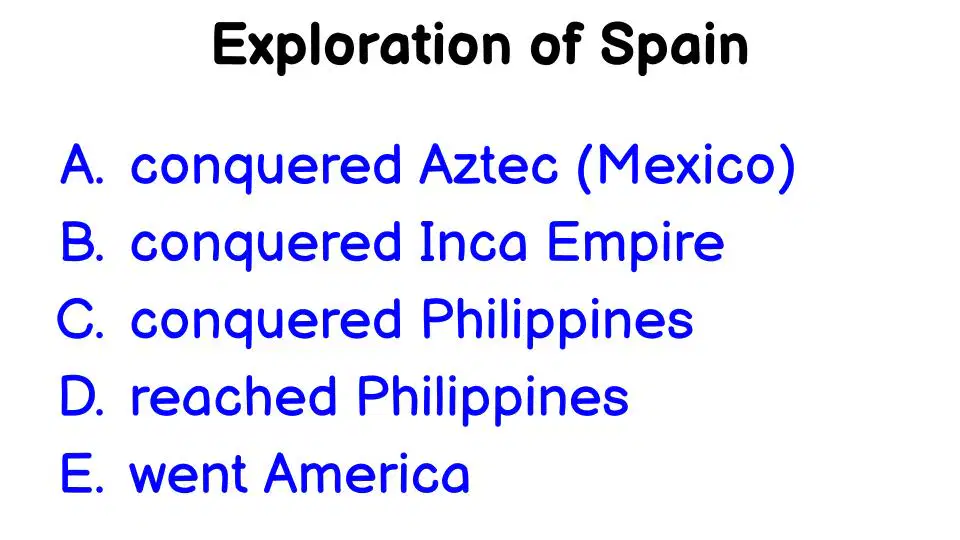
Arrange the exploration of Spain in chronological order.
E-D-C-B-A
E-A-B-D-C
E-A-C-B-D
E-A-D-C-B
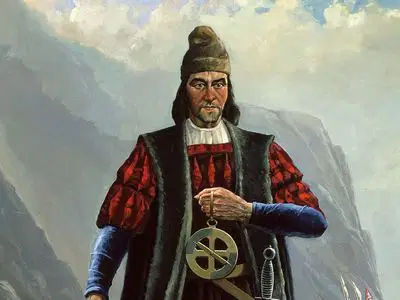
In 1498, discovered the Cape of Good Hope route in South Africa to India.
Bartholomeu Dias
Vasco da Gama
Christopher Columbus
Amerigo Vespucci


Discovery of Spices and Lands
Improvements in Navigation instruments
Travels of Marco Polo
Rounding of the Cape of Good Hope
All are reasons for explorations except
aspiration for new culture
desire for power
need for raw materials and spices
spread of Christianity
What is the purpose of the British East India Company?
for colonization
for cultural education
for religious affiliation
for trade route
An agreement that was signed between Portugal and Spain stating the action of the line of demarcation towards the West and laying out their permanent divisions in various parts of the world that have yet to be explored.
International Date Line
Treaty of Tordesillas
Treaty of Paris
Council of Trent
Spanish and Portuguese knights, soldiers, and conquerors who used force to obtain a place for the name of the Church and the king
Traders
Crusaders
Soldiers
Conquistador
All are colonies of France except
Canada
New York City
Quebec
Louisiana
All are colonies of the Netherlands except
Cape of Good Hope
New Netherland
Malacca
New Amsterdam
All are effects of the age exploration of the concept of geography except
looking for the North Star
knowing Earth is round
making map
naming bodies of water and lands
All are factors contributed to the Scientific Revolution except
spread of diseases
emergence of Mestizo
Mestizos were elected as officials of colonized countries.
Mestizos observed that there were differences in the culture of their families.
How did the emergence of Mestizos contribute to Scientific Revolution?
Mestizos were granted equal rights.
Mestizos traveled to Europe and Asia to visit their families.
Mestizos were elected as officials of colonized countries.
Mestizos observed that there were differences in the culture of their families.
Nicolaus Copernicus
Ptolemy
Galileo Galilei
Johannes Kepler
geocentric
heliocentric
earthcentric
astrocentric
All are reasons why people believed that Earth is the center of the Solar System except
it was supported by the Church
it was written in Genesis of the Bible
it was observed by Ptolemy
it was suggested by Copernicus and Galileo

Isaac Newton
Galileo Galilei
Johann Keppler
Nicolaus Copernicus
During the scientific revolution, people started using experiments to test theories rather than just believing the ___________
King
Scientists
Church
Explorers
Francis Bacon argued that the truth could not be known at the beginning of a question, but only at the end after a long process of?
investigating
exploring
conspiring
formulating
What invention helped scientists spread their findings and ideas?
scientific method
printing press
telescope
astrolabe
All are reasons why the Church did not support the Scientific Revolution except
It is against the Bible.
It will provoke queries that difficult to explain.
It will challenge faith to God.
It needed more priests.
To gain his knowledge, Descartes did NOT rely on...
mathematics
astronomy
logic
reason
The inductive reasoning popularized by Francis Bacon to understand the natural world is
Experiment
Observation
Scientific Method
Comparison
people wanted to explore
factories offered jobs to incoming immigrants
people wanted to own a factory
no one bought homemade items
Who made up most of the work force in the factories?
slave labor
adult men
children and women
retired farmers
Why did the factory hire more children and women than men?
less salary
less health issues
more dedicated
more agile
What is the movement to and growth of cities called?
strict housing regulations
spacious and fancy
overcrowded and unhealthy
extended families in one house
Which energy source helped launch the first industrial revolution?
water wheels
steam engine
nuclear engine
electric car
All are reasons why Britain has a good location except
island has excellent harbors and ports
accepted different religions and culture
did not suffer from wars of the 18th century
its climate benefited the textile industry
All are reasons why Britain had enough monetary capital except
trading
middle class
colonies
church
Why are there more poor people during the Industrial Revolution despite of opening of more factories?
How did Industrial Revolution affect the environment?
All are the effects of the Industrial Revolution except
accessible transportation
establishing
factory-system
faster communication
unifying the work forces
All are the effects of inventions that lead to the Industrial Revolution except
more goods are manufactured
more people went to the cities
more raw materials are harvested
faster transportation of products
All are factors why Britain is great except
The government supported people to travel beyond boundaries.
There are enough natural resources from coal and iron mines.
It established colonies in Asia and Africa.
It transferred its criminal to its colonies making it more peaceful in their lands.
The Intellectual Revolution is
a time of rebirth
a time of technological innovations
a time of rational reasoning
a time of self-discovery
The intellectual philosophers questioned
the need for social classes
the traditional authority
the role of science in society
the purpose of tax in a country
The Intellectual Revolution tried to discuss the purpose of
church
government
economy
education
The group of social thinkers in France during the Enlightenment is called
Critics
Encyclopedes
Philosophes
Salons
The group of social thinkers in France during the Enlightenment met on this place to debate and share ideas.
Critics
Encyclopedes
Philosophes
Salons
He believed in the separation of powers in a government.
Thomas Hobbes
John Locke
Baron Charles de Montesquieu
Jean Jacques Rousseau
Voltaire
(François-Marie Arouet)
The enlightenment philosopher believed man is naturally good.
Thomas Hobbes
John Locke
Baron Charles de Montesquieu
Jean Jacques Rousseau
Voltaire
(François-Marie Arouet)
There should be a separation of church and state.
Thomas Hobbes
John Locke
Baron Charles de Montesquieu
Jean Jacques Rousseau
Voltaire
(François-Marie Arouet)
The enlightenment philosopher believed that people would always be in conflict.
Thomas Hobbes
John Locke
Baron Charles de Montesquieu
Jean Jacques Rousseau
Voltaire
(François-Marie Arouet)
The enlightenment philosopher believed that a government should have check-and-balance.
Thomas Hobbes
John Locke
Baron Charles de Montesquieu
Jean Jacques Rousseau
Voltaire
(François-Marie Arouet)
The enlightenment philosopher believed that the world is full of chaos, brutal and short for him.
Thomas Hobbes
John Locke
Baron Charles de Montesquieu
Jean Jacques Rousseau
Voltaire
(François-Marie Arouet)
The enlightenment philosopher believed that citizens are free to decide what religion they will accept in and follow so the government can't force or bias.
Thomas Hobbes
John Locke
Baron Charles de Montesquieu
Jean Jacques Rousseau
Voltaire
(François-Marie Arouet)
The enlightenment philosopher believed to limit the power of a single individual in the government to provide harmonious relations of the people/government.
Thomas Hobbes
John Locke
Baron Charles de Montesquieu
Jean Jacques Rousseau
Voltaire
(François-Marie Arouet)
The enlightenment philosopher believed people use emotions and instincts as a person.
Thomas Hobbes
John Locke
Baron Charles de Montesquieu
Jean Jacques Rousseau
Voltaire
(François-Marie Arouet)
The enlightenment philosopher believed that people should have an agreement with the government.
Thomas Hobbes
John Locke
Baron Charles de Montesquieu
Jean Jacques Rousseau
Voltaire
(François-Marie Arouet)
The enlightenment philosopher condemned the government for its support to one religion and prohibiting others to have other religion.
Thomas Hobbes
John Locke
Baron Charles de Montesquieu
Jean Jacques Rousseau
Voltaire
(François-Marie Arouet)
The enlightenment philosopher defined an ideal society where people experience democracy by voting.
Thomas Hobbes
John Locke
Baron Charles de Montesquieu
Jean Jacques Rousseau
Voltaire
(François-Marie Arouet)
Social Contract should be made between the government and people.
Thomas Hobbes
John Locke
Baron Charles de Montesquieu
Jean Jacques Rousseau
Voltaire
(François-Marie Arouet)
Which do you most believe in Thomas Hobbes' ideas or John Locke's? Why?
According to Montesquieu, how does a government do the check-and-balance?
What are the natural rights of the people according to John Locke?
What is the impact of the Age of Enlightenment on the modern world?
How did the intellectual revolution spread?
travelling
book printing
painting
storytelling
Drag the name of the philosopher to his belief/book.
All are effects of the Intellectual Revolution except
change in political views
change in human ideologies
change in economics and trading laws
change in science innovations
It is the domination of one country over the political, economic, and cultural aspect of another country.
Colinialism
Feudalism
Imperialism
Mercantilism
Type T if the statement is correct. Type the correct word if the statement is false.
Sphere of Influence is a form of control of imperialism when an outside power claims trading privileges over a country.
(a)
Type T if the statement is correct. Type the correct word if the statement is false.
Protectorate is a form of control of imperialism which establishes its own government and maintains direct control to its territories.
(a)
Type T if the statement is correct. Type the correct word if the statement is false.
Protectorate is a form of control of imperialism which a country has its own government but still governed by outside imperial country.
(a)
Type T if the statement is correct. Type the correct word if the statement is false.
Mandate is a form of control of imperialism When private business from a foreign country controls independent but less developed country.
(a)

This country in Asia was known as Britain's "jewel in the crown".
Pakistan
India
Calcuta
Bengali


Why was India known as the "Jewel in the Crown" of the British Empire?
India supplied most of the soldiers of the British army
India supplied raw materials and a large market
India provided gemstones and precious metals
India was the first colony to become a democracy


Native Indians who served in the British East India Co. as soldiers.
Raja
Viceroy
Sepoy
Varna
What was the first country that stablished trading in India?
Dutch
Portugal
England
France
Indian nationalism in the 1800s began as a reaction to
Communist Revolutions
Religious Conflict
British Rule
long periods of drought and famine

What is the social hierarchy of India; divides society into groups based on a person's birth, wealth, or job
theocracy
caste system
Hinduism
karma
Queen Victoria was appointed as the ___ in India.
Sepoy
Governor
Viceroy
Prime Minister
Mahatma Gandhi served as a Sepoy during the British rule in India.
True
False
Indian traders were allowed to trade on their own terms.
True
False
Berlin Conference tried to unite European and African countries.
True
False
What was the effect of the Berlin Conference on Africa?
African culture became known all over the world.
African countries were exploited by the Europeans.
African people were able to travel and work in Europe.
African countries unified European countries.

What good did Britain export (send) to China?
tea
silver
opium
rubber
When the Chinese government did this, the British responded with military force.
attacked Britain
destroyed millions of dollars worth of opium
sent diplomats to Britain to discuss trade
began selling opium to Japan
There were (a) Opium Wars
China (a) the first opium war
The Treaty of (a) was formed after the first Opium War.
Which was NOT a result of the first Opium War?
China had to open more ports to foreign trade
Britain received compensation for the destroyed opium
Britain took control of the island of Hong Kong
China became a British colony
As a result of the second Opium War China had to open even more ports to foreign trade and make opium legal.
True
False
Which of these best describes the type of imperialism that took place in China?
sphere of influence
protectorate
colony
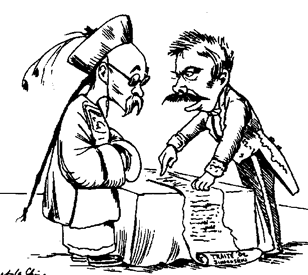

Why did the Chinese emperor ban the sale of Opium?
Opium was not making the Chinese enough money
The emperor wanted to make money from other goods
Opium is highly addictive and was ruining China
Opium growers were gaining power in Chinese court
All are effects of British Imperialism in India except
developing railroad system
learning English Language
reshaping Caste System
banning opium in their country
Give three (3) negative effects of imperialism.
In modern days, can you still see imperialism in our country? How?

