
Font size
 Worksheets
Binary Sound 2023
Total questions: 20
Worksheet time: 19mins
State more than one effect of increasing the sample rate.
More samples will be taken per second
File size will be larger
Less samples will be taken per second
File size will be smaller
Digital sound will be closer to the original analogue sound (more accurate)
State more than one effect of decreasing the sample rate.
More samples will be taken per second
File size will be larger
Less samples will be taken per second
File size will be smaller
Digital sound will be less accurate to the original analogue sound.
State more than one effect of increasing the sampling interval.
More samples will be taken per second
File size will be larger
Less samples will be taken per second
File size will be smaller
Digital sound will be less accurate to the original analogue sound.
State more than one effect of shortening/decreasing the sampling interval.
More samples will be taken per second
File size will be larger
Less samples will be taken per second
File size will be smaller
Digital sound will be closer to the original analogue sound (more accurate)
State the measurement used for the sample rate of an audio file.
Hertz (Hz)
Seconds (s)
Minutes (m)
Bytes (b)
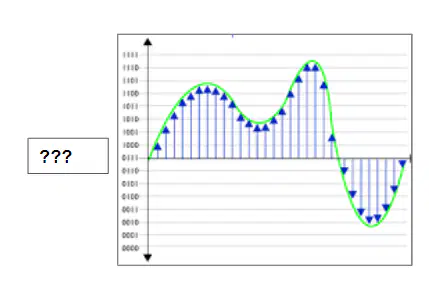
Label the y axis of this analogue sound wave.
Amplitude
Frequency
Duration (Time)
Volume
Pitch
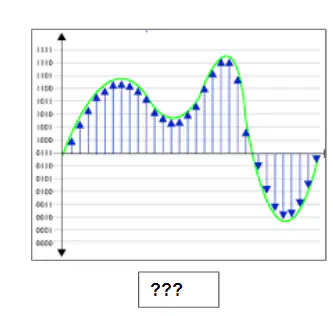
Label the x axis of this analogue sound wave.
Amplitude
Frequency
Duration (Time)
Volume
Pitch
Calculate the number of bits needed for a 10 second audio file with sample rate of 5Khz. The bit depth is 8 bits.
(a)
Define what is meant by "sampling rate", when converting an analogue sound into digital.
How many samples of the sound is taken per second.
How many samples of the sound is taken per minute.
It is the gap between each of the points where the analogue sound is sampled.
It is the number of bits used for each sample.
Define what is meant by "sampling interval", when converting an analogue sound into digital.
How many samples of the sound is taken per second.
How many samples of the sound is taken per minute.
It is the gap between each of the points where the analogue sound is sampled.
It is the number of bits used for each sample.
Define what is meant by "sample size", when converting an analogue sound into digital.
How many samples of the sound is taken per second.
How many samples of the sound is taken per minute.
It is the gap between each of the points where the analogue sound is sampled.
It is the number of bits used for each sample.
Describe how an analogue sound is converted into digital form.
Samples of the amplitude are taken at regular intervals. Each sample is stored as a binary number to form an approximated sound.
Samples of the wavelength is measured for the whole recording. This measurement is stored as binary numbers to form an approximated sound.
With a sound wave, the higher the amplitude...
The louder the sound.
The quieter the sound.
The higher the pitch.
The lower the pitch.
With a sound wave, the shorter the amplitude...
The louder the sound.
The quieter the sound.
The higher the pitch.
The lower the pitch.
State more than one example of metadata on a sound file
File type
Sample rate
Bit rate
Colour depth
Resolution
State the number of samples that would be taken per second if the sample rate is 30KHz.
(a)
State the number of samples that would be taken per second if the sample rate is 44.1KHz.
(a)

