
 Worksheets
Genetics Review Part 2
Total questions: 83
Worksheet time: 2hrs 16mins
Asexual reproduction produces offspring with DNA that is _________ the parent.
different from
the same as

Hydra reproduce by
binary fission
budding
sexual reproduction
A benefit of sexual reproduction is
less energy is used
greater genetic diversity in the species
it is more efficient than asexual reproduction
A disadvantage of sexual reproduction is that it is
more time consuming than asexual reproduction
creates less diversity than asexual reproduction
uses less energy than asexual reproduction
Why is greater genetic diversity important for a species?
the species is more likely to survive disasters
the population of the species will never get too large
there will be less competition with other species
Which results in offspring that are genetically unique and display a combination of traits from each parent?
Sexual
Asexual
Neither
Both
Which type of reproduction results in offspring that are identical to the parent?
Sexual
Asexual
Neither
Both
Which type of reproduction tends to be a longer process?
Sexual
Asexual
They occur at the same rate
Both are slow processes
Which type of reproduction tends to produce more offspring?
Sexual
Asexual
They occur at the same rate

Sexual, Asexual, or Both?
Sexual
Asexual
Both
Neither
What is asexual reproduction?
1 parent
2 parents
What is sexual reproduction?
1 parent
2 parents
What is the process called where a sperm and egg make a zygote?
Fertilization
Budding
Fragmentation
An earthworm regrows itself.
This is an example of ...
Fertilization
Binary Fission
Fragmentation
Budding

What type of sexual reproduction is this photo showing?
budding
binary fission
fertilization
fragmentation

What type of sexual reproduction is this?
fertilization
budding
vegetative propagation
fragmentation
What is an advantage of asexual reproduction?
it's fast- no need to look for a mate
It uses a lot of energy.
There are a lot of predators to face.
What is a disadvantage (bad) to sexual reproduction?
It is fast and easy to find a mate.
It may cause disease.
Makes environments change
What type of reproduction produces an offspring that is created from 1 parent organism?
Sexual Reproduction
Asexual Reproduction
What type of reproduction forms an offspring that is gentically identical to the parent?
Sexual Reproduction
Asexual Reproduction
What type of reproduction forms an offspring that is created from 2 parent organisms?
Sexual Reproduction
Asexual Reproduction
Which type of reproduction allows for generic variation in a population?
Asexual Reproduction
Sexual Reproduction
What type of cells are sex cells?
Haploids
Diploids
What is is the diploid cell that results from fertilization?
Gamete
Zygote
Haploid Cell
Sex cell
Which of the following are subject to massive die offs if the environment changes?
Offspring from asexual reproduction
Offspring from sexual reproduction
Which is a trait that is always expressed?
Dominant
Recessive
What is combination of alleles for an organism?
Genotype
Phenotype
Rr
HOMOZYGOUS DOMINANT
HOMOZYGOUS RECESSIVE
HETEROZYGOUS
tt
HOMOZYGOUS DOMINANT
HOMOZYGOUS RECESSIVE
HETEROZYGOUS
BB
HOMOZYGOUS DOMINANT
HOMOZYGOUS RECESSIVE
HETEROZYGOUS
What is the observable expression of the genotype?
Zygote
Allele
Gamete
Phenotype
T = Tall
t= short
What is the phenotype for tt?
Tall
Short
T = Tall
t= short
What is the phenotype for TT?
Tall
Short
T = Tall
t= short
What is the phenotype for Tt?
Tall
Short
What is used to figure out what the possible combinations of alleles are for a trait?
Karyotype
Punnett Square

B = Black Hair
b = Blonde Hair
100% black hair phenotype
50% black hair phenotype and 50% blonde hair
100% blonde hair phenotype

G = Green leaves
g = yellow leaves
Genotype: Gg, GG
Phenotype: 100% yellow
Genotype: Gg, gg
Phenotype: 50% green and 50% yellow
Genotype: gg
Phenotype: 100% Green
Genotype: Gg, gg
Phenotype: 100% Yellow
Which type of reproduction forms chromosomes and genes that are the
same, but the alleles may be different?
Sexual Reproduction
Asexual Reproduction
Which type of organism organism is a sexually reproducing organism with a pair of each chromosome in its cell?
Diploid
Haploid
What type of reproduction occurs through fertilization?
Asexual Reproduction
Sexual Reproduciton
When does fertilization occur?
when gamete cells fuse together to form a zygote
when gamete cells split to form zygote

P= purple
p= white


In the punnett square, what is the probability for white fur?


BB
The combination of genes a person has, represented by letters, is their...
Genotype
Phenotype
Chromosome
Punnett Square
The physical (observable) traits a person has is their...
Genotype
Phenotype
Chromosome
Punnett Square
Choose the genotypes that are heterozygous.
Hh
ll
TT
Yy
Choose the genotypes that are homozygous.
Rr
DD
Tt
ee
When completing a Punnett Square, where are the genotypes of the parents?
In the boxes
On the top and side
Nowhere
When completing a Punnett Square, where do we put the genotypes of the offspring?
Inside the boxes
On the top and side
Nowwhere
If a person has the genotype, Yy, which trait do we see? (Y=Yellow, y=blue).
Yellow, since it is the dominant trait
Blue, since it is the recessive trait
Both

What belongs in the last box?
RR
Rr
rr
ff

What is the genotype of the missing parent?
BB
Bb
bb

If B=Hair, b=bald... what is the percent chance of the offspring being bald?
100%
75%
50%
25%
Traits come from...
(There may be more than one)
Our parents
The environment
Thin Air
What is a segment of DNA that determines a trait?
Gene
Phenotype
Punnett Square
How many alleles (versions of a gene) do we get from each parent?
1
2
3
4
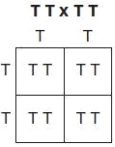
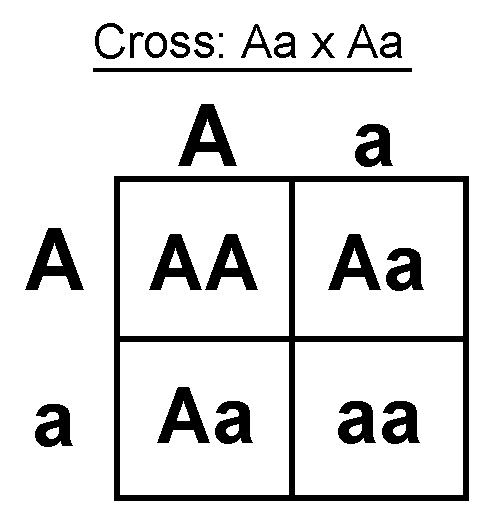


What belongs in Box 2?
y
Y
YY
yy
What belongs in Box 4?
Y
YY
Yy
yy
What belongs in Box 8?
Y
YY
Yy
yy

What belongs in box 1?
F
f
FF
Ff
What belongs in box 4?
F
FF
Ff
ff
What belongs in box 5?
F
FF
Ff
ff
What belongs in box 8?
F
FF
Ff
ff
The letters that make-up the genetic code for a trait
genotype
heterozygous
phenotype
trait

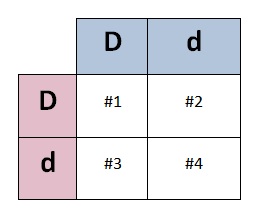
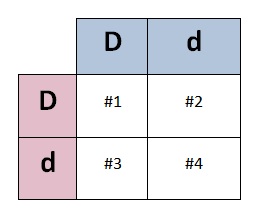


In the Punnett square, what is the probability for white fur?

