
 Worksheets
Quiz 4
Total questions: 16
Worksheet time: 8mins
Name
Class
Date
1.
Angle of vision is ...
a)
a perspective, bias, lens, filter, frame or screen that helps determine what a writer sees or doesn't see
b)
a perspective, bias, or frame that the audience sees because of their underlying assumption
2.
Suppose a small town in Java has scheduled a public hearing on whether online transportation such as Grab and Gojek needs a stricter regulation. Which of the following evidence would you use if you supported for more stricter regulation for online taxis?
a)
Grab and Gojek has provided income opportunity for more than thousands of drivers.
b)
Grab and Gojek's drivers are independent contractors rather than employees. Therefore, these drivers doesn't have health insurance, overtime pay, and other benefits.
c)
Customers love these online taxis because of easy billing experience through the apps.
3.
Suppose a small town in Java has scheduled a public hearing on whether online transportation such as Grab and Gojek needs a stricter regulation. Which of the following evidence would you use if you supported the current online taxis business model?
a)
Grab and Gojek has provided income opportunity for more than thousands of drivers.
b)
Grab and Gojek's drivers are independent contractors rather than employees. Therefore, these drivers doesn't have health insurance, overtime pay, and other benefits.
c)
These online taxi apps track user's ride history and data even if you're not on the app.
4.
What does it mean by 'framing evidence'?
a)
Arguer consciously selects evidence to make some facts disappear.
b)
Arguer consciously selects evidence to achieve different rhetorical effects.
c)
Arguer consciously selects evidence to lie about the truth.
5.
Some of the strategies for framing evidence . . .
a)
Devote most of your space to supporting evidence and minimal space to contrary evidence.
b)
Support your point by telling a memorable individual case to achieve a strongly persuasive effect.
c)
Write as many words as possible that explain the evidence
6.
One strategy for framing statistical evidence is by ...
a)
using images to guide the reader's response to data.
b)
minimizing some statistic by reporting it as a percentage rather than mentioning the numbers
c)
putting contrary evidence in subordinate positions.
7.
The book says that a more appropriate metaphor about logos, ethos, and pathos are . . .
a)
That these persuasive appeals are like spices you add to a casserole
b)
That these persuasive appeals are like lighting effects on a stage.
c)
That these persuasive appeals are like argumentative appeals.
8.
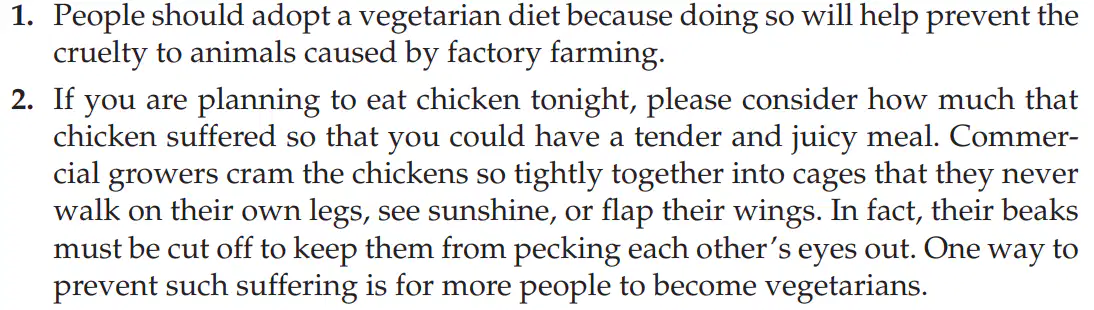
Check the following arguments. Between argument 1 and 2 which has the most emotional power?
a)
Argument 1
b)
Argument 2
9.

Check the following arguments. Which argument may be too strong, too abusive, and too insulting for some?
a)
Argument 1
b)
Argument 2
c)
Argument 3
d)
Argument 4
10.
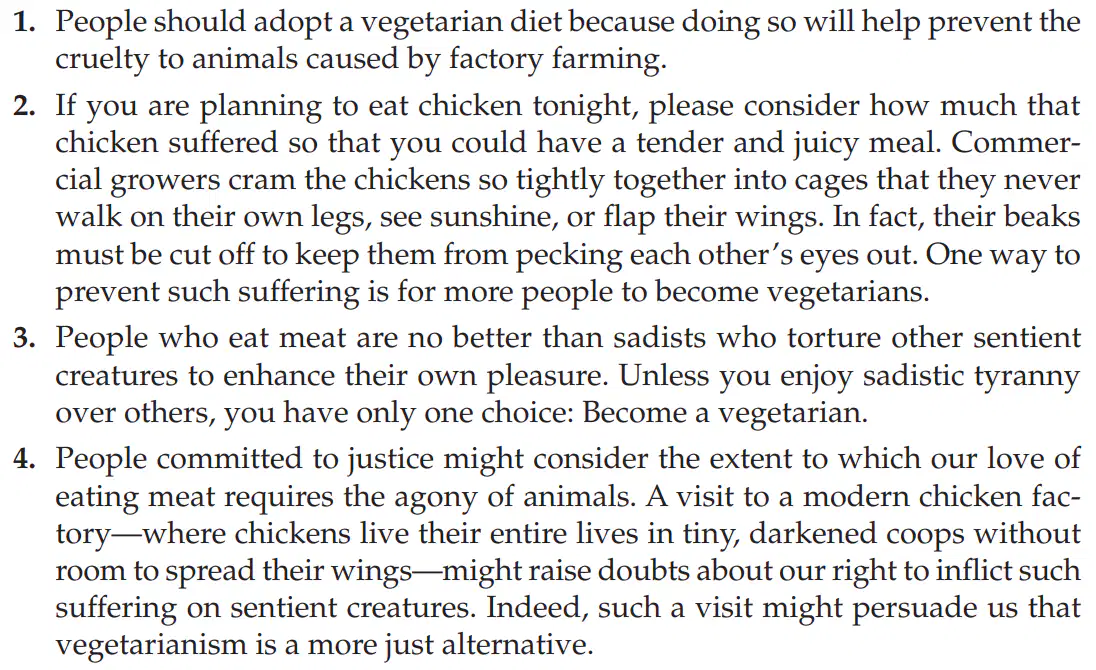
Check the following arguments. Which argument is trying to build rapport with its readers and also try to use a qualifier in the argument?
a)
Argument 1
b)
Argument 2
c)
Argument 3
d)
Argument 4
11.
How does a writer build credibility? (4 answers)
a)
Be knowledgeable
b)
Be fair
c)
Demonstrate professionalism
d)
Build a bridge to the audience
e)
Use pathos and logos
12.
Using narratives to evoke pathos can be powerful, but they are also risky and can backfire if ...
a)
very vivid
b)
too sentimental
c)
very logical
d)
too dramatic
13.
Kairos is . . .
a)
appeal to logic and evidence
b)
appeal to emotion
c)
the timeliness and fitness of arguments
14.
In the introduction, to create the kairos of our argument, we might . . .
a)
tell an interesting evidence that supports our claim and reason.
b)
mention a recent news event that the audience may have experienced.
c)
use a photograph or cartoon that signals the timeliness of the argument.
15.
Some questions to analyze your audience (2 answers)
a)
What values, beliefs, or assumptions about the world do you and your audience share?
b)
What is your reason?
c)
How much does your audience know or care about the issue?
d)
How many evidence have you got so far?
16.
We can hope to persuade our audience only if we can (two answers) . . .
a)
build bridges to the audience with audience-based reasons
b)
build bridges to the audience with appeals to shared values
c)
build bridges to the audience with as many evidence as possible.
100 %

