
 Worksheets
Unit 5 Practice Test
Total questions: 12
Worksheet time: 9mins
Living things range in complexity. Some organisms are simply one cell; others are made up of many cells. Those that are made up of many cells can organize their cells to perform certain functions. Which of the following correctly states the increasing cellular complexity of a cat?
hemoglobin (molecule), nucleus, muscle cell, veins, heart, circulatory system, cat
muscle cell, veins, heart, circulatory system, cat, hemoglobin (molecule), nucleus
nucleus, veins, heart, circulatory system, cat, hemoglobin (molecule), muscle cell
cat, hemoglobin (molecule), muscle cell, veins, circulatory system, nucleus, heart
Which of the following lists all of the classification levels in order of fewest shared characteristics to most shared characteristics?
species, genus, family, order, class, phylum, kingdom, domain
kingdom, species, phylum, class, family, order, domain, genus
domain, kingdom, phylum, class, order, family, genus, species
domain, phylum, kingdom, family, species, genus, order, class
What is the simplest structure that performs life functions?
brain
heart
organ
cell
In what kingdom does a multicellular, eukaryotic heterotroph without a cell wall belong?
protist
fungi
plant
animal
Which of the following statements is true concerning classification?
Organisms in the same phylum will have more in common than organisms in the same family
Organisms in the same domain will have more in common than organisms in the same genus
Organisms in the same kingdom will have less in common than organisms in the same class
Organisms in the same genus have less in common than organisms in the same order
Which list contains both unicellular and multicellular organisms?
a caterpillar, an ant, a tadpole
a pea plant, a maple tree, a snail
a bacterium, an earthworm, a lion
a mushroom, a strawberry plant, a lemon tree
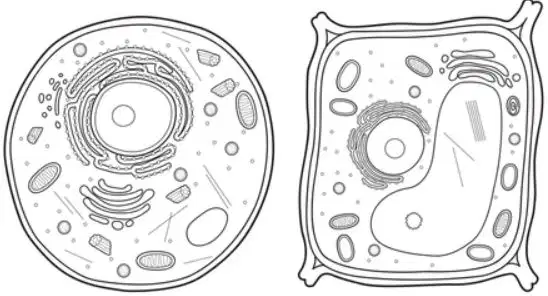
Which of the following BEST describes the differences between plant cells and animal cells?
plant cells are prokaryotic; have chloroplasts, a cell wall, and many small vacuoles / animal cells are eukaryotic; have no cell wall; and one large vacuole.
plant cells are eukaryotic; have cytoplasm, a cell membrane, and one large vacuole / animal cells are prokaryotic; have no cytoplasm, a cell wall, and many small vacuoles
plant cells are eukaryotic cells that have chloroplasts, a cell wall, and one large vacuole / animal cells are eukaryotic cells that do not have chloroplasts or a cell wall; and have many small vacuoles.
plant cells are eukaryotic cells that do not have nuclei, cytoplasm or a cell wall; and have many small vacuoles / animal cells are prokaryotic cell that have nuclei, chloroplasts, and cytoplasm; one large vacuole
Which statement BEST describes how the function of the cell wall is different from the cell membrane?
The cell wall makes energy for the cell while the cell membrane lets materials in and out of the cell
The cell wall forms a stiff outer layer to keep the cell's shape and provide protection while the cell membrane separates the cell from its environment and decides what can enter and leave
The cell wall stores the cell's hereditary information (DNA) while the cell membrane provides structure and protection
The cell wall stores water and nutrients while the cell membrane forms a stiff outer layer to keep the cell's shape
Which of the following correctly shows the reactants and products of photosynthesis?
C₆H₁₂O₆ + O₂ + sunlight --> CO₂ + H₂O
CO₂ + H₂O + sunlight --> C₆H₁₂O₆ + O₂
CO₂ + H₂O + O₂ --> C₆H₁₂O₆ + sunlight
O₂ + H₂O + sunlight --> C₆H₁₂O₆ + CO₂
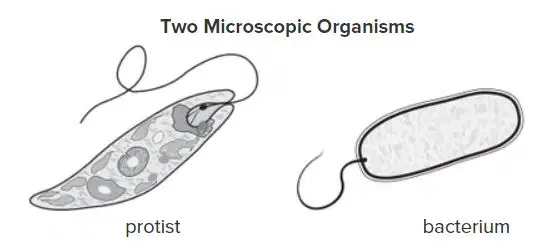
Which characteristic would be most helpful to classify these organisms into two different groups?
cell type
mode of transport
source of nutrition
method of reproduction
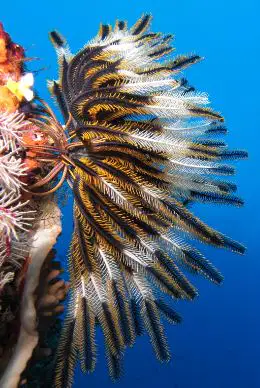
Crinoids look like flowers. However, crinoids are animals related to sea stars and sea urchins. Crinoids first appeared on Earth about 490 million years ago. Today, they still live in the ocean. What do crinoids, sea stars, and sea urchins have in common?
Eukaryotic, multicellular, heterotrophs that are in the invertebrate group
Prokaryotic, unicellular, autotrophs that are in the vertebrate group
Eukaryotic, unicellular, autotrophs that are in the invertebrate group
Prokaryotic, multicellular, heterotrophs that are in the vertebrate group
ALL living things share certain characteristics. Which of the following states these characteristics of life?
made up of at least one cell, use energy, maintain homeostasis, grow & develop, respond to stimuli, reproduce
eukaryotic cells, photosynthesize, respond to stimuli, breathe, reproduce, heterotroph
have a brain, use energy, grow, breathe, move, prokaryotic cells
made up of at least one cell, use energy, spores, respond to stimuli, maintain homeostasis, photosynthesize, breathe

