
NEW
Font size
 Worksheets
Ch 10 Direct current circuits Quiz
Total questions: 10
Worksheet time: 5mins
A radio enthusiast has a power supply to driver her radio. When set to receive the power supply delivers 500mA at 12V. When set to transmit, it delivers 10.5A at 10V. What is the internal resistance of the power supply?
0.20 Ω
0.95 Ω
24 Ω
42 mΩ

What is the total resistance of the 4 x 100 Ω resistors connected as shown in the diagram?
50 Ω
400 Ω
200 Ω
100 Ω
Why is the total current at a junction of a circuit always zero?
The rule is based on observation, in the absence of experimental evidence to question it, it must be accepted.
Charge building up in one part of the circuit is counterbalanced by charge of the opposite polarity collecting elsewhere.
Opposing currents cancel each other out, so the result is always zero.
In a circuit, charge cannot be created or destroyed.
What is the fundamental rule for potential difference in any circuit?
Positive emf results in a clockwise current and vice versa.
The potential difference across the battery terminals must be positive.
The potential difference around a closed path in any circuit must sum to zero.
The electromotive force in any circuit must be greater than the loss of potential difference in the rest of the circuit in order for current to flow.
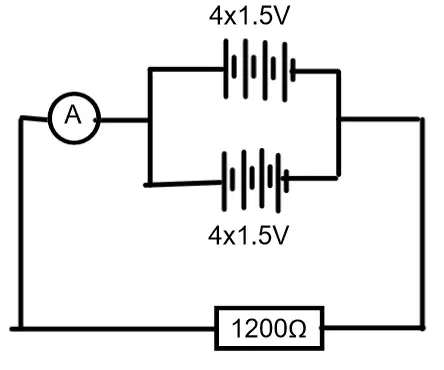
In the circuit diagram shown, each cell has an emf of 1.5V and negligible internal resistance and the resistor has a resistance of 1200 Ω. What will be the current shown on the ammeter?
12 mA
10 mA
2.5 mA
5 mA

When Mr. Brown starts his car on a wintry morning, he always turns on the headlights before operating the starter motor. The headlights always go dim as the starter motor turns the engine but then go back to full brightness when the engine starts. Why does this dimming happen? (the battery, lights and starter motor are in parallel)
Switching on the starter motor adds resistance to the circuit, so the current through the lights drops.
The increased current drain on the battery due to the starter motor causes a potential drop inside the battery due to its internal resistance.
The battery is faulty. There should be no effect whatsoever as the battery can deliver unlimited current until it goes flat.
Current from the battery is diverted from the lights to the starter motor.
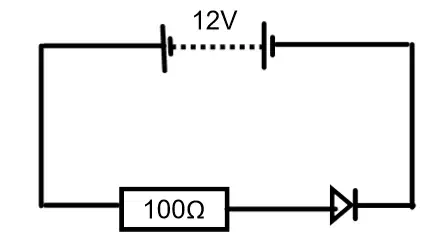
In the diagram, the battery has an emf of 12V and its internal resistance is negligible. The diode is a silicon type. The resistor has a resistance of 100 ohms. What is the current in the circuit?
120 mA
less than 120 mA
0 mA
more than 120 mA
Energy is transferred when charge flows through a resistor. Where does this energy come from and where does it go?
The energy comes from the source of the emf and dissipated by the resistor as heat.
The energy comes from a battery, power supply or similar source and is returned there as the electrons return, thereby obeying the conservation of energy principle.
The energy comes from the source of the emf and is stored as charge density in the resistor.
The energy come from the potential on the resistor and goes into kinetic energy in the electrons.
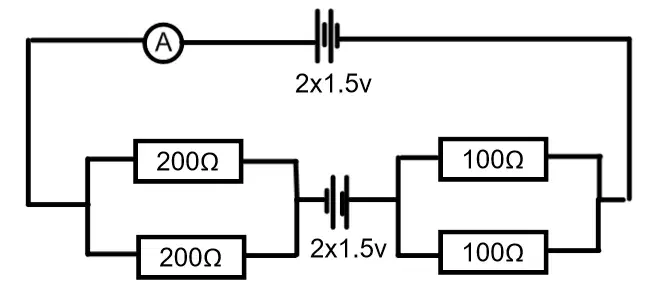
Each of the cells shown in the diagram has an emf of 1.5V and negligible internal resistance. What will be the current shown on the ammeter?
10 mA
20 mA
0 mA
40 mA
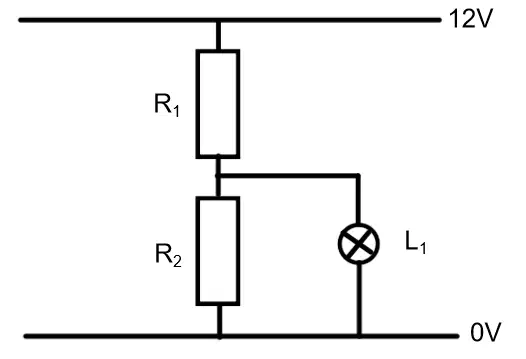
In the diagram shown the supply voltage is 12V (with negligible internal resistance), R1 is 100 Ω and R2 is 300 Ω, L1 is a lamp and when illuminated it has a resistance of 500 Ω. What is the current in L1.
15.7 mA
8 mA
20 mA
18 mA

